
NEWS
Europe’s River Cruises Run on Buses After Record Lows
Record-low Rhine and Danube water forced Europe river cruises onto coaches this summer, yet lines are still adding ships and selling 2027.

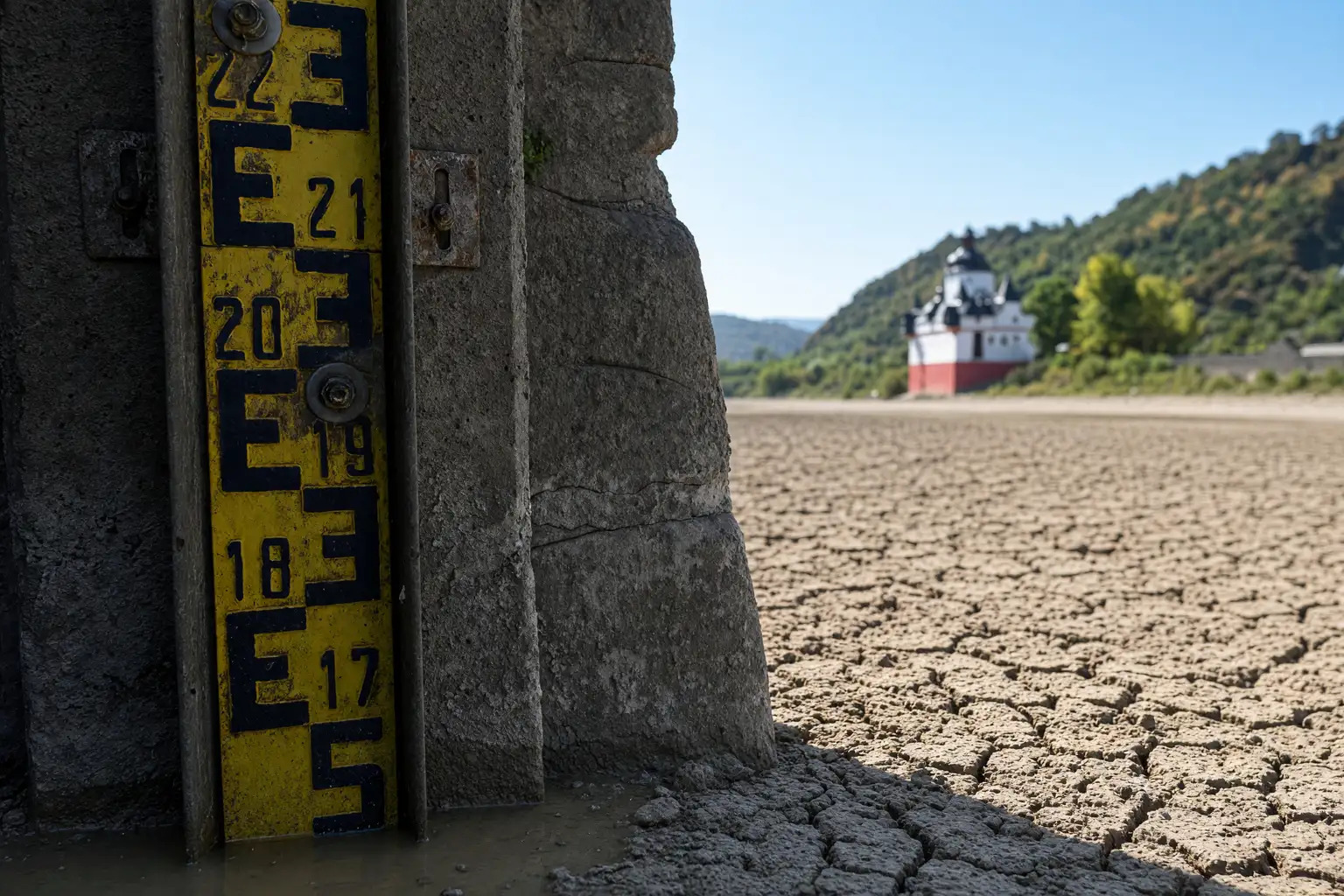
The Rhine at Kaub fell to 5 centimeters on August 17, a record that left Europe river cruises swapping ships and filling coaches.
Budapest sat near 9 centimeters in early August. Viking, the largest river line, said more than half of its river-cruise days from mid-July to mid-August were affected, and 2027 is still selling.
The Rhine Gauge at Kaub Fell to 5 Centimeters
Kaub is a German village in the Middle Rhine Gorge, and the number painted on its gauge is the one captains, cargo desks and cruise operations rooms all watch. On August 4 the board read 24 centimeters, tying the old mark from October 22, 2018. By August 14 Germany’s waterways office at Bingen had it at 7 centimeters. Three days later the trough was 5 centimeters, the lowest known reading at that station.
The figure is a reference, not the depth under a keel. Germany’s waterways office says the river at Kaub still holds about 1 metre more water than the board shows, which in mid-August left a thin fairway and closed the run toward Frankfurt. Mean water at the same gauge is 208 centimeters. The equivalent water level used for shipping, 77 centimeters, is the line where loads start getting cut.
The analog staff kept showing a number after the electronic sensor quit. Michael Ebling, the Rhineland-Palatinate economy minister, asked Berlin to put fairway deepening first. The Middle Rhine capacity project between Budenheim and St. Goar, a 49-kilometer stretch that includes Kaub, has been on the books since 1992.
THE KAUB GAUGE THIS SUMMER
| Gauge | Date | Reading | What it closed |
|---|---|---|---|
| Kaub, Rhine | August 17, 2026 | 5 cm | Record low; prior mark 25 cm in 2018 |
| Kaub, Rhine | September 1, 2026 | 69 cm | Still under the 77 cm shipping line |
| Budapest, Danube | Early August 2026 | About 9 cm | Under the 33 cm mark from October 2018 |
| Pfelling, upper Danube | August 17, 2026 | 194 cm | Under the 221 cm low from August 17, 2022 |
| Danube at the Romanian border | Late August 2026 | 1,600 m³/s | 41 percent of the 3,900 m³/s August average |
Germany’s live Kaub gauge readings are public, and cargo boats felt the same pinch cruise passengers did. Barges that share the gorge had to run light. The cruise product, sold as a floating hotel you unpack once, ran into the same gravel.
Coaches, Sister Ships and a Voucher Home
Richard Landfield, 68, an avid river cruiser from Portsmouth, England, was on a Viking sailing from Switzerland to the Netherlands when the water ran out. He said he spent more time on buses than on the ship, including a dock wait at Arnhem for a coach to Nijmegen, about 30 minutes away.
Usually you unpack your bag and then it’s smooth sailing. I like an adventure, but between the heat and the grueling bus rides I came back home utterly exhausted.
Richard Landfield, river-cruise passenger from Portsmouth, England
That unpack-once line is the pitch. When a shallow bar blocks the channel, the lines do not usually send everyone home. They run a set of backups that used to look like emergencies and now look like a second timetable.
HOW THE TRIPS KEPT MOVING
- Ship swaps: Two sister ships sit on opposite sides of the shallow stretch, and guests walk off one and onto the same cabin number on the other after a coach ride.
- Motorcoaches: The ship stays put and the towns arrive by bus, sometimes for several days in a row.
- Hotel nights: When a vessel cannot dock, the line puts people ashore and catches up later.
- Missed ports: Uniworld’s SS Emilie could not pass Vilshofen on a Vienna-to-Nuremberg sailing, so the group lost Deggendorf, Regensburg and Nuremberg.
- Cancellations: Avalon Waterways dropped three July Danube Dreams departures, and Viking said 10 to 12 percent of guests on hit sailings canceled.
Viking’s own wording is blunt about the swap. The company said the move “allows guests and their luggage to transfer to their exact same stateroom on an identical sister ship on the other side of the affected section of river.” AmaWaterways is building AmaRudi with a shallower draft than AmaMagna for the same reason. Writer Mark Dapin, sailing AmaCerto toward the gorge, watched Kaub sit near 62 centimeters, under the 78-centimeter trouble line, with about 30 centimeters as the point even that hull would have to stop.
A rebound at Kaub does not put a Budapest week back on the water. Guests holding late-August Danube dates were still being shifted onto coaches, or told the week was off, after the Rhine had already begun to rise.
More Than Half of Viking’s River Days Changed
On August 19, Leah Talactac, Viking’s president and chief executive, and Linh Banh, the chief financial officer, took the low water on the Q2 call. They dated the operational mess from mid-July, even though Viking Einar had already gone aground on the Rhine at Cologne at the end of June. Viking Ullur then hit a shoal near Vidin, Bulgaria, on July 28, and 186 guests were taken ashore. The two groundings put nearly 400 people off the ships.
VIKING’S SUMMER ON THE RIVERS
- Hit rate: More than half of river capacity cruise days from mid-July to mid-August were affected.
- Walkaways: 10 to 12 percent of guests on those sailings canceled.
- 2027 rivers: More than 40 percent of next year’s river capacity was already booked as of August 9.
- Company book: 2027 stand at $4.7 billion, 53 percent of a program that is 15 percent larger, with 96 percent of 2026 core capacity sold.
Viking is issuing future-cruise vouchers for later in 2026 through 2028, credits Banh said will cut yields when they are redeemed. Occupancy in the second quarter was 94.4 percent. Ten more river ships are due in 2026, and the fleet numbered 99 vessels on June 30. Talactac called the identical hulls a competitive edge because a guest can change ships and still know the corridor.
This year, portions of several European rivers, particularly the Danube and the Rhine, have experienced historically low water levels, creating operational challenges across the industry. Generally, Viking’s purpose-built river fleet, deployment flexibility and well-established ship swap capabilities are significant competitive advantages that enable us to minimize disruptions as much as possible.
Leah Talactac, President and CEO, Viking Q2 2026 earnings call
Banh told analysts the company does not believe low water is hitting the booking curve, and that this season has been lower than 2018 or 2022, years when Viking also refused to cancel wholesale. “This is a reality of operating in the rivers,” the call put it. AmaWaterways, on a normal year, sees high or low water touch about 3.5 percent of its 1,100 to 1,200 European departures. Half a season of rewritten days is a different product.
Why the Danube Stopped at Budapest
The Danube is the turnaround river for the classic week between Germany and Hungary, and it spent 2026 below the flow where ships start to have trouble for 130 days through September 1, according to River Water Watch, which counts from the European Union’s GloFAS record back to 1997. The old high by the same date was 74 days in 1998. The Rhine’s count was 117 days, past 85 in 2011. The Elbe sat at 74, past 53 in 2018.
In early August the Budapest gauge was about 9 centimeters, under the 33-centimeter mark from October 2018. Pfelling, the free-flowing Bavarian bottleneck between Regensburg and Passau, read 194 centimeters on August 17, under its 221-centimeter low from August 17, 2022. Scenic listed navigation as closed between Regensburg and Passau, and between Bratislava and Budapest, in late August. Travel editor Chris Gray Faust, on Uniworld’s SS Emilie, watched the upper river refuse to let the ship past Vilshofen.
Downstream looked no kinder. A Copernicus Sentinel-2 image from August 30 shows the Danube near Corabia, on the Romania-Bulgaria border, with sandbanks standing in the channel. Flow at the Romanian border had fallen to 1,600 cubic metres per second in late August, against an August average of about 3,900, a cut to 41 percent that also appears in the Romanian Danube hydrology bulletin. Romania and Serbia were already at 30-year lows. The Seine, by contrast, had an ordinary year, with high water as the headache rather than gravel.
New Ships Keep Coming for the Same Two Rivers
IG RiverCruise, working with Centouris at the University of Passau, counted 1.49 million European passengers in 2025, up 8 percent, and 3.728 billion euros in revenue, up 5 percent, across 10.72 million passenger nights. The fleet was 386 ships, 18 more than the year before, with an average age of 16 years. Seventy-five percent of operators in the study expected passenger growth again in 2026.
The next steel is aimed at the same two rivers that failed this summer. Of about 60 new vessels due on European rivers into the early 2030s, 33 are for the Rhine/Main/Danube system. Five are for French rivers. Three are for the Douro, where the port authority already barred extra ships this summer after the river hit capacity. Viking has talked about 24 more river ships by 2028, with options into 2032. AmaWaterways has talked about 15 more in Europe on the way to a global fleet above 50 by 2032.
WHERE THE NEW HULLS ARE HEADED
| River system | New ships into the early 2030s | Summer 2026 water |
|---|---|---|
| Rhine, Main and Danube | 33 | Record lows, routes rewritten |
| French rivers | 5 | Seine had an ordinary year |
| Douro | 3 | Port at capacity, extra ships barred |
Overseas guests pay for most of the profit even when they are not most of the heads. Germany, Austria and Switzerland sent 587,000 passengers; the United States and Canada sent 545,000, and those North American bookings brought 2.02 billion euros. The average cruise-only price was 3,671 euros from outside Europe and 1,554 euros from inside it, with overseas guests staying 8 nights and Europeans 6.5 days. Those long American weeks are the ones that run Amsterdam to Basel and Passau to Budapest, the two corridors that need Kaub and Pfelling to behave.
2018 and 2022 Already Wrote This Playbook
Low water in late summer is not new on these rivers. What is new is how early it arrived, how many basins dropped together, and how many extra ships now sit on the same bottlenecks. The Central Commission for the Navigation of the Rhine, looking back across 2015 to 2022, found that 2018 low-draught days on the Rhine and the Danube outnumbered every other year in that span. 2022 was shorter, a July-August hit rather than a crawl into November.
HOW THE SEASON BROKE
- June 30, 2026: Viking Einar runs aground on the Rhine at Cologne.
- July 28, 2026: Viking Ullur hits a shoal near Vidin, and 186 guests leave the ship.
- August 4, 2026: Kaub reads 24 centimeters, matching the 2018 record.
- August 17, 2026: Kaub troughs at 5 centimeters; Pfelling sits at 194 centimeters.
- August 19, 2026: Viking tells investors more than half of its river days have been rewritten and starts issuing vouchers into 2028.
- August 30, 2026: A Sentinel-2 pass shows sandbanks in the Danube near Corabia.
- September 1, 2026: Kaub reads 69 centimeters; the Danube’s low-water count stands at 130 days.
Travel advisors already treated water as a sales problem before this summer. In a 2025 advisor survey, 48 percent named rerouting over water levels as a hurdle, just behind the fare itself. Tauck president Jeremy Palmer said the low water was not enough to slow the firm’s fastest-growing segment. Avalon and AmaWaterways also described 2027 as strong. The book is holding. The week on board is the part that changed.
Rain Lifted the Rhine While the Danube Stayed Low
Rain in late August finally moved the Rhine. Kaub climbed from 5 centimeters on August 17 to 75 centimeters on August 25, then stood at 72 centimeters on August 31 and 69 centimeters on the morning of September 1, still under the 77-centimeter shipping line. Uniworld was still swapping S.S. Antoinette and S.S. Elisabeth between Amsterdam and Basel for August 30 departures. Full loads on the cargo side want something closer to 1.5 metres at Kaub.
The Danube did not travel with it. Budapest’s short-range forecast in late August was still pointed down, and the large cruise boats there were not running a normal westbound pattern. River Water Watch’s own comparison with earlier dry years is that the Rhine does come back over the line, then often ducks under it again through autumn. Winter rain and Alpine snowmelt, not a single wet week in August, are what refill these basins.
So the 2027 brochure still sells the castle gorge and the Budapest night. The 2026 season already showed what that week looks like when Kaub is in single digits: a sister ship, a coach, a voucher, and a river that may or may not be there when the next hull arrives.

Xbox Sign-In Failed After a Client Update Hit One Region

PepsiCo’s Mykolaiv Juice Plant Is Hit Again

JetBlue’s Boston BlueHouse Lounge Is a Premium Fare Fence

Grand Canyon Hotels Close After a Repeat Pipe Flood

Giardia Cases Hit a Decade High Beyond Holiday Warnings

Flight Cancellations Rise While the FAA Shrinks Staffing Targets

The EU Pulled the 2026 ETIAS Date After Border Chaos

Hitachi’s Aurora Faults Drove the EMR Bank Holiday Strike

Extra Months on Old UK Passports Still Block EU Entry

Mont Blanc Tops the Hiking List on Already Busy Trails
-
 AIRLINES2 weeks ago
Flight Cancellations Rise While the FAA Shrinks Staffing Targets
-
 NEWS2 weeks ago
The EU Pulled the 2026 ETIAS Date After Border Chaos
-
 NEWS2 weeks ago
Hitachi’s Aurora Faults Drove the EMR Bank Holiday Strike
-
 NEWS1 week ago
Extra Months on Old UK Passports Still Block EU Entry
-
 DESTINATIONS3 weeks ago
Mont Blanc Tops the Hiking List on Already Busy Trails
-

 AIRLINES2 weeks ago
United Bets the A321XLR on 10 New International Cities
-

 HOTELS3 weeks ago
Nirvana Hamta Retreat Sits on a Built Hydel Road
-

 HOTELS1 week ago
Airbnb’s 6% Direct Links Undercut the Host Website Pitch