
NEWS
Hitachi’s Aurora Faults Drove the EMR Bank Holiday Strike
East Midlands Railway ran one train an hour last weekend after an RMT walkout over Hitachi Class 810 faults.

East Midlands Railway ran one train an hour to London last Sunday and Monday after RMT staff walked out over Hitachi Class 810 faults. The operator, run by Transport UK, told passengers to travel only if the trip was essential, with first trains around 08:00 and last trains before 19:00.
The walkout grew from a nine-month argument over Hitachi’s Class 810 Aurora fleet. On the same Sunday, Network Rail closed the East Coast Main Line south of Peterborough for digital signalling tests, which pushed leftover London traffic toward a strike-thinned St Pancras.
One Train an Hour on the Midland Main Line
RMT members struck from 00:01 on Sunday 30 August to 23:59 on Monday 31 August. EMR published a significantly reduced timetable to and from London on both days and said it would not put rail replacement buses on the cancelled paths.
Philippa Cresswell, EMR’s customer experience director, apologised for the hit to bank holiday plans after three Saturday strikes earlier in August. She said the company had met the union six times and was still talking, and she told LNER passengers not to reroute via Sheffield or Nottingham.
Regional EMR trains were meant to run as normal. Intercity and Connect into St Pancras were cut to an hourly pattern on each of the three London corridors, with queues planned at London St Pancras and Sheffield and a warning that some people would not board the train they wanted.
THE PUBLISHED STRIKE TIMETABLE
| Route | Sunday 30 August | Monday 31 August |
|---|---|---|
| Nottingham to London St Pancras | One train an hour, about 08:00 to before 19:00 | One train an hour, about 08:00 to before 19:00 |
| Sheffield to London St Pancras | One train an hour, about 08:00 to before 19:00 | One train an hour, about 08:00 to before 19:00 |
| Corby to London St Pancras (Connect) | One train an hour, about 08:00 to before 19:00 | One train an hour, about 08:00 to before 19:00 |
| Rail replacement buses | None | None |
That is a short day even when a train appears. Anyone needing an early start or a late return had no advertised EMR path into London, and standing room was the official forecast on the trains that did run.
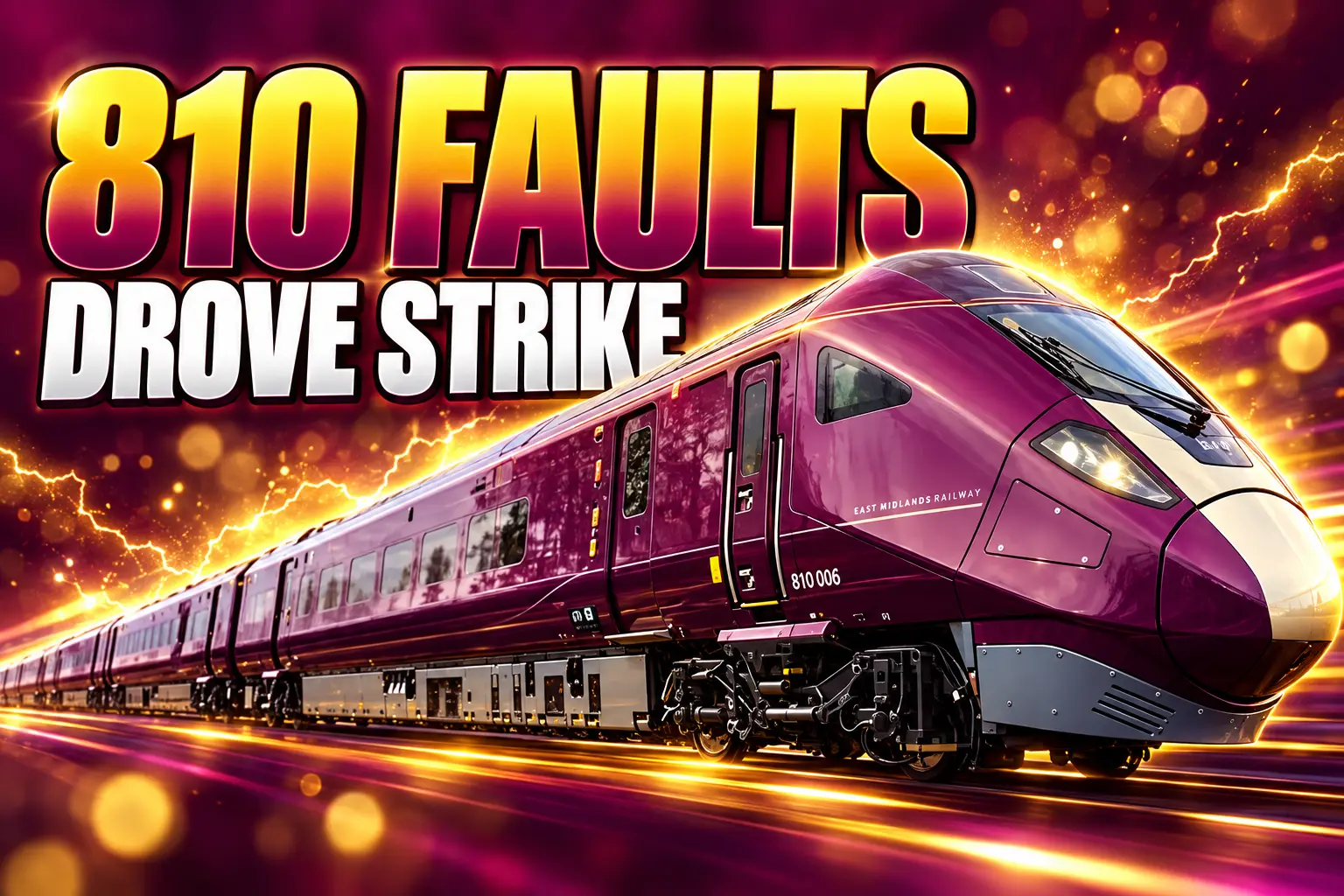
Hitachi’s £400 Million Fleet Is Still the Fight
The trains at the centre of the dispute are Hitachi’s Auroras, ordered as a £400 million fleet of 33 bi-mode trains to replace Class 222 Meridians on the Midland Main Line. The first passenger working left Sheffield at 07:00 on 3 December 2025, about three years later than first planned, and headed for London St Pancras.
EMR sold the rollout on space and power. A five-car Aurora has 24 per cent more seats and over 19 per cent more legroom than a typical Meridian. The full 33-strong fleet is meant to add 46 per cent more seats on the route and to cut carbon emissions by 66 per cent once it can run under the £1.5 billion Midland Main Line wires.
Delivery has not matched the launch copy. Hitachi said in July that more than a third of the fleet had been delivered and that it was adding test work at Long Marston. Industry tallies that month put only six Auroras in the daily plan, with one unit stored after a collision at Bedford on 19 June. EMR cut Intercity trains from 20 July after reliability problems on both the new 810s and the older 222s, which Hitachi also maintains.
The Department for Transport told parliament in August that Hitachi’s handling of the Class 810 programme had been unacceptable and that the first train entered service around three years late. Rock Rail funds the stock. The detailed penalty clauses in those contracts stay confidential.
HOW THE AURORA DISPUTE GOT TO A BANK HOLIDAY
- December 3, 2025: First Aurora carries passengers from Sheffield to London St Pancras.
- April 2026: RMT opens a formal dispute over faults on the new fleet.
- June 19, 2026: A Class 810 is damaged in a collision at Bedford and later stored.
- July 20, 2026: EMR cuts Intercity trains until further notice over 810 and 222 reliability.
- August 1, 8 and 15, 2026: RMT stages three Saturday strikes on Intercity and Connect.
- August 30 and 31, 2026: Bank holiday walkout hits London trains; Intercity uplift slips to 1 September.
- September 16 and 17, 2026: Further strike window already notified, from 12:00 on the Wednesday.
Will Rogers, then EMR managing director, said in July that Class 810 performance had fallen below the levels he and customers expected. Hitachi said the fleet had completed testing and independent approval before it carried passengers, and that it was working through an agreed action plan on both the 810s and the 222s.
Crews Refused Trains With Dead Toilets and Doors
This is not a national pay round. RMT members have been on action short of strike as well as the walkouts, and they have been told not to work a Class 810 if a published fault list is still live. Drivers were not the striking grade, which is why some Auroras could still appear in the hourly plan.
The sharpest technical fight is the auxiliary reset. Union briefings describe an Aux Off / Aux On procedure that takes about 20 minutes and, while it runs, drops several safety systems, including the driver’s usual link to the signaller. RMT said EMR had sent trains out that then needed a full reset, with three such cases in one week of July and 16 by 7 August.
RMT is demanding that whilst these faults exist and until these trains are shown to be operating properly, they should be taken out of service. It is now time for EMR management to act on the safety concerns of our members.
Eddie Dempsey, RMT general secretary
EMR’s line has been consistent: no safety-critical faults have been found that stop the trains meeting the regulator’s rules for passenger service. The Office of Rail and Road has not withdrawn the fleet. That gap, a union calling the units unfit and an operator saying they are legal to run, is why the argument has lasted from April into September.
RMT CREW REFUSAL RULES ON CLASS 810S
- Air and heat: Staff will not work a unit if heating, ventilation or air conditioning is dead in any compartment.
- Doors: Any internal or external door fault is enough to refuse the train.
- Galley limit: Crews will not work if the galley is hotter than 29.4C.
- Toilets: At least two toilets must work, and one of them must be the universal toilet.
- Fire cabinet: The fire reset cabinet must be reachable.
Those rules sit beside a longer unofficial catalogue from the summer: unsolicited brake applications, cab door locks that jam, AWS warnings that are hard to hear, and toilets that fail so often they became a public complaint. John Watson, RMT’s Midlands organiser, put the split in plain terms: when the trains work they are a lovely unit, but they have had more bad days than good ones.
On Sunday morning of the bank holiday strike, the union said two more Class 810s had failed, one of them for the same fault on consecutive days.
RMT East Midlands Railway members back on the picket line in Derby.
This morning, two more Class 810’s have broken down. One of these has broken down for the same reason on consecutive days.
East Midlands Railway must act now over the safety concerns of our members! pic.twitter.com/lyBQUWi4jB— RMT (@RMTunion) August 30, 2026
Photographs from the Midland Main Line that afternoon still showed an Aurora on a Nottingham to St Pancras path around 10:00, which fits a dispute aimed at onboard RMT grades rather than at drivers. The union’s own demand remains withdrawal until the faults are gone. EMR has refused to withdraw the 810s from service, and talks have not closed the gap.
Why King’s Cross Closed on the Same Sunday
The strike would have been ugly on its own. It landed on the same Sunday as a long East Coast blockade. Network Rail shut lines south of Peterborough and Royston from 22:00 on Saturday 29 August until 08:00 on Monday 31 August for testing on the £1.4 billion East Coast Digital Programme.
Ricky Barsby, Network Rail’s head of access integration for the programme, said the work was the last preparation before in-cab digital signalling starts to replace lineside lights on the East Coast Main Line. He said the blockade was timed to miss the busiest parts of the holiday weekend and asked passengers to travel on Saturday or after Sunday if they could.
LNER ran no trains between London King’s Cross and Peterborough on Sunday. Most long-distance services started and finished at Peterborough, with coaches onward to Bedford for Thameslink into St Pancras. The operator also put on two extra trains each way via Bedford, the 08:26 and 12:27 from Newcastle, returning at 12:49 and 16:57, and told people not to go via Sheffield or Chesterfield because EMR and CrossCountry would already be full.
Hull Trains cut back to a reduced St Pancras service on Sunday. Grand Central ran nothing that day. Great Northern and Thameslink had no trains between Potters Bar or Hertford North and Royston or Peterborough. The only fast London terminal still advertising a Midland Main Line path was St Pancras, on an hourly EMR plan with no buses behind it.
St Pancras Took East Coast Overflow With No Spare Seats
EMR saw that clash coming. Its own notice told East Coast passengers to use Thameslink to Bedford and the dedicated coaches to Peterborough, not to join the Sheffield or Nottingham queues. Cresswell said trains between those cities and St Pancras were likely to be extremely busy, with standing room only and a chance that some passengers would be left on the platform.
Sheffield and Nottingham were named as pinch points as well as St Pancras. Queuing systems were planned at St Pancras and Sheffield. No extra stock was coming from the 810 fleet to soak up a diverted East Coast crowd, because the union’s fault list is what took the timetable down in the first place.
The operator had already delayed a planned Intercity uplift because of the strike. That extra service was due to start on Tuesday 1 September, the day after the bank holiday, rather than during the holiday itself. Whether every restored path actually ran on Tuesday has not been confirmed in a fresh public notice.
WHAT WE KNOW
- The walkout: RMT picket lines were up in London, Sheffield and Derby on 30 and 31 August.
- The plan: EMR advertised one train an hour on each London corridor, with no replacement buses.
- The fleet: The union reported two Class 810 failures on Sunday morning, while at least one Aurora still worked a London path later that day.
WHAT IS UNCONFIRMED
- Turned-away totals: EMR has not published how many people missed a train at St Pancras or Sheffield.
- Queue length: Station crowding was forecast, not counted in a public after-action note.
- Tuesday uplift: The 1 September Intercity increase was scheduled, not independently verified after the day.
The practical effect for anyone who still had to move was a short, crowded railway with a closed East Coast neighbour. Saturday and Tuesday were the days EMR itself suggested instead, which is a poor answer if the hotel, the shift or the family lunch sat on the Sunday.
Valid Tickets Through Wednesday for Strike Dates
Passengers who held EMR tickets for the two strike days were not stuck with a worthless reservation. Industry easements let those tickets be used on other days without buying a new one, and the window is still open today.
WHERE STRIKE TICKETS CAN STILL BE USED
- Dated 30 or 31 August: Valid from Friday 28 August through Wednesday 2 September, including connecting operators named in the easement.
- No new ticket: The switch is automatic; holders do not need a fresh document.
- Overnight run-on: Tickets stay good until 04:29 the next morning on the day of use.
- If you did not travel: A refund remains available through the usual delay and cancellation routes.
Wednesday 2 September is the last day of that bank holiday easement. Anyone still holding a 30 or 31 August ticket and still trying to complete the trip has today, then the paper expires.
Mid-September Dates Are Already on the Board
The bank holiday did not end the dispute. RMT has already notified a further strike from 12:00 on Wednesday 16 September to 11:59 on Thursday 17 September. EMR said it is still assessing what it can run those days and will publish a timetable when it has one.
Action short of strike also continues, so Class 810 diagrams can still drop out at short notice on days that are not strike days. Cresswell’s six meetings have not produced a withdrawal of the fleet, which is the union’s condition, and they have not produced a public fault-clear list that would let crews drop the refusal rules.
Hitachi is now a permanent party to those talks. Dempsey said RMT representatives would stay in the room with both EMR and the manufacturer until the units “are shown to be operating properly.” For passengers, that means the Midland Main Line is still running a new train and an old argument at the same time, with another two-day hole already marked for the middle of September.

Marriott Stakes the JW Name on a Converted Guanacaste Resort

Alaska Stakes Aurora Suites on an Uncertified 737-10

Leeds Bradford Strike Puts Aena Between Two Airports

United Bets on Flagstaff Again With Denver Flights

UK eGates Start Letting British Passengers Skip the Passport Scan

Flight Cancellations Rise While the FAA Shrinks Staffing Targets

United Folds Newark’s Lima Nonstop Into Its Houston Hub

Hitachi’s Aurora Faults Drove the EMR Bank Holiday Strike

Airbnb’s 6% Direct Links Undercut the Host Website Pitch

United Bets the A321XLR on 10 New International Cities
-
 AIRLINES1 month ago
Flight Cancellations Rise While the FAA Shrinks Staffing Targets
-
 AIRLINES1 month ago
United Folds Newark’s Lima Nonstop Into Its Houston Hub
-
 HOTELS1 month ago
Airbnb’s 6% Direct Links Undercut the Host Website Pitch
-
 AIRLINES1 month ago
United Bets the A321XLR on 10 New International Cities
-

 HOTELS1 month ago
Grand Canyon Hotels Close After a Repeat Pipe Flood
-
 NEWS1 month ago
The EU Pulled the 2026 ETIAS Date After Border Chaos
-
 NEWS1 month ago
ATSB Opens Six Sydney Airport Ground Conflict Files
-

 NEWS1 month ago
Extra Months on Old UK Passports Still Block EU Entry