
NEWS
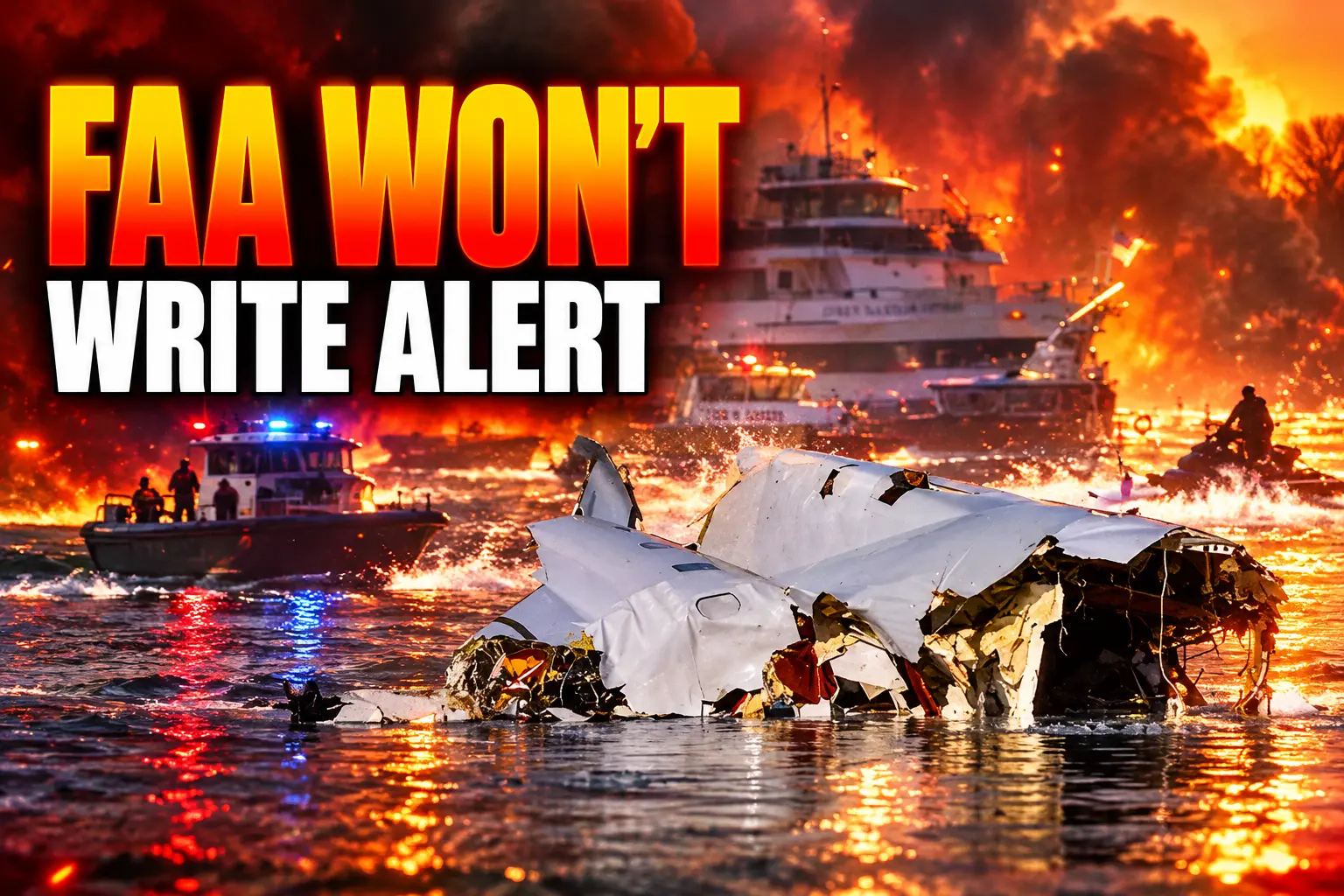
The FAA Still Won’t Write the 59-Second Alert
The FAA can require the 59-second ADS-B In alert after 67 Potomac deaths, yet it still wants Congress to order the rule.

The National Transportation Safety Board on September 14 classified 11 of 33 FAA answers after the Potomac crash as unacceptable, and the silence on an ADS-B In mandate sat at the center of that grade. That cockpit alert, the board says, would have given the American Eagle crew 59 seconds of warning before the January 29, 2025 collision that killed 67 people.
FAA Administrator Bryan Bedford said in July that his agency can write ADS-B rules without a new statute, and that he would rather have lawmakers order the change. On September 15, families stood with NTSB Chair Jennifer Homendy at the Capitol anyway, because the Senate bill that would have forced the issue already died in the House by one vote.
The FAA Has the Power and Will Not Use It
ADS-B Out has been required in most controlled U.S. airspace since 2020. It broadcasts an aircraft’s GPS position to controllers and to anyone equipped to listen. ADS-B In is the receive side: a cockpit traffic display plus an audible alert, so a crew can see the other aircraft instead of waiting on a controller or on eyesight at night.
Homendy has been asking the FAA to require that receive function since 2008. In prepared Senate testimony after the final report, she walked the committee through 59 seconds of warning in the reconstruction for the CRJ700 and 48 seconds for the Black Hawk, against the 19.5 seconds the regional jet actually had.
How many more decades have to go by before we again and again and again have to recommend it after terrible tragedy?
Jennifer Homendy, NTSB Chair
Bedford’s July comment left the legal question settled. The FAA can impose the mandate. The September 14 grade says it has not said it will. In an earlier written reply the agency talked about starting rulemaking on equipage, then added that a finished bill could set the timeline, which is how a preference for Congress becomes a reason nothing moves.
Eleven Answers the Safety Board Will Not Accept
The January 27, 2026 final report produced 74 findings and 50 safety recommendations. Homendy told families and lawmakers on September 15 that 33 went to the FAA, eight to the Army, five to the Department of War Policy Board on Federal Aviation, two to the Transportation Department, and one each to that department’s inspector general and to RTCA. She also said every one of the 50 remains open, meaning none has been fully carried out.
The board tracks those replies. It marks a response unacceptable if the agency rejects the ask, offers a substitute the board thinks will not fix the hazard, or fails to move in time. Homendy said the board had “unanimously designated a third of the recommendations to FAA as unacceptable action.” The public list of those 11 items is broader than one radio.
THE 11 UNACCEPTABLE FAA ANSWERS
- A-26-008: Time-on-position limits for supervisory controllers, fitted to local staffing.
- A-26-009: Annual instructor-led threat-and-error training on scanning, communication, and decisions under stress.
- A-26-010: A risk-assessment tool for supervisors during live operations.
- A-26-015: Objective criteria for rating air traffic facility levels, including complexity and cost of living.
- A-26-016: A fresh look at whether Reagan National’s Level 9 tower rating matches the work.
- A-26-022: On-site supervisors deciding post-accident drug and alcohol tests without waiting for later approval.
- A-26-023: Annual training and a knowledge test for staff who make those testing calls.
- A-26-031: ADS-B In with a cockpit display and an audible alert wherever ADS-B Out is already required.
- A-26-037: A public definition and database of close-proximity encounters.
- A-26-038: Fast notice to crews after near-midair collisions or TCAS resolution advisories, while the data still exist.
- A-26-040: A log entry, with a reason, whenever control positions are combined.
The February 17, 2026 letter to Bedford asked the agency to require ADS-B In wherever ADS-B Out is mandatory, with the display set to alert so a crew can hear it. The same package asked the Army to let crews turn ADS-B Out on in flight and to put ADS-B In on military aircraft in the same airspace. An unacceptable mark does not close a recommendation. It keeps the file open and waits for a better answer.
What ADS-B In Would Have Given Both Crews
PSA Airlines Flight 5342, a CRJ700 flying as American Eagle, was on approach to Runway 33 at Ronald Reagan Washington National Airport when it hit U.S. Army Priority Air Transport Flight 25, a UH-60L Black Hawk, over the Potomac. Homendy told the Senate the crash was “100% preventable.”
The jet’s existing TCAS traffic advisory arrived much later, and low-altitude limits kept the stronger resolution advisory from commanding an escape. The helicopter crew, Homendy said, never got an equivalent integrated warning. Investigators later found that the Black Hawk’s lack of ADS-B Out did not decide the outcome, because the airliner had no ADS-B In that could have displayed the traffic even if the helicopter had been broadcasting.
THE WARNING THE CREWS DID NOT GET
| Aircraft | ADS-B In alert in the NTSB simulation | What the crew actually had |
|---|---|---|
| American Eagle Flight 5342 (CRJ700) | 59 seconds before impact | 19.5 seconds |
| Army Black Hawk PAT25 | 48 seconds before impact over Hains Point | No equivalent integrated collision warning |
Homendy’s point to the committee was that the hardware is not exotic. American Airlines, she said, has already fitted its fleet of more than 300 Airbus A321s with ADS-B In. For older general aviation airplanes, she said a phone or iPad, a headset, and a receiver that costs a few hundred dollars can do the job. Since 2008 the board has investigated 211 midair collisions or losses of separation that killed 281 people and injured 112 others, and in almost half of those files it flagged see-and-avoid.
Reagan National Changed, the National Rule Did Not
Anyone who has flown into Reagan National since the crash is already in a different airport. On March 14, 2025, the FAA took the Helicopter Route 4 segment between Hains Point and the Wilson Bridge off the charts. Routine mixed helicopter and airliner work near the field was restricted. Helicopter zones were moved. Controllers were told to stop leaning on visual separation. An Interim Final Rule in January 2026 made the helicopter and powered-lift limits around the airport permanent except for essential flights. ADS-B Out around DCA is now required, with very limited exceptions.
The agency also says it went further than the board asked on separation. In a general notice issued with Transportation Secretary Sean P. Duffy on March 18, 2026, it suspended visual separation near busy airports nationwide and ordered controllers to use radar separation between helicopters and airplanes at set lateral or vertical distances. Bedford said then that the FAA had looked across the country after the collision and found “an overreliance on pilot ‘see and avoid’ operations.”
In its running address several more recommendations by year-end file, the FAA says it has already handled several NTSB items and that it “exceeded what the NTSB recommended in requiring greater separation between helicopters and airplanes.” That is a real operational change. It is also a different product from A-26-31. A radar rule in the tower does not put a 59-second tone in the cockpit, and the board’s September 14 grade treats the two as separate asks.
The ROTOR Act Died by a Single Vote
Congress has spent a year proving Bedford’s preference is a trap. The Senate passed the Rotorcraft Operations Transparency and Oversight Reform Act unanimously in December 2025. The Senate-passed ROTOR Act text would require ADS-B In in the airspace where ADS-B Out is already required, narrow the military broadcasting carve-out so routine training flights cannot hide, and put a 2031 deadline on the work.
The House took it up under fast-track rules on February 24, 2026, after the Pentagon withdrew support over cost and operational security. The vote was 264-133, one short of the two-thirds margin that procedure demands. Thirty-five members did not vote. In April the House instead passed its own bill, the ALERT Act, 396-10. Homendy and three other board members wrote committee leaders that they could not support that version, because it required only that some “covered” aircraft be “capable” of receiving ADS-B In, not that all aircraft in ADS-B Out airspace actually carry a working display with an audible alert.
That left the Senate holding a bill the safety board wants and the House holding one it does not, with no conference product since spring. The delay is the mechanism. Bedford can wait for a statute. The statute cannot get through both chambers in the same form.
THE STALL AFTER FLIGHT 5342
- January 29, 2025: A CRJ700 on approach to Runway 33 collides with an Army UH-60L over the Potomac, killing 67 people.
- March 14, 2025: The FAA removes the Route 4 segment between Hains Point and the Wilson Bridge from helicopter charts.
- January 27, 2026: The NTSB adopts its final report and 50 safety recommendations.
- February 17, 2026: Homendy sends the FAA recommendation letter, including A-26-31 on ADS-B In.
- February 24, 2026: The House vote on the ROTOR Act fails 264-133 under two-thirds rules.
- March 18, 2026: The FAA issues a nationwide notice replacing visual helicopter-airplane separation with radar distances.
- April 2026: The House passes the ALERT Act 396-10; the NTSB says it does not implement A-26-31.
- September 14, 2026: The board classifies 11 of 33 FAA responses as unacceptable.
- September 15, 2026: Homendy and families return to the Capitol to ask for a finished bill.
The stubborn public argument still tries to make this a single Black Hawk altitude error. Homendy’s report does not. She told the Senate the board had “seen this before,” including a 1969 midair near Shelbyville, Indiana, that killed 83 people, after which the board first asked the FAA to put a collision-avoidance system in civil aircraft. TCAS, she noted, took another two decades and a congressional mandate.
Families Returned to the Capitol in September
On September 15, relatives held photographs outside the Capitol with Homendy, Sen. Ted Cruz of Texas, Sen. Maria Cantwell of Washington, and Virginia Reps. Suhas Subramanyam and Don Beyer. Cruz, who chairs the Senate commerce committee, called the crash “utterly and completely preventable.” Homendy said every day without the recommendations in force is “an unacceptable risk to aviation safety,” to crews, and to passengers.
Doug Lane, who lost his wife Christine and their 16-year-old son Spencer on Flight 5342, put the politics in one line. “The families have done our part,” he said. “Members of both parties have come together around meaningful legislation. It’s time to finish it.” Subramanyam said near-misses have continued in Washington and elsewhere while the bills sit. Cruz and Cantwell said it would be a shame to reach the second anniversary of the crash, January 29, 2027, without the reforms in law.
Homendy pledged to “push relentlessly.” She has to, because the NTSB cannot write FAA rules. Bedford, appearing the same day, said some recommendations had been addressed and that work continues “with guidance from Congress,” and that the FAA “will continue to have engagement with the NTSB.” Engagement is not A-26-31.
Helicopter Route Reviews Still Skip the Cockpit Alert
In its letter answering the board, the FAA said it had finished helicopter-route assessments in four cities, was reviewing six other large metro areas, and had ordered physical separation between airplanes and helicopters. The board did not dispute that those reviews happened. It said they do not answer the specific request in A-26-31, and it said the FAA gave no sign it intends to draft a rule requiring ADS-B In.
For travelers, the split is local and national at once. Reagan National no longer runs that Route 4 segment against Runway 33. Other hubs are in a paperwork queue whose city names the FAA has not published. None of that work puts a receive display and a tone in the next regional jet or the next military helicopter sharing a final approach. Homendy’s 2008 letter said ADS-B In would help “especially in and around airports.” Nineteen months after 67 people died on that approach, the FAA still wants Congress to tell it to require the alert it already has the power to require.

The World Cup Ended and U.S. Arrivals Fell Harder

Royal Caribbean Buys Half of Sandals and the Storm Risk

Etna Ash Shuts Catania, and Palermo Takes the Flights

A Judge Keeps American Prairie Bison on Public Land

The FAA Still Won’t Write the 59-Second Alert

Flight Cancellations Rise While the FAA Shrinks Staffing Targets

United Bets the A321XLR on 10 New International Cities

Hitachi’s Aurora Faults Drove the EMR Bank Holiday Strike

United Folds Newark’s Lima Nonstop Into Its Houston Hub

Airbnb’s 6% Direct Links Undercut the Host Website Pitch
-
 AIRLINES1 month ago
Flight Cancellations Rise While the FAA Shrinks Staffing Targets
-
 AIRLINES1 month ago
United Bets the A321XLR on 10 New International Cities
-
 NEWS1 month ago
Hitachi’s Aurora Faults Drove the EMR Bank Holiday Strike
-
 AIRLINES1 month ago
United Folds Newark’s Lima Nonstop Into Its Houston Hub
-
 HOTELS1 month ago
Airbnb’s 6% Direct Links Undercut the Host Website Pitch
-

 NEWS1 month ago
The EU Pulled the 2026 ETIAS Date After Border Chaos
-
 NEWS1 month ago
ATSB Opens Six Sydney Airport Ground Conflict Files
-

 NEWS1 month ago
Extra Months on Old UK Passports Still Block EU Entry