
NEWS
Thailand Halves Visa-Free Stays and Caps Land Crossings
From 15 September 2026 Thailand cuts visa-free stays to 30 days for 60 countries and limits most land-border entries to twice a year.

Thailand will cut visa-free stays from 60 days to 30 days from 15 September 2026 for passport holders from 60 countries and territories. The United Kingdom, the United States, Canada and Australia sit on that list, as do Japan, India and most of the European Union.
Four Interior Ministry notices in the Royal Gazette on 31 August 2026 also cap most visa-free land entries at two per calendar year and confine the free stamp to tourism. Two-week holidays still fit. The renewable-base stay that grew up after July 2024 does not.
Visa-Free Thailand Drops Back to 30 Days
Prime Minister Anutin Charnvirakul signed the notices on 26 August 2026 in his dual role as interior minister, after the Council of Ministers approved them on 14 July 2026. They appear in Volume 143, Special Issue 207 Ngor, and take effect 15 days after publication, which is 15 September 2026.
Until 14 September, eligible travellers still receive the 60-day stamp created on 15 July 2024 for 93 countries and territories. Anyone already in the country, or anyone who lands on or before 14 September, keeps the stay printed on the passport. The new stamp applies to new entries, not to trips already under way.
Mauritius and Seychelles move to a 15-day visa-free lane. Visa on Arrival shrinks to Azerbaijan, Belarus and Serbia. The old 60-day special case covered tourism, work and short-term business. The replacement lists say tourism, and nothing else.
OLD STAMP VERSUS NEW STAMP
| Rule | Until 14 September 2026 | From 15 September 2026 |
|---|---|---|
| Standard visa-free stay | 60 days | 30 days |
| Countries on the main list | 93 | 60 |
| Mauritius and Seychelles | 60 days | 15 days |
| Visa on Arrival | Wider paid list, now repealed | Azerbaijan, Belarus, Serbia |
| Land-border visa-free entries | Officer discretion, with a 2025 crackdown | Two per calendar year for most passports |
| Stated purpose | Tourism, work, short-term business | Tourism only |
A one-time in-country extension of up to 30 days, long sold at immigration offices for 1,900 baht, is still being treated as open, which would take a new visa-free visit to 60 days rather than the 90-day ceiling people used under the 2024 scheme.
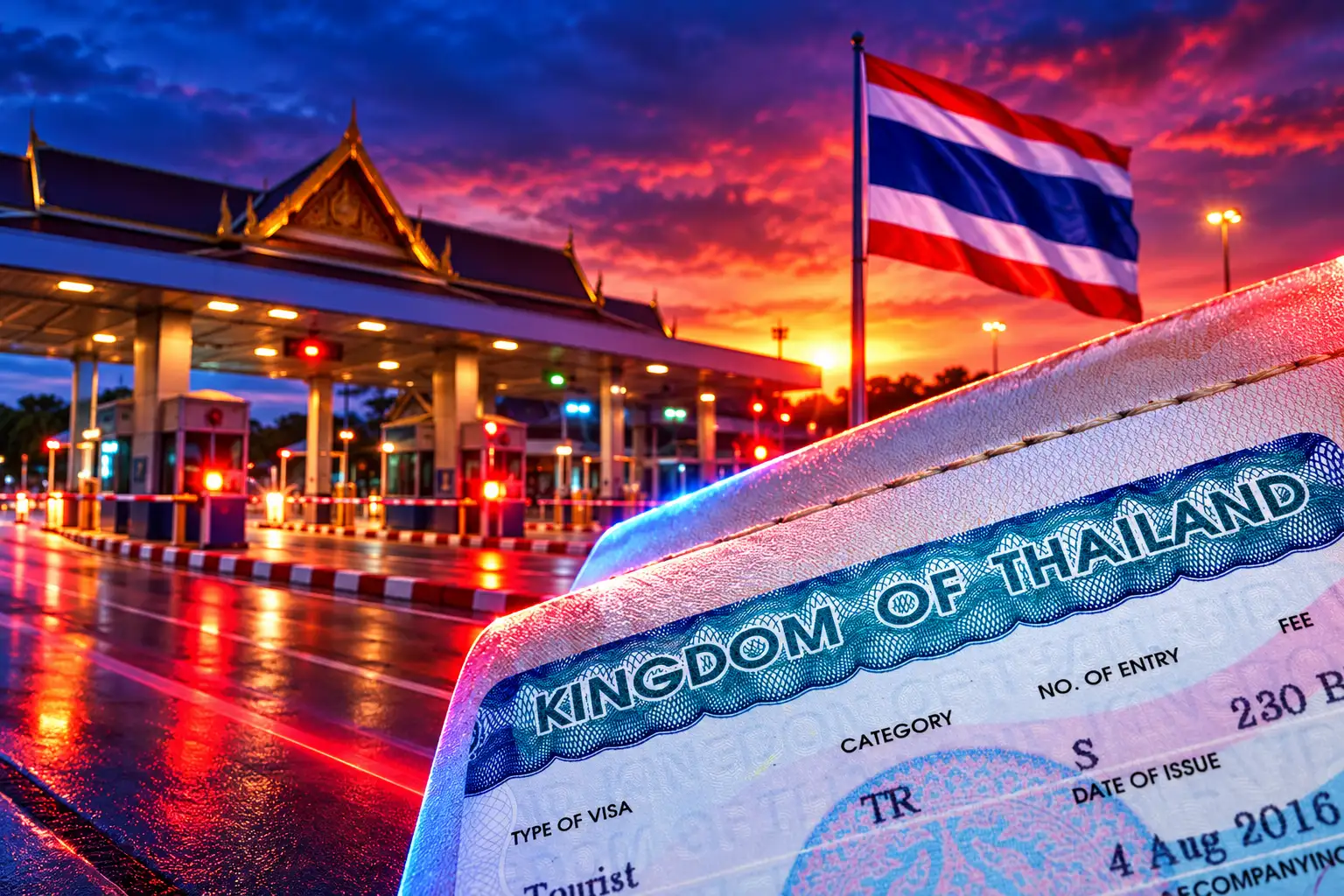
Two Land Crossings a Year, Then a Visa
The stay cut will dominate booking emails. The clause that changes how long-stay travel actually works is the land-border count. From 15 September, a visa-free traveller may enter through a land checkpoint no more than twice per calendar year. Nationals of Malaysia, Brunei Darussalam, Indonesia and Singapore are excepted, and the interior minister may name others later. Airports are not given a numerical cap in the notices.
That is the classic visa run, written down. The minivan to Poipet, Vientiane or the Malaysian line and straight back for a fresh stamp is now a twice-a-year allowance, not a lifestyle. The Tourism Authority of Thailand says travellers using the 30-day exemption at land checkpoints may generally enter no more than twice per calendar year.
Holders of passports or documents in lieu of passports who are exempted from visa requirements for tourism and who are permitted to enter the Kingdom temporarily under clause 1, in the case of entry through a designated channel at an immigration checkpoint or at a land-border checkpoint, may enter the Kingdom not more than twice per calendar year, except that a person holding the nationality of a country designated by the Minister may enter the Kingdom more than twice per calendar year.
Ministry of Interior notification, Royal Gazette, 31 August 2026
Flying in and out still resets the 30-day clock with no published annual limit. Officers already had, and used, the power to refuse a passenger whose stamps look like residence rather than a holiday. The Immigration Bureau told officers in November 2025 they could turn away visa-exempt travellers who crossed more than twice without a good reason. The Gazette now puts a hard number on the land side and leaves the air side to that older discretion.
Which Passports Stay on the List?
Holders of passports from the United Kingdom, the United States, Canada, Australia, New Zealand, Japan, India, the Philippines, Singapore, Malaysia, Indonesia, Taiwan, Israel, South Africa, the Gulf states on the list, and the EU countries named by TAT still enter without a visa for 30 days of tourism. They do not need to apply before they fly for a stay that fits inside that month.
China, Russia, South Korea, Hong Kong, Macau, Laos, Vietnam, Mongolia and several Latin American states are not on the new 60-country notice because they already hold separate bilateral deals. South Korea, Argentina, Brazil, Chile and Peru keep 90-day reciprocal stays. China and Russia keep 30 days under treaty. Cambodia and Myanmar sit on shorter 14-day arrangements, with Myanmar limited to international airports. Those travellers did not “lose” visa-free Thailand; they fall back to the deal they had before the 2024 special case.
Nationalities that are on neither the 60-country list nor a bilateral deal will need a visa from 15 September. Mexico, Morocco, Colombia, Sri Lanka and Jamaica are in that group, along with a string of smaller states that rode the 2024 expansion and now drop off it. For them the practical route is a tourist eVisa before departure, not a hope that the airport counter still waves them through.
Business Meetings No Longer Ride the Tourist Stamp
The Government Public Relations Department, citing the Department of Consular Affairs at the Ministry of Foreign Affairs, set the legal frame on 4 September 2026. The review covers only the 30-day and 15-day visa-free schemes and Visa on Arrival, “which apply to travel for tourism purposes only,” and “does not affect other visa categories at this point.”
That sentence is the one consultants, installers, conference speakers and contract signers need. From 15 September, a one-week job that used to hide inside the 60-day “work or short-term business” stamp wants a Non-Immigrant B visa, and a work permit if the activity requires one. Immigration advisers say it is still unclear whether Thailand’s old urgent-work notification, which covered some assignments of up to 15 days, can be filed by someone who landed on the new tourism stamp.
The Thailand Digital Arrival Card stays mandatory and free. Proof of funds, an onward ticket and a hotel booking remain at the officer’s discretion, as they have been. Third-party sites that charge for the arrival card are selling a form the government already gives away.
The Two-Year Experiment Ends in the Gazette
The 60-day scheme was a post-pandemic volume bet. It ran for a little over two years, and Bangkok has now decided the extra month was being used for things a tourist stamp was never built to cover, including informal work and a revolving door at land borders.
HOW THE 60-DAY SCHEME WAS WOUND UP
- 15 July 2024: Interior Ministry notice creates a 60-day visa-free special case for 93 countries and territories, covering tourism, work and short-term business.
- 19 May 2026: Cabinet approves a review of visa-free and Visa on Arrival measures under a one-country, one-scheme rule.
- 14 July 2026: Council of Ministers approves the four replacement notices, including repeal of the 2024 special case.
- 26 August 2026: Anutin Charnvirakul signs the notices as prime minister and interior minister.
- 31 August 2026: The notices are published in the Royal Gazette, Volume 143, Special Issue 207 Ngor.
- 15 September 2026: The 30-day and 15-day tourism lists, the three-country Visa on Arrival list, and the land-border cap take effect.
The Department of Consular Affairs listed five tests for the rewrite: national security, tourism and economic interests, reciprocity, cutting overlapping privileges that confused visitors, and the eVisa system already on offer. The same briefing is explicit about revoking the 60-day visa exemption scheme rather than trimming it in place.
Foreign Arrivals Already Down This Year
The cut lands on a market that is not booming. Official figures put 32.97 million foreign visitors in 2025, a 7.23 percent drop on the year before, while tourism still generated 2.7 trillion baht. Long-haul travel was the bright line in that year, at 10.8 million arrivals, an all-time high and up 10.64 percent, led by the United Kingdom and the United States, the same passports now dropping from 60 days to 30.
The Ministry of Tourism and Sports counted 20,935,135 foreign arrivals from 1 January to 31 August 2026, down 3.08 percent on the same stretch of 2025. China remained the largest source market at 3,543,272 visitors, up 16.05 percent, and Chinese travellers sit on a bilateral 30-day deal, so the new Gazette list does not change their stay. The Tourism Authority of Thailand has forecast 33 million foreign arrivals for 2026.
THE ARRIVAL NUMBERS BEHIND THE NEW STAMP
- 2025 total: 32.97 million foreign visitors, down 7.23 percent, with 2.7 trillion baht in tourism revenue.
- Long-haul 2025: 10.8 million arrivals, up 10.64 percent, an all-time high.
- 2026 through August: 20,935,135 foreign arrivals, down 3.08 percent year on year.
- TAT 2026 forecast: 33 million foreign arrivals.
Long-stayers arguing online that Bangkok is tightening the gate while the visitor count slips are looking at the same chart. A two-week beach trip still fits inside 30 days, which is why holiday volume may barely move. The people who rented by the quarter, chained stamps, and treated the land border as a reset button are the ones who have to buy a real visa or leave.
Long Stayers Are Being Pointed at the DTV
If the new stamp is the stick, the Destination Thailand Visa is the door Bangkok wants those visitors to use. The DTV, launched in July 2024 in the same policy wave as the 60-day exemption, is a five-year multiple-entry visa with 180 days per entry and one in-country extension of 180 days. Applicants must show 500,000 baht in funds. The government fee is 10,000 baht. It is not a Thai work permit, and it does not let the holder take local clients.
The same week the Gazette killed the 60-day tourist stamp, DTV filing rules hardened. From 31 August 2026, applications go through the Thai mission that covers the applicant’s nationality or permanent residence, which ends the habit of walking a file into a convenient third-country post. Some missions now want a criminal-record certificate with the packet. The visa’s length did not change. Getting one did.
LEGAL WAYS TO STAY PAST 30 DAYS
- In-country extension: One extra period of up to 30 days at an immigration office, 1,900 baht, still being offered on a tourist stamp.
- Tourist eVisa: Apply before flying if the trip is already longer than a month; a common grant is 60 days on arrival, with its own extension path.
- Destination Thailand Visa: Five years, 180 days per entry, 500,000 baht in funds, for remote work and listed Thai activities.
- Non-Immigrant B: The visa that now matches meetings, contract work and short assignments that the old 60-day stamp used to swallow.
Retirement, marriage, student and Thailand Privilege visas are outside this rewrite. So is a stay already stamped. The squeeze is on people who were living in Thailand on tourist ink and on people who flew in for a week of work without the visa that work requires.
Frequently Asked Questions
When Does Thailand’s 30-Day Visa-Free Rule Start?
The notices take effect on 15 September 2026 because they commence 15 days after Gazette publication on 31 August 2026. The stay you receive is set by the day you physically arrive, not the day you bought the ticket, so a landing on 14 September still gets the 60-day stamp even if you fly home in October.
Can You Extend a 30-Day Visa Exemption After 15 September 2026?
Immigration offices still process one extension of stay on form TM.7 for 1,900 baht in cash, usually the same day, with a passport photo. It is discretionary, granted once per entry, and it is the difference between a 30-day holiday and a 60-day one. If you already know the trip is longer, a tourist eVisa filed before departure is the calmer route.
Does the Land-Border Cap Apply If You Fly Into Bangkok?
No. The Interior Ministry notices put the twice-a-year limit on designated-channel and land-border entries and do not set a numerical cap on airport arrivals. The count runs by calendar year from 1 January to 31 December. Officers can still refuse a passenger whose air stamps look like residence, which is a separate power from the new land cap.
Do US, UK and EU Travellers Need a Visa for Thailand?
Not for tourism of 30 days or less. Those passports remain on TAT’s 60-country list. You still complete the free Thailand Digital Arrival Card before you fly. If the trip is already longer than a month, apply for a tourist eVisa rather than counting on the 1,900 baht extension, and do not pay a third-party site for the arrival card.
What Happens If You Overstay a Thai Visa Exemption?
The overstay fine is 500 baht per day, capped at 20,000 baht. Hitting the cap does not wipe the record, and a person caught inside the country after the stamp expires can face a re-entry ban. Leaving voluntarily after a short overstay is treated more lightly than being found overstaying, but the cheaper move is to extend or leave on time.
Is the Destination Thailand Visa Affected by the 30-Day Cut?
The DTV’s five-year validity, 180-day stays and 500,000 baht funds test are unchanged, and it remains the main lawful path for remote workers who actually live in Thailand. What changed on 31 August 2026 is the filing rule: you apply through the mission that covers your nationality or permanent residence, and you should expect a criminal-record certificate on the checklist.
From 15 September the free stamp is a month of tourism, two land entries a year for most passports, and a push toward the visa that matches the stay. A holiday that always fitted inside 30 days does not need a new plan. A life built on the next border run does.
Disclaimer: This article is news reporting on published Thai immigration notices and official tourism figures, and it is for information only. It is not immigration, visa or legal advice, and it is not a substitute for a ruling by Thai Immigration, a Royal Thai embassy or the eVisa system. Anyone who needs a stay longer than the published exemption, or who is travelling for work, should check the current rules for their passport with a qualified immigration lawyer or the relevant Thai mission before booking or flying. Stay lengths, country lists and fees reflect the Royal Gazette notices of 31 August 2026 and related official briefings, and practice at the border can still change.

Marriott Stakes the JW Name on a Converted Guanacaste Resort

Alaska Stakes Aurora Suites on an Uncertified 737-10

Leeds Bradford Strike Puts Aena Between Two Airports

United Bets on Flagstaff Again With Denver Flights

UK eGates Start Letting British Passengers Skip the Passport Scan

Flight Cancellations Rise While the FAA Shrinks Staffing Targets

United Folds Newark’s Lima Nonstop Into Its Houston Hub

Airbnb’s 6% Direct Links Undercut the Host Website Pitch

Hitachi’s Aurora Faults Drove the EMR Bank Holiday Strike

Grand Canyon Hotels Close After a Repeat Pipe Flood
-
 AIRLINES2 months ago
Flight Cancellations Rise While the FAA Shrinks Staffing Targets
-
 AIRLINES2 months ago
United Folds Newark’s Lima Nonstop Into Its Houston Hub
-
 HOTELS2 months ago
Airbnb’s 6% Direct Links Undercut the Host Website Pitch
-
 NEWS2 months ago
Hitachi’s Aurora Faults Drove the EMR Bank Holiday Strike
-
 HOTELS2 months ago
Grand Canyon Hotels Close After a Repeat Pipe Flood
-

 NEWS2 months ago
The EU Pulled the 2026 ETIAS Date After Border Chaos
-

 AIRLINES2 months ago
United Bets the A321XLR on 10 New International Cities
-

 NEWS2 months ago
ATSB Opens Six Sydney Airport Ground Conflict Files