
NEWS
The EU Pulled the 2026 ETIAS Date After Border Chaos
British travellers will not need ETIAS in 2026 after the EU stripped the launch date, while fake sites already sell the €20 permit.

British travellers do not need an ETIAS travel authorisation for trips this autumn. The EU has not named a start date, and the official site is still not taking applications.
The delay is easy to read as a free pass. The people who will actually stop a passenger are airline, ferry and coach staff, plus a web of unofficial sites that are already asking for passport data.
A €20 Permit for 59 Passport Lines
ETIAS is the EU’s pre-travel check for people who can visit without a visa. It covers nationals of 59 visa-free countries and territories, a pool Frontex puts at about 1.4 billion people, including British passport holders after Brexit. The permit is for short stays in 30 European countries, up to 90 days in any 180-day period.
The official pages that explain what ETIAS is for visa-free travellers now carry a blunt holding line: the system is not in operation, and no applications are being collected. The Union says it will give several months’ notice before launch. That is the only public timetable that still stands.
ETIAS AT A GLANCE
- The fee: Adults aged 18 to 70 pay €20 (£17); under-18s and over-70s still apply, but pay nothing.
- The life of the permit: Multiple entries for three years, or until the passport used in the application expires, whichever comes first.
- The zone: Almost all of the EU except Ireland, plus Iceland, Norway, Switzerland, Liechtenstein and Cyprus.
- The old public target: Last quarter of 2026, a window that has now been stripped off the main ETIAS site.
The fee started at €7 in the original design and was raised to €20. Holding the permit does not lock in a right of entry. Border guards can still turn a traveller away if other conditions fail, and the authorisation itself can be pulled.
Airlines Will Refuse Boarding Without It
Frontex, which will host the ETIAS Central Unit around the clock, has already written the enforcement line that matters at 5am in Stansted. Travellers without a valid authorisation will be refused boarding by the carrier, including an airline, bus or ferry company. Air, sea and coach operators will query a carrier interface before the aircraft door closes, in the same family of checks used for the US ESTA.
That is why the permit will be felt at check-in, not at the kiosk in Lisbon. Most British trips to the Schengen area begin with a carrier that is legally on the hook if it flies someone who lacks the right paper. After Brexit, a few airlines invented extra passport rules of their own and left passengers stranded. A three-stage ETIAS rollout, optional then grace then hard, is built for the same kind of mix-up.
How-to pages are already telling travellers they must hold ETIAS to fly in 2026, and some still quote the old €7 fee. That is false today. It is also a preview of the boarding argument that starts the day carriers get a yes/no flag and borders are still running exceptions.
If you only change planes and stay inside the airport’s international transit area, you will not need the permit. If you pass a border desk to switch terminals or airports, you will. Cyprus counts its 90 days apart from the rest of the zone, which is a small mercy for anyone stitching a longer loop.
Unofficial Sites Opened Before the Permit
The application will live on the official ETIAS website and a later app, both under the europa.eu domain. Friends, family and travel agents may apply for someone else, and they will have to sign a declaration of representation. Commercial intermediaries are allowed. They may add their own service charge on top of the €20.
The EU does not licence those firms. Frontex has already found over 100 unofficial websites talking about a system that cannot yet issue a permit. Some mimic the official layout, paste the EU logo (which they are not allowed to use), or collect names, passport numbers and card details now.
We are aware of several sites that claim to already accept ETIAS applications. Travellers should be very cautious about those websites, as it is not currently possible to apply for an official ETIAS travel authorisation since the system is not operational yet.
Francois Laruelle, Director, ETIAS Central Unit Division, Frontex
The warning is older than this summer’s border chaos, and it has not gone stale. Sites have claimed to have processed applications that do not exist. Others have advertised early-bird discounts. The harm is not only the extra fee. It is identity theft on a form that asks for convictions, family names and a first-night address.
HOW TO SPOT A FAKE ETIAS SITE
- The domain: Anything that is not europa.eu is unofficial, even if it looks like a government portal.
- The pitch: Any page taking applications today is selling a product the EU has not switched on.
- The price: The official fee is €20, or free outside ages 18 to 70; a higher figure is a middleman mark-up or a fraud.
- The logo: Copying EU marks is illegal, and a 40 percent “early” discount is a classic lure.
Once the real site opens, report abuse there. Until then, treat every paid ETIAS offer as a request for your passport data with no permit at the end of it.
What Will the Application Ask For?
The form is closer to a short security file than a landing card. You will give name, birth details, sex, nationality, home address, email and phone, plus both parents’ first names, education level and current job. You must name the country of first intended stay. The address of that first night is optional, and the EU says you may change plans once the permit is issued.
Then come the questions that will snag people who think this is a rubber stamp. You must say whether you were convicted, in the last 15 years, of listed serious offences, and whether you were convicted of terrorist offences in the last 25 years. You will also be asked about stays in named war or conflict zones in the last 10 years, and about any order to leave a member state or a return decision in that same decade.
Frontex expects about 97% of applications to be approved automatically in minutes. The remaining 3 percent go to the Central Unit and then to a national unit, usually the country you named first. EU law says most files are still handled within minutes, or within 96 hours. If officers want more papers, or an interview at a consulate as a last resort, that can add up to 30 days. The EU’s own advice is to get the permit before you buy tickets or book hotels.
THE APPLICATION CLOCK
| Stage | What happens | Clock |
|---|---|---|
| Most files | Automatic approval against EU and Interpol databases, plus an ETIAS watch list | Minutes (about 97 percent) |
| Clear but slower files | Extra checks without an interview | Up to 96 hours |
| Flagged files | More documents, then possibly an interview | Up to 30 extra days |
| A refusal | You can appeal; the notice will say how | Set out in the refusal letter |
Nothing needs printing. The guard, and the airline, will read the permit from the passport you used to apply. If you renew that passport, you apply again. Dual nationals who travel on an EU or Schengen passport skip ETIAS; a British passport on the same trip does not.
EES Fingerprints Already Slow the Line
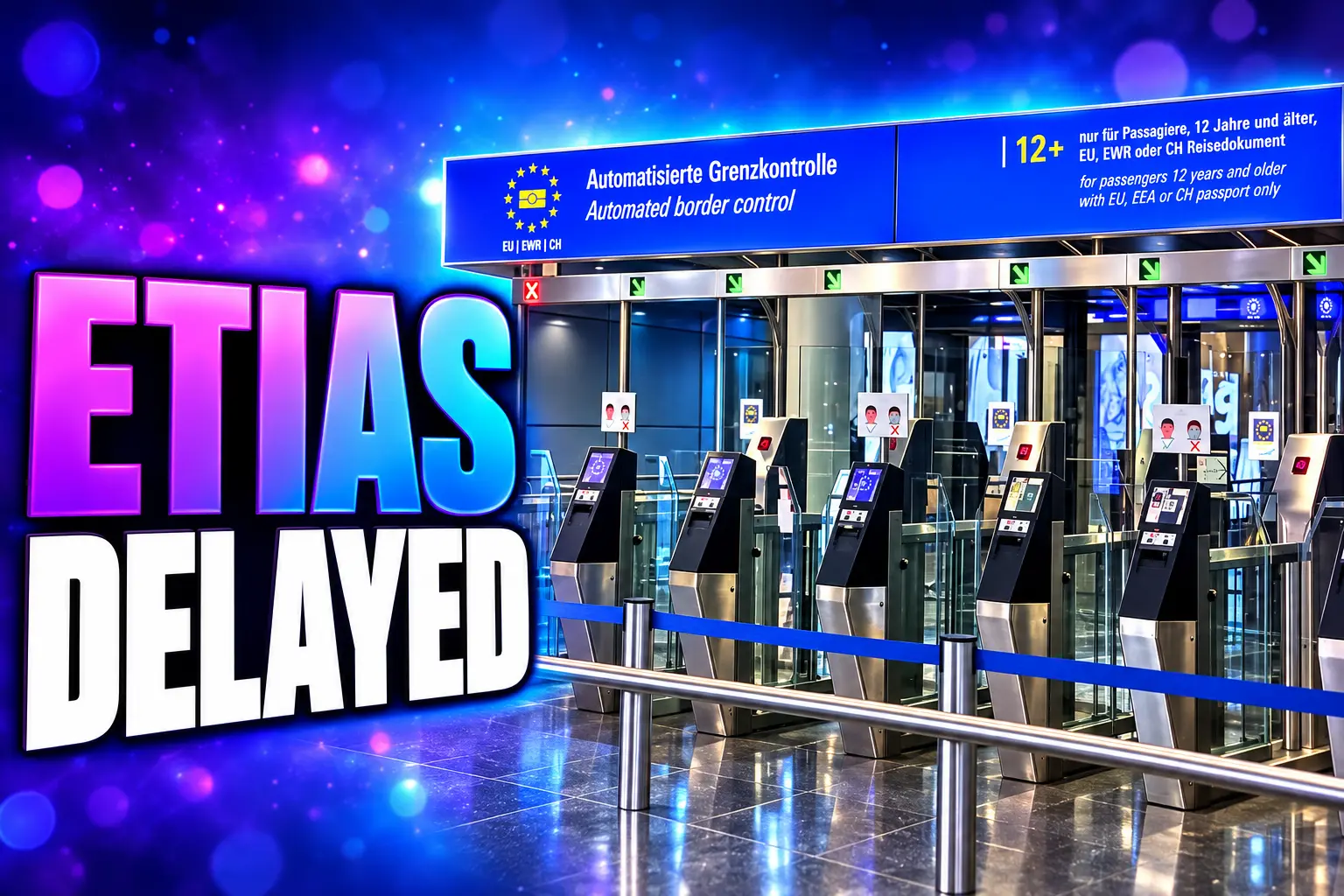
ETIAS cannot start until the Entry/Exit System is running, because the two systems share the same border machines. EES already records face and fingerprint data for non-EU travellers, replaces most passport stamps, and counts the 90 days in 180. That is the queue British travellers have been standing in this year. ETIAS adds a pre-check on top; it does not collect new biometrics of its own.
THE EES AND ETIAS CALENDAR
- 12 October 2025: EES begins a 180-day progressive start across Schengen external borders.
- 10 April 2026: eu-LISA, the EU’s large-scale IT agency, says EES is fully deployed at those borders.
- 17 June 2026: The eu-LISA management board discusses ETIAS entry into operation; a spokesperson later said there had been no further public move.
- July 2026: The official ETIAS site drops the last-quarter-2026 launch line and says the date will come several months in advance.
- 31 July 2026: eu-LISA’s own 2026-2028 plan, adopted that day, still lists ETIAS as in development for 2026.
On paper the biometric step is short. The Commission has said a typical entry or exit takes about 70 seconds, and that the system had already logged more than 108 million entries and exits since October. Airline and airport groups wrote that waits had reached up to five hours at peaks. Officials put the worst trouble at around 20 of about 1,500 crossing points. Greece paused EES enrolment for British visitors for a stretch. Several states used built-in flexibility to ease summer pressure.
Ursula von der Leyen, President of the European Commission, admitted in early July that technical problems remained. “There’s still quite a lot of work to do to have these technical issues solved together with the member states,” she said. Uku Särekanno, a deputy executive director at Frontex, had already told travel agents the hard part is first enrolment: “We expect the situation will stabilise in one or two years because the most challenging part is the first enrolment.” Returning travellers who are asked for prints again are being processed against the rulebook, not with it.
People who have used those kiosks this summer already treat the new border as a delay with little visible gain. Stacking a pre-travel permit on machines that still stumble is why people briefed on the June board called a 2026 ETIAS launch no longer feasible, and why the 2026 ETIAS start date was pulled from the public site.
When Will Travellers Need the Permit?
No traveller needs ETIAS today. The Commission, not Frontex and not eu-LISA, sets the switch-on date, and only after testing is done. A Commission spokesperson has said preparations continue and that a date will follow once the conditions are in place. People close to the June board talked about 2027. Until Brussels publishes a day, that remains a briefing, not a law.
Launch is also not the day you will be turned away. EU rules build in a long, confusing on-ramp that carriers will have to code into departure systems.
THE THREE PHASES AFTER SWITCH-ON
| Phase | How long | If you arrive with no ETIAS |
|---|---|---|
| Transitional | At least six months (the Commission can stretch this) | You should apply, but you are let in if you meet every other entry rule |
| Grace | Six months after the transitional phase ends | Allowed only on your first trip since the transitional phase ended; repeat visitors can be refused |
| Fully required | After grace | Carriers can block boarding; border guards can refuse entry |
Taken together, the public site says the transitional and grace periods last at least 12 months. So even a spring 2027 start would leave many British holidaymakers able to travel without the permit into 2028, unless an airline decides to treat the flag as a hard stop from day one. That gap between border law and a departure-control screen is where people will lose flights.
The 90/180 cap does not wait for ETIAS. Spend the first 90 days of 2027 in the zone, January through almost all of March, and you cannot return until late June. EES is already meant to count those days for you, which is why a jammed kiosk is not a side issue. It is the clock.
Ireland Stays Out, Gibraltar Does Not
Ireland is not in Schengen and will not run ETIAS. The Common Travel Area still covers the UK, Ireland, the Isle of Man and the Channel Islands, so a Dublin weekend does not need the permit. A British-Irish dual national who travels on an Irish passport is treated as an EU citizen for these checks.
Gibraltar is the other way round. From 15 July 2026 the UK-EU deal on the territory has applied on a provisional basis, and short-stay rules there now line up with Schengen. UK travel advice says ETIAS will also apply once operational, alongside EES where it is used. Time spent in Gibraltar counts toward the same 90 days in 180.
WHO DOES NOT NEED ETIAS
- Ireland trips: No permit, because Ireland sits outside the 30-country list.
- Long-stay papers: A visa or residence permit for study or work in a participating country replaces the short-stay authorisation.
- Withdrawal Agreement residents: UK nationals and family members with the right uniform-format residence document are exempt, with tight extra rules if that document was issued by Ireland or Cyprus.
- EU-document dual nationals: Travel on the EU or Schengen passport and the permit does not apply.
The passport in your hand can still strand you before any of this is switched on. It must not be more than 10 years old on the day you enter, and it must have at least three months left on the day you plan to leave. Those extra months on old UK passports already fail people who think a date printed on page 44 is the whole story.
Until the Commission names a day, the only new border step that is live is EES. The only safe ETIAS move is to ignore anyone selling the form, and to treat airline emails about a “required” permit as a request to check the official site, not an order to pay a stranger €20.
Disclaimer: This article is news reporting on published EU rules and official statements, and it is for information only. It is not immigration, visa or legal advice, and it is not a ruling on whether any person will be allowed to board or to enter. Readers should check the official ETIAS pages and, where needed, take advice from a qualified immigration lawyer or the relevant consulate before they travel or pay a third party. Fees, dates and border procedures are those given by the cited official sources as of 2 September 2026 and can change when the Commission sets a start date.

Marriott Stakes the JW Name on a Converted Guanacaste Resort

Alaska Stakes Aurora Suites on an Uncertified 737-10

Leeds Bradford Strike Puts Aena Between Two Airports

United Bets on Flagstaff Again With Denver Flights

UK eGates Start Letting British Passengers Skip the Passport Scan

Flight Cancellations Rise While the FAA Shrinks Staffing Targets

United Folds Newark’s Lima Nonstop Into Its Houston Hub

Hitachi’s Aurora Faults Drove the EMR Bank Holiday Strike

Airbnb’s 6% Direct Links Undercut the Host Website Pitch

United Bets the A321XLR on 10 New International Cities
-
 AIRLINES1 month ago
Flight Cancellations Rise While the FAA Shrinks Staffing Targets
-
 AIRLINES1 month ago
United Folds Newark’s Lima Nonstop Into Its Houston Hub
-
 NEWS1 month ago
Hitachi’s Aurora Faults Drove the EMR Bank Holiday Strike
-
 HOTELS1 month ago
Airbnb’s 6% Direct Links Undercut the Host Website Pitch
-
 AIRLINES1 month ago
United Bets the A321XLR on 10 New International Cities
-
 NEWS1 month ago
ATSB Opens Six Sydney Airport Ground Conflict Files
-

 HOTELS1 month ago
Grand Canyon Hotels Close After a Repeat Pipe Flood
-
 NEWS1 month ago
Extra Months on Old UK Passports Still Block EU Entry