
NEWS
The EES Safety Valve Shut Before the Next Holiday Peak
The EU Entry/Exit System lost its queue pause on 6 September, leaving UK-France car crossings and busy airports to run full biometrics through the next holiday peak.

Ryanair asked the European Commission on 7 September to restore Entry/Exit System flexibility until April 2027, one day after the summer safety valve expired. Chief operating officer Neal McMahon called the EU’s handling of EES a “shambles from start to finish.”
Border posts must now take fingerprints and photos with no legal pause when queues explode, and the next UK school holiday will be the first peak under that rule. The airline is shouting about airports. The slower problem sits at the Channel, where the kit built for cars was still not the finished system in late August.
The Safety Valve Shut on 6 September
EES is the EU’s digital replacement for passport stamps. It records the entry and exit of non-EU nationals on short stays in the Schengen area, stores a face image and fingerprints, and calculates the 90 days allowed in any 180-day window.
The system went live on 12 October 2025 and reached every external crossing on 10 April 2026 after a coordinated 180-day implementation phase. Twenty-nine countries use it: every EU member except Ireland and Cyprus, plus Iceland, Liechtenstein, Norway and Switzerland.
A built-in emergency rule let states pause biometric collection at a crossing when waits became excessive. That rule, which the Commission said ran through the summer “including until the 6th of September,” ended on 6 September 2026. From that Sunday, member states lost the formal way to switch the scanners off for a few hours and go back to stamps.
THE EES CALENDAR
- 12 October 2025: Progressive start of operations begins; stamping continues in parallel.
- 10 April 2026: Full deployment at external borders; manual stamps end for eligible travellers.
- May 2026: Port of Dover declares a critical incident after waits hit four and a half hours.
- 7 July 2026: Nine Schengen governments ask Brussels to keep the emergency pause past 6 September.
- 6 September 2026: The biometric suspension rule expires.
- 7 September 2026: Ryanair asks for a new derogation running to April 2027.
By 27 July the Commission said the system had registered over 145 million entries and exits since launch. That volume is the case for keeping it on. It is also why a missing pause at a busy booth now has nowhere to go.
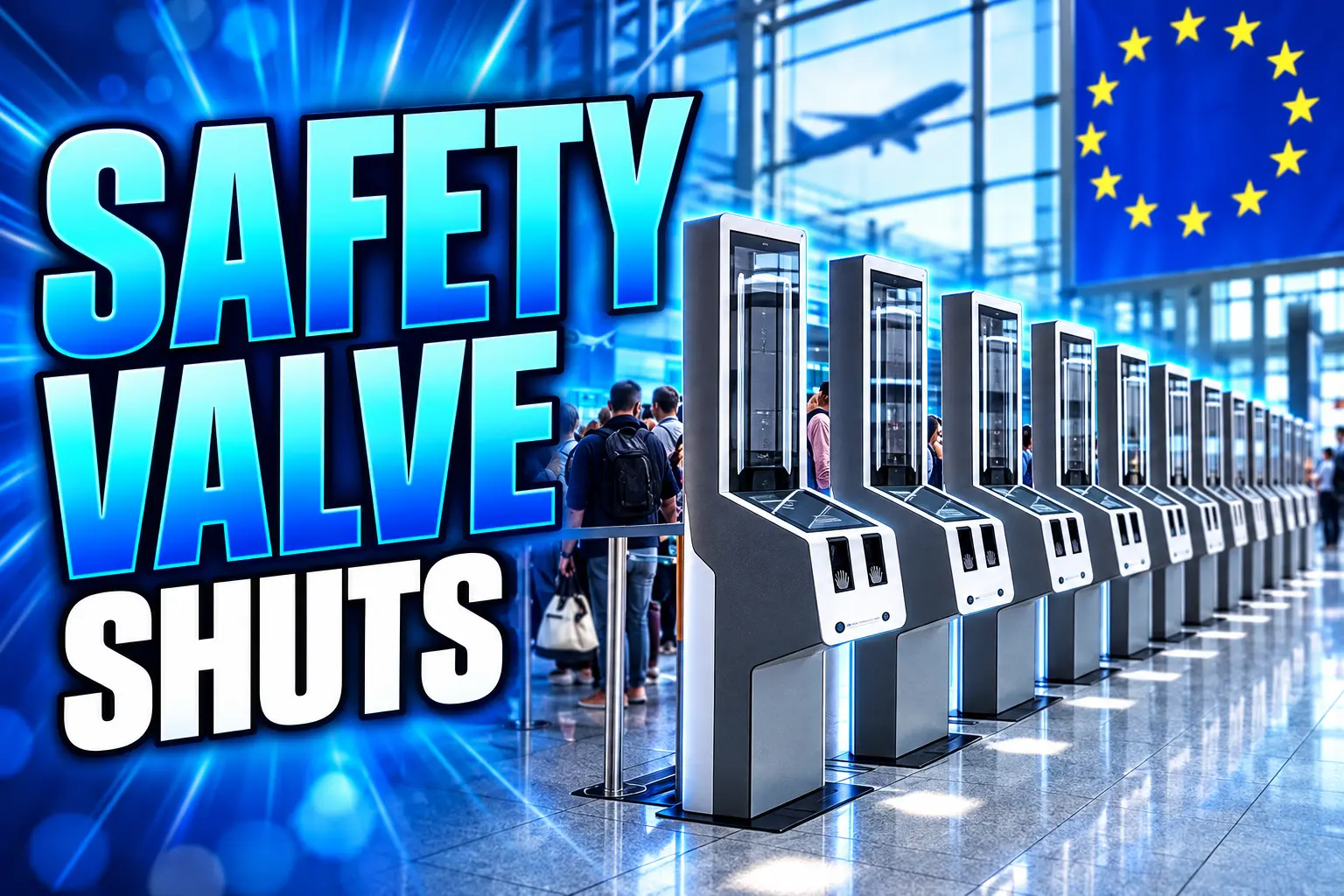
Ryanair Wants Another Winter to Fix the Kiosks
In a statement dated 7 September, the airline said summer border waits reached 2-3 hours in Krakow, Lisbon, Milan and Rome. It blamed broken kiosks, short staffing and slow processing, and said removing the derogation leaves states with no flexibility in peak periods.
The EU’s handling of EES has been a shambles from start to finish. Airlines, airports and border authorities repeatedly warned Brussels that the rollout was not ready, that it would increase processing times and that it would create excessive queues for passengers. Those warnings were ignored, with EU citizens the ones delayed and disrupted.
Neal McMahon, chief operating officer, Ryanair statement, 7 September 2026
McMahon’s “EU citizens” line needs a correction beside it. EES does not enrol EU, Icelandic, Liechtenstein, Norwegian or Swiss nationals. They still show a passport or ID. When non-Schengen and Schengen traffic share one hall, a slow third-country queue still fills the room, which is how a system aimed at visitors backs up people it does not even record.
Ryanair wants the Commission to extend the EES derogation until April 2027 so airports can repair kiosks and hire before another season of full enforcement. That date is the airline’s ask, not an agreed deadline. Airports Council International, writing in June, put peak waits at up to five hours and also asked for a way to pause the process in exceptional crowds.
The practical complaint on the ground is narrower than the press-release fight. At Milan Malpensa on 4 September, Milan Airports told a passenger that new non-Schengen controls plus several arrivals at once had stretched waits, and did not say it had used a 45-minute suspension trigger. The missing pieces named in that exchange were staff, computers and e-gates. Copenhagen passengers were still asking, after the cutoff, where the digital self-service booths they had been promised actually were.
Dover Built 84 Booths France Has Not Switched On
Most UK flyers hit EES on arrival in Spain, Italy, Portugal or France. People leaving through the Channel do the French check before they leave Britain, at the Port of Dover, Eurotunnel Le Shuttle in Folkestone, or Eurostar at London St Pancras. That is why a kiosk failure in Kent is a UK queue, not a Calais one.
Dover spent £40 million reclaiming land at the Western Docks and installing 84 kiosks on a site about the size of five football pitches, with space for 600 cars. Chief executive Doug Bannister said the port’s infrastructure was ready and that turning the kiosks on sat with the French Police Aux Frontières. Through the summer those booths were not in use for cars. Coaches used the new area. Car passengers had EES files created by hand at the Eastern Docks, often without fingerprints or a facial scan.
Le Shuttle’s pre-registration kiosks were in the same boat. Eurostar has 49 kiosks in three parts of St Pancras; reporting in July still described enrolment without full biometrics while kit was being stabilised. French authorities had aimed for a workable level of performance by 6 September. There was no public confirmation by late August that car kiosks at Dover or Folkestone were live.
WHERE THE CHECK HAPPENS
| Crossing | Where UK travellers enrol | What late-summer reporting showed |
|---|---|---|
| Schengen airports | On arrival at the destination | Ryanair: 2-3 hour waits in Krakow, Lisbon, Milan and Rome |
| Port of Dover (cars) | In the UK, before the ferry | 84 Western Docks kiosks not activated for cars; manual files at the Eastern Docks |
| Le Shuttle, Folkestone | In the UK, before the shuttle | Pre-registration kiosks not operational |
| Eurostar, St Pancras | In the UK, before the train | 49 kiosks in three station areas; biometrics still being bedded in |
The May half-term Saturday that forced Dover to call a critical incident handled about 8,500 outbound tourist vehicles and built a four-and-a-half-hour wait. French officers then dropped EES and went back to stamps. The port expected about 10,500 outbound cars on both 24 and 25 July, and has warned that peak days can top 12,000. Dover moves about 11 million passengers a year and about a third of UK goods trade with the continent on short-sea ferries, so a tourist tailback is also a freight problem.
The UK government put £10.5 million into the three hubs, £3.5 million each for Eurostar, Eurotunnel and Dover. The money bought booths. It could not switch on French software. Bannister told MPs the port would face “repeated episodes of severe congestion” unless Brussels allowed more flexibility. That flexibility is what expired on 6 September.
What UK Travellers Must Do at Schengen Borders
British passport holders on a short stay do not apply in advance. GOV.UK says there is no cost for EES registration and nothing to submit before you reach the desk. The record is meant to last three years, or until the passport expires, whichever comes first. Overstayers’ data is kept for five years from the day the authorised stay ran out.
On a first trip, the booth or the officer scans the passport, takes a photo, and, for anyone aged 12 or over, scans fingerprints. Later trips are supposed to be a passport scan plus a photo or a fingerprint. You can also be asked for a biometric check on the way out. Home Office minister Alex Norris said in March that checks “should take only a few minutes per person,” while warning that longer waits were possible, including on the way home.
THE FIRST ENROLMENT
- Passport scan: The machine or the officer reads the chip and the biodata page.
- Face photo: A still image is stored against the travel record.
- Fingerprints: Taken from adults and from children aged 12 and over.
- Later visits: Passport plus a photo or a fingerprint, unless the file has to be rebuilt.
- The 90/180 rule: Time in all EES countries is added together, not counted per country.
A web tool on the EU travel site lets people check remaining days. A smartphone app for pre-registering some data exists at selected crossings only, so it is not a plan you can count on at every airport. Ireland and Cyprus sit outside Schengen, so a trip to Dublin or Larnaca does not create an EES file.
Some UK nationals skip the scanners if they show the right document at the desk: Withdrawal Agreement residents, people legally resident in the EU or the four Schengen associates, and UK-EU dual citizens travelling on the EU passport. Family members of EU or Schengen-associate citizens who hold a residence card are also out of the system. If a file is created by mistake, a border guard is supposed to delete it.
ETIAS, a separate pre-travel authorisation with a €20 fee, is expected to start in autumn 2026. GOV.UK says the EU will name the date and that any site selling ETIAS now is a scam. That is the next layer, not a substitute for the kiosk in front of you.
Nine Capitals Already Asked for the Same Pause
Ryanair did not invent the request. On 7 July, interior ministers from Belgium, France, Germany, Greece, Italy, Malta, the Netherlands, Portugal and Switzerland wrote to Internal Affairs Commissioner Magnus Brunner. They backed full EES registration of non-EU travellers, and they wanted the emergency mechanism kept after 6 September, plus written guarantees before it lapsed.
THE JULY LETTER
- Who signed: Nine Schengen governments, including the three busiest for UK road and rail (France, Belgium, the Netherlands) and four big leisure markets (Italy, Greece, Portugal, Germany).
- What they wanted: Keep the right to pause fingerprint and face collection when a crossing is overwhelmed.
- What they accepted: Everyone entering and leaving would still be registered.
- What Brussels said: The Commission welcomed the pledge to implement EES in full and pointed to flexibilities already written into the law.
France was in that group while its own kiosk software at Dover and Folkestone was still not ready for cars. Greece had already used a wide pause in the spring. Spain, which did not sign, was the state Ryanair had attacked in April over one-to-two-hour waits in Malaga, Alicante and several Canary and Catalan airports, saying kiosks and staff were not in place three years after the April 2026 date was known.
ABTA’s Luke Petherbridge said after the summer that the industry was still pushing for the measures to be usable beyond September because the system was not “fully and consistently operational” everywhere. The airline letter and the ministerial letter are the same ask from different letterheads.
Extra Frontex Officers, Not Another Derogation
On 1 September, Commission spokesperson Markus Lammert said EES had “broadly worked well” over the summer, “also thanks to the flexibilities that are inbuilt in the system.” After 6 September, he said, Brussels was in “close and constructive contact with those few member states where some adjustments are needed at certain border crossing points.”
We have offered additional help to the member states concerned and asked them to further intensify the operational preparedness, including the necessary technical, organisational, and communication measures, with a view to ensuring that remaining challenges are fully addressed by the end of the year.
Markus Lammert, European Commission spokesperson, midday briefing, 1 September 2026
The extra help he named was operational assistance and more Frontex standing-corps officers, not a new legal right to turn biometrics off. The Commission’s clock is the end of 2026. That is the same window as Christmas travel, and it sits after October half-term.
WHAT WE KNOW
- The pause: The rule that let states suspend biometric collection in exceptional crowds expired on 6 September 2026.
- The airline ask: Ryanair wants that rule restored until at least April 2027.
- The Commission offer: Extra support, including Frontex officers, and a year-end target for remaining weak crossings.
WHAT IS UNCONFIRMED
- Car kiosks: Whether Dover’s 84 booths and Le Shuttle’s pre-registration hall were actually switched on for cars once the pause died.
- A new derogation: Whether the nine-country letter or the Ryanair demand will produce fresh legislation.
- Peak waits: How long October half-term and Christmas queues will run with no off-switch.
Polish embassy staff in Portugal told non-Schengen travellers on 9 September to budget more time at Portuguese airports because full EES applied from 6 September. AJet told its passengers to be at the airport at least three hours before departure. Those are carrier and consular hedges, not a Commission climbdown.
October Half-Term Has No Legal Off-Switch
The first-order row is familiar: an airline calls a Brussels IT project a mess, Brussels says most crossings are fine. The second-order problem is the calendar. Summer had a valve. Autumn half-term does not. Christmas sits on top of the Commission’s own year-end deadline for “remaining challenges.”
UK travellers flying to a Schengen airport still do the work on arrival, so the useful move is an earlier reporting time and a clear view of whether you already have a three-year file. People driving or taking the train should treat Dover, Folkestone and St Pancras as French border posts that may still be mixing kiosks, manual files and ordinary desks, and should follow the operator’s cut-off rather than the sailing time on the ticket.
McMahon wants April 2027. Lammert has offered officers and a December finish line. Until one of those dates moves, the scanners stay on even when the hall is full.
Disclaimer: This article is news reporting on border procedures and public statements, and it is for information only. It is not legal, immigration or travel advice, and it does not tell you whether you personally must enrol. Rules vary by nationality, residence papers and crossing point, so check official EU and UK government guidance and your carrier before you travel, and speak to an immigration lawyer if your status is complex. Figures and operating details reflect the statements and guidance cited here and can change at short notice.

The World Cup Ended and U.S. Arrivals Fell Harder

Royal Caribbean Buys Half of Sandals and the Storm Risk

Delta Drops Five Routes and Parks Vegas for CES

The EES Safety Valve Shut Before the Next Holiday Peak

Hersheypark Docks Tidal Force After 32 Years of Splashes

Flight Cancellations Rise While the FAA Shrinks Staffing Targets

United Bets the A321XLR on 10 New International Cities

Hitachi’s Aurora Faults Drove the EMR Bank Holiday Strike

Airbnb’s 6% Direct Links Undercut the Host Website Pitch

The EU Pulled the 2026 ETIAS Date After Border Chaos
-
 AIRLINES1 month ago
Flight Cancellations Rise While the FAA Shrinks Staffing Targets
-
 AIRLINES1 month ago
United Bets the A321XLR on 10 New International Cities
-
 NEWS1 month ago
Hitachi’s Aurora Faults Drove the EMR Bank Holiday Strike
-
 HOTELS4 weeks ago
Airbnb’s 6% Direct Links Undercut the Host Website Pitch
-
 NEWS1 month ago
The EU Pulled the 2026 ETIAS Date After Border Chaos
-

 NEWS1 month ago
ATSB Opens Six Sydney Airport Ground Conflict Files
-

 DESTINATIONS2 months ago
Mont Blanc Tops the Hiking List on Already Busy Trails
-

 NEWS4 weeks ago
Extra Months on Old UK Passports Still Block EU Entry