
NEWS
Extra Months on Old UK Passports Still Block EU Entry
Extra months once added to UK passports now fail the Schengen 10-year issue test, and airlines stop families at the gate.

UK travellers are still being stopped at the gate by a 10-year passport rule, even when the book has not expired. Last week a woman was pulled from a flight to Split; her husband and four children boarded without her.
At Bristol Airport the same week, Jet2 staff told Celia Jenkins, 78, and her husband Rees, 82, that their passports were 10 years and three days old and could not fly to Kefalonia, where the family has a second home. The books were current. They failed on the issue date, a leftover of a UK policy that once added extra months as a gift.
Bristol, Kefalonia and a Passport Three Days Too Old
Celia and Rees travel the route often. They looked at the expiry date, packed, and went to the airport. Gate staff then measured the other date, the one most people never check, and walked them back out of the terminal. Celia put the wasted buses, taxis, an airport hotel and replacement flights at £500, plus a week with their children and grandchildren that they did not get.
Don’t go to the airport unless you’ve double-checked, because the airlines are not picking it up.
Celia Jenkins, passenger, Bristol Airport
She said they felt like criminals as they were escorted out. They had not been told clearly enough, she said, and they had treated the expiry date as the only date that could go wrong. The Split passenger hit the same wall on a Croatian flight, another Schengen arrival, with an unexpired British passport that was simply too old from the day it was printed.
Both cases sit inside a shrinking group of adult passports issued before the UK stopped carrying leftover time from one book to the next. Those books can still look healthy on the expiry line while already failing the issue-date test that Schengen applies to British visitors.
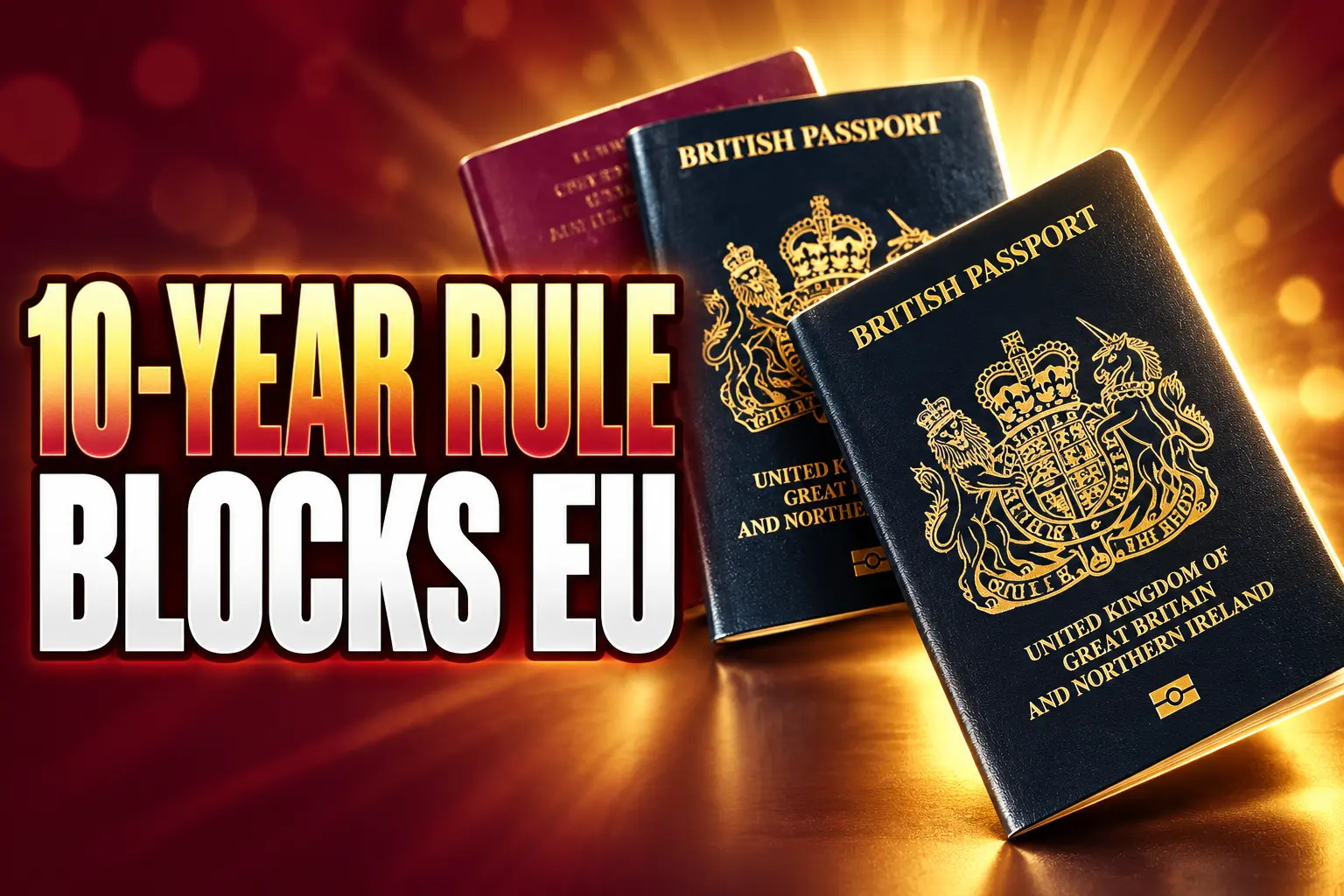
The Two Dates Schengen Officers Check
British citizens travelling for a short stay must meet two tests that do not fold into one. Foreign Office advice for Greece, which follows Schengen area rules, says a passport must have a date of issue less than 10 years before the day you arrive, and an expiry date at least three months after the day you plan to leave the Schengen area. The same page is explicit that the expiry date does not need to sit within 10 years of the issue date.
That wording matches Article 6 of the Schengen Borders Code, the EU rule that has applied to so-called third-country nationals for years and applied to Britons once free movement ended. The travel document’s time left must run at least three months past the intended departure, and it must have been issued within the previous 10 years. An emergency waiver exists only for the three-month limb, not for the issue-date limb.
The European Commission’s migration department has said the 10-year test is checked on the day of entry, not stretched across the holiday. A traveller who arrives on the last legal day of that decade, with three months still on the book at the planned exit, is allowed in. The two conditions stay independent. There is no extra hidden rule that a passport must be under nine years and nine months old.
THE TWO TESTS ON A BRITISH PASSPORT
| Test | What you check | Worked example |
|---|---|---|
| Issue date | Must be under 10 years old on the day you enter Schengen | Issued 6 June 2016, expires 6 March 2027: blocked from 6 June 2026, months before expiry |
| Time left | Must have 3 months remaining after the day you plan to leave | A 10-year book issued 1 October 2018 and expiring 1 October 2028 fails this test from 1 July 2028 |
| Extra-month book | Issue date usually fails first | Issued 1 June 2018, expires 1 March 2029: last Schengen entry 31 May 2028 |
| Post-2018 book | The 3-month test usually fails first | Exact 10-year adult passports run out of spare time before they turn 10 years old |
Ireland does not apply these Schengen tests; a British passport only needs to cover the stay. Cyprus is outside Schengen as well. Everywhere else in the system, including Greece, Croatia, France, Spain and the non-EU Schengen states of Norway, Iceland, Switzerland and Liechtenstein, both dates count.
HM Passport Office Stopped Adding Time in 2018
The trap is a British quirk colliding with an EU rule that never cared about British extra months. Between November 2004 and October 2018, HM Passport Office let people renew early and keep leftover time, up to nine months, on the new book. An adult who renewed with seven months still on the old passport received a new one valid for 10 years and seven months. Ten months leftover was capped at 10 years and nine months.
That courtesy was sold as a reason to renew in good time. It produced millions of passports whose expiry date sits more than a decade after the issue date. While the UK was inside the EU, border officers cared about whether the book was in date, not how long ago it had been printed. Once Britons became third-country nationals, Article 6’s issue-date cap started to bite those extra months one by one.
HM Passport Office staff guidance now says leftover time was dropped from October 2018 so that customers travelling to some other European countries could only use a passport issued in the last 10 years. The Home Office had already told callers the change ran from Monday 10 September 2018. Foreign Office travel advice warns that a passport renewed before 1 October 2018 might have an issue date more than 10 years ago, making it invalid for Schengen entry even if the expiry date looks fine.
HOW THE EXTRA MONTHS BECAME A GATE PROBLEM
- November 2004: HM Passport Office starts adding leftover time, up to 9 months, when adults renew early.
- 10 September 2018: The Home Office confirms leftover months are no longer carried over; new adult books are issued for 10 years only.
- 31 December 2020: The Brexit transition ends and British visitors fall under Schengen rules for third-country nationals.
- Late August 2026: Celia and Rees are stopped at Bristol, 10 years and three days after issue, and a passenger is pulled from a Split flight on the same rule.
- Autumn 2028: The last extra-month adult books, printed in 2018, reach their 10th birthday and fail the issue-date test.
Children’s passports were issued for five years, or five years and up to nine months in the leftover era, so they clear the 10-year issue test by design. The people walking into this now are adults who renewed in the leftover years and then held the book until close to expiry, a habit that is common among older travellers who do not fly every season.
Why Airlines Stop You Before the Border Does
The refusal almost always happens in the UK, at check-in or at the gate, not at passport control in Split or Kefalonia. Carriers that bring a passenger who is then refused entry can be fined and must fly that person back. HM Passport Office’s own historic guidance notes that more than 40 countries, including EU member states, run carrier-liability rules of that kind. Staff who stop someone in error may owe denied-boarding pay instead. The cheaper commercial guess, if the dates look close, is to keep the passenger on the ground.
That incentive is why a document that might still get a sympathetic reading from a border officer never leaves Bristol. It is also why mistakes run in both directions. In September 2025, British Airways turned Chris Taylor and his wife Cathy away from a Heathrow flight to Palma. The couple drove a 200-mile round trip to renew, even though both passports met the two EU tests. Some ground staff still squash the two independent conditions into a single cutoff of nine years and nine months, which is the right maths only for a book issued for exactly 10 years, and the wrong maths for an extra-month passport that still has a legal issue date.
As part of our pre-departure communications, we always remind customers to check the validity of their passport, in line with Government advice.
Jet2.com spokesperson
Celia’s complaint was the opposite of a reminder email. The airline, she said, did not catch the dates until the gate, after bags, security and the walk to the stand. Pre-departure messages that say “check your passport” without telling people to read the issue date as well as the expiry date send travellers to the airport with the wrong confidence. The book looks fine. The gate is where the second date is finally read.
A One-Day Passport Now Costs £239.50
Once you are already at the airport, the official escape hatch is the premium counter, and it is not same-morning. The 1-day premium service can print a new book in four hours after the appointment, but the earliest slot last week was two days out. From 8 April 2026 the premium service rose to £239.50 for an application made in the UK, up from £222. A new flight on top of that, plus hotels and transfers, is how a three-day overshoot on the issue date becomes a four-figure salvage job.
The Home Office said the April rise helps move passport costs onto the people who use the service and off general taxation, and that the government does not make a profit on applications. Fees also help pay for consular help overseas and for processing British citizens at the UK border. In 2025, where no further information was required, 99.7% of standard UK applications were processed within three weeks. That is the cheap way out of this rule, and it only works if someone looks at the issue date when they book, not when they reach the gate.
WHAT A REPLACEMENT PASSPORT COSTS FROM 8 APRIL 2026
- Online adult: £102 from inside the UK, up from £94.50.
- Postal adult: £115.50, up from £107.
- Online child: £66.50, up from £61.50.
- Premium 1-day: £239.50 at a UK counter, up from £222, with a non-refundable booking slice inside the fee.
People born on or before 2 September 1929 can still renew for free. Everyone else who leaves this until the airport is buying the most expensive product HM Passport Office sells, then buying another ticket. Standard online renewal at £102, started when the trip is booked, is the version of this story that never becomes a gate scene.
Ireland, Children and the 9-Year-9-Month Myth
A House of Commons Library briefing sets out the two separate requirements for British travellers and the 90-days-in-180-days cap that sits beside them. It also records the exceptions that keep getting lost in the panic. Ireland remains a Common Travel Area destination; the 10-year issue rule and the three-month buffer do not apply, and a British passport only needs to cover the stay. Visits to Cyprus do not count toward the Schengen 90-in-180 limit, and Cyprus is not in the Schengen area.
The false shortcut that does the most damage is the claim that no British passport is good for the EU after nine years and nine months. For a post-2018 adult book issued for exactly 10 years, that is a rough way of restating the three-month test. For an extra-month book, it is wrong, and it has already sent people on wasted renewal trips. The Commission’s worked example still stands: a non-EU traveller arriving on 1 December 2021 for a 20-day stay, with a passport issued on 2 December 2011 and valid until 2 April 2022, was to be allowed in, because the issue-date test was met on arrival and three months remained at exit.
WHO THIS RULE DOES NOT CATCH
- Child passports: Issued for 5 years, or 5 years plus leftover months, so they cannot be 10 years past issue.
- Ireland trips: No Schengen issue-date or three-month test; the book must simply be in date for the stay.
- Post-2018 adult books: The three-month expiry test hits before the 10-year issue test, so the leftover-months trap does not apply.
- Issue date on day one: The 10-year clock is tested at entry, not every day of the holiday.
The remaining risk for a new-style 10-year passport is ordinary and easy to calendar: do not plan to leave Schengen inside the last three months of the book. The remaining risk for a 2016, 2017 or 2018 extra-month passport is the one that caught Celia, Rees and the Split passenger. Read the issue date. If that date is already 10 years behind the outbound flight, the expiry line will not save you.
EES Is Live as Extra-Month Passports Run Down
The European Commission says the EES became fully operational on 10 April 2026, after a phased start on 12 October 2025. Non-EU visitors now register fingerprints and a photo at the external border; stamps are going. The House of Commons Library noted in July that the three juxtaposed UK points at Dover, Folkestone and St Pancras were still not fully live even after that April date. Foreign Office advice for Greece adds another wrinkle: Greek authorities have indicated they will not collect biometric data for UK travellers as part of EES, and residents should show their papers so they are not enrolled by mistake.
ETIAS, the pre-travel screening form that will sit on top of EES, is still not in operation. The Commission says the EU will give several months’ notice before it starts, after previously pointing to the last quarter of 2026. When it does arrive, airlines will be expected to refuse boarding to anyone without the authorisation, another carrier check in front of the border. It will not replace Article 6. A perfect ETIAS grant on an extra-month passport that turned 10 last Tuesday still fails the issue-date test.
The last adult books with leftover months were printed in 2018. Their 10th birthday falls in 2028, which is the last year this particular collision can happen. After that, a standard 10-year adult passport will fail the three-month expiry test first, and the issue-date test will mostly be a dead letter for British travellers. Until those last extra-month passports expire, the check that still catches people is the small date of issue, not the big expiry date on the other corner of the page.

Marriott Stakes the JW Name on a Converted Guanacaste Resort

Alaska Stakes Aurora Suites on an Uncertified 737-10

Leeds Bradford Strike Puts Aena Between Two Airports

United Bets on Flagstaff Again With Denver Flights

UK eGates Start Letting British Passengers Skip the Passport Scan

Flight Cancellations Rise While the FAA Shrinks Staffing Targets

United Folds Newark’s Lima Nonstop Into Its Houston Hub

Airbnb’s 6% Direct Links Undercut the Host Website Pitch

Hitachi’s Aurora Faults Drove the EMR Bank Holiday Strike

Grand Canyon Hotels Close After a Repeat Pipe Flood
-
 AIRLINES2 months ago
Flight Cancellations Rise While the FAA Shrinks Staffing Targets
-
 AIRLINES2 months ago
United Folds Newark’s Lima Nonstop Into Its Houston Hub
-
 HOTELS2 months ago
Airbnb’s 6% Direct Links Undercut the Host Website Pitch
-
 NEWS2 months ago
Hitachi’s Aurora Faults Drove the EMR Bank Holiday Strike
-
 HOTELS1 month ago
Grand Canyon Hotels Close After a Repeat Pipe Flood
-

 AIRLINES2 months ago
United Bets the A321XLR on 10 New International Cities
-

 NEWS2 months ago
The EU Pulled the 2026 ETIAS Date After Border Chaos
-

 NEWS2 months ago
ATSB Opens Six Sydney Airport Ground Conflict Files