
NEWS
TSA Pulls Checkpoint Chairs and Calls It Hospitality
TSA is pulling ID-check chairs nationwide and calling it hospitality, after unpaid shutdowns already showed what tired checkpoints do to airport lines.

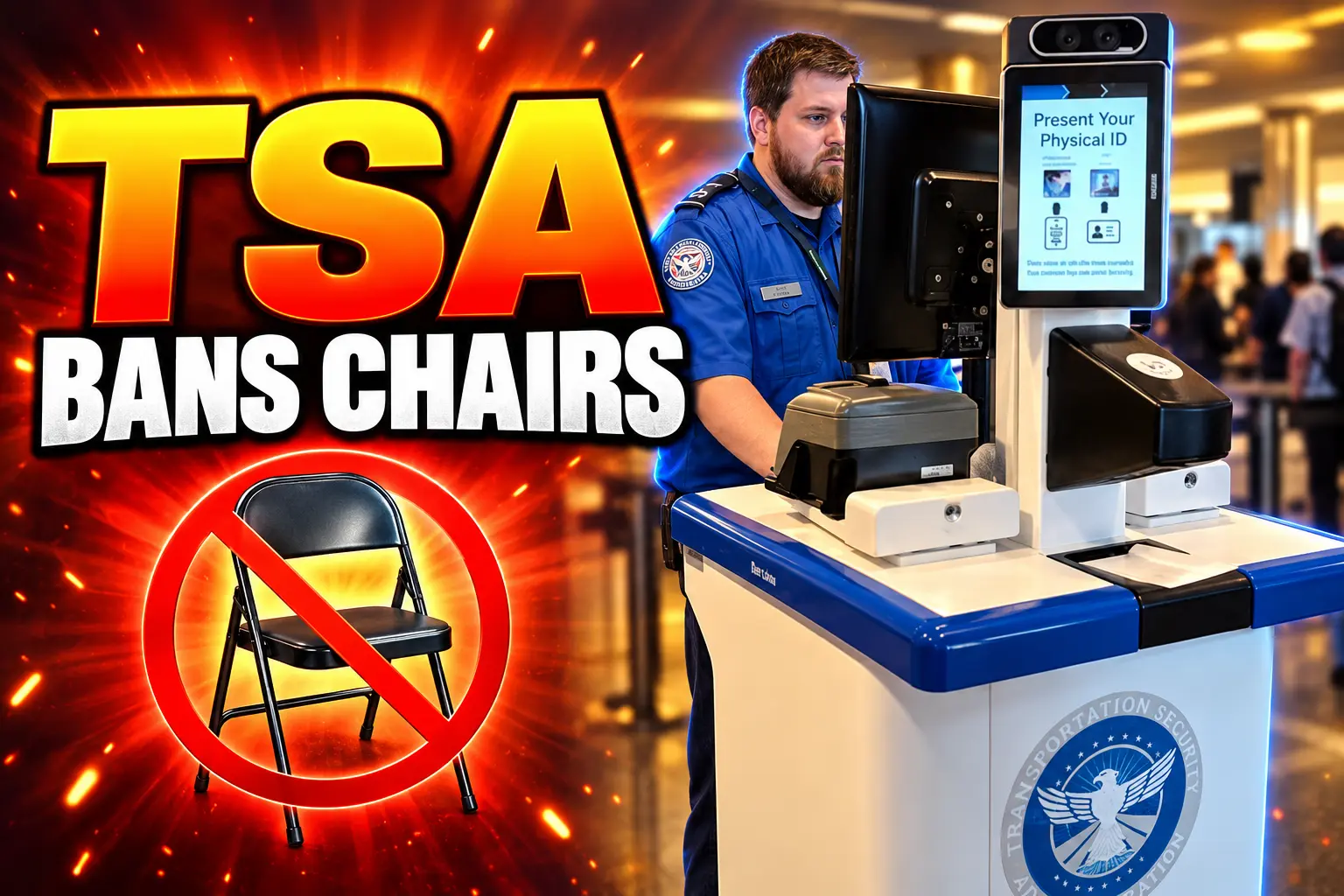
TSA is pulling chairs from ID-check podiums at U.S. airports, a nationwide order the agency confirmed on September 29.
Officers who verify boarding passes and identification must now stand. TSA says that keeps them alert and makes the first hello feel like hospitality. AFGE TSA Council 100, which speaks for about 45,000 screeners, says the chairs were safety gear for people who already walk hard floors all day.
TSA Is Taking the Chairs From ID Podiums
The change hits one station, the travel document checker podium at the front of the lane, where an officer matches a face to a credential and a boarding pass before a traveler enters screening. AFGE TSA Council 100 said every chair at those podiums is coming out, and that the removals had already started at most commercial airports before the agency spoke in public.
Union leaders said they were not given formal notice. Members flagged the order around September 25. Local chapters heard the same way, from the floor, not from a bargaining table.
TSA tied the furniture to the first impression a traveler gets, and to a fitness standard the agency already requires.
This welcome change reinforces both our security posture and our commitment to hospitality by having these officers on their feet and alert. All officers must meet fitness for duty requirements to be capable of performing their vital national security function while simultaneously creating a welcoming and professional environment for travelers.
Transportation Security Administration statement, September 29, 2026
The agency has not published data showing that a standing document check catches more threats than a seated one. The argument on paper is posture, presence, and a friendlier first contact.
WHAT CHANGES AT THE PODIUM
- ID check: Travel document checkers must stand, and chairs come off those podiums nationwide.
- Carry-on X-ray: Officers who run and watch bag scanners may still sit.
- Bins and bag search: Those posts were already on foot, directing trays and pat-downs on the hard floor.
- Notice: AFGE said it was not consulted before the chairs started disappearing.
Some officers say a few airports pulled the chairs months before the national order. The September instruction makes that local practice the rule at the front of the line.
The Short Sit Inside a Long Checkpoint Shift
Screeners do not spend a whole day in one chair. They rotate through the lane: document check, bin coaching, bag search, the exit, then back around. One officer account described the document-check assignment as typically lasting around 30 minutes, a brief sit before the next standing job.
That is the piece of the shift TSA just took. The rest of the work was already upright on concrete and tile, lifting bags, bending over belts, and walking the same few yards for hours. AFGE put that load in one sentence: the chairs were “basic ergonomic and safety support for officers that stand and walk on hard surfaces all day.”
A seated ID check also never ranked high on the list of things travelers complain about. People argue about laptops, shoes, liquids, and how long the queue is. They do not, as a rule, walk up to a podium, see an officer in a chair, and decide the checkpoint is unsafe. The hospitality pitch asks them to treat standing as a service upgrade. The more common worry on the other side of the lectern is simpler. A sore officer is a shorter-tempered officer, and the first person in the lane is the one who sets the tone.
The New Administrator Framed Standing as Hospitality
David Cummins, a former senior vice president at the U.K. contractor Serco, was confirmed as TSA administrator on August 7. The chair order landed 53 days later. In between, he rolled out Horizon 25, a reset timed to the agency’s 25th anniversary in November, and told staff the checkpoint could be secure, fast, and pleasant at the same time.
Cummins said in the Horizon 25 passenger experience plan that TSA does not have to choose between a secure checkpoint, an efficient checkpoint, and an elevated passenger experience. Standing document checkers sit inside that same language, even if the agency has not listed the chair ban as a Horizon 25 item. The words are hospitality, alertness, and professionalism. The tool is a missing stool.
He took the job after a long gap. President Donald Trump fired former administrator David Pekoske on the first day of the new term in 2025 and went 16 months before a replacement was confirmed. The workforce Cummins inherited had already worked through two unpaid funding fights, and he told senators during confirmation that morale was very, very low, with people of 20 years walking out.
HOW THE STANDING ORDER LANDED
- April 2026: The White House budget proposes cutting more than 9,400 TSA jobs and just over $1.5 billion, about 20 percent of the 60,000-employee agency’s operating budget, and pushing smaller airports toward private screening.
- August 7, 2026: The Senate confirms Cummins as administrator.
- August 24, 2026: Cummins launches Horizon 25, with checkpoint modernization and the traveler experience among the stated aims.
- September 25, 2026: Officers begin telling the union that chairs are coming out of document-check podiums.
- September 29, 2026: TSA confirms the standing rule and the furniture removal in a public statement.
The sequence is culture first, contract later. A new administrator who talks like a customer-service brief changed the one visible posture at the front of the lane before publishing a study, and before sitting down with the union that still claims the 2024 contract.
What Prolonged Standing Does on Hard Airport Floors
Federal occupational-health research does not treat standing as a free way to look more awake. A National Institute for Occupational Safety and Health review of prolonged standing at work and back pain found a consistent pattern: more low back pain, physical fatigue, muscle pain, leg swelling, tiredness, and discomfort when people stand for long stretches, especially in one place.
The same review found that the interventions employers actually use are floor mats, better shoes, compression stockings, and the option to sit or to alternate sitting and standing. Dynamic movement, not a locked upright pose, looked like the better protection. That maps poorly onto a document checker who must stay planted at a podium, watching faces and cards, for the length of a rotation.
WHAT THE STANDING RESEARCH FLAGS
- The body: Long standing is tied to low back pain, fatigue, muscle pain, and swollen legs, not to sharper attention.
- The floor: Risk rises when someone stands in one place, which is the posture of an ID podium.
- The usual fix: Mats, sit-stand setups, and movement. TSA’s 2024 contract already calls for anti-fatigue mats where officers stand in one place for extended periods, and for appropriate ergonomic gear.
A federal court in January ordered TSA to keep treating that 2024 agreement as binding while a larger labor fight continues. DHS had moved in late 2025 to strip transportation security officers of exclusive representation and to cancel the contract effective January 11, 2026, returning the agency to the no-bargaining model it used in its first decade. The court paused that reset. The chair order now tests how much of the old safety language still has force when the furniture itself is gone.
Shutdown Lines Already Showed What Fatigue Costs
Travelers do not need a new study to know what happens when screeners are worn down. They stood in those lines this year. During a Department of Homeland Security funding gap that ran from February 14 to April 30, 2026, officers kept working without regular pay. Wait times at Houston’s William P. Hobby Airport reached nearly three hours. The top executive overseeing Houston’s airports warned that lines of four hours or more could stretch further if the standoff held.
Then-acting administrator Ha Nguyen McNeill told lawmakers in March that travelers were seeing the highest wait times in the agency’s history, that some airports were logging callout rates above 40 percent, and that more than 480 officers had quit during that lapse. She also said assaults on officers had jumped more than 500 percent since the shutdown began. About 50,000 officers were working through that stretch without a normal paycheck.
That DHS-only fight followed a broader 42-day lapse in DHS funding that began October 1, 2025, and ended with a November 12 continuing resolution. Screeners were unpaid then too. Call-outs rose. Queues spilled back toward the ticket counters. The lesson for anyone who flies is not subtle. When the people at the podium are exhausted, the line gets longer, and the encounter at the front gets worse.
TWO FUNDING GAPS THAT HIT THE LINE
| Period | Who went unpaid | What travelers saw |
|---|---|---|
| October 1 to November 12, 2025 | TSA screeners in a 42-day government-wide lapse | Higher call-outs and long checkpoint queues |
| February 14 to April 30, 2026 | About 50,000 officers in a DHS-only funding gap | Hobby waits near 3 hours; Houston warned of 4 hours; more than 480 quits; some airports above 40% call-outs |
Standing up the ID checker does not add a body to those lanes. It does not restore the people who quit. It asks the officer who is already covering extra rotations to do the first job of the day without the one stool that used to break up the hard floor. If the hospitality bet is wrong, travelers will meet that error before they meet the scanner.
Private Screeners Already Cover 20 Airports
The chair fight is a small object in a larger argument about who staffs the lane. The April budget proposed requiring smaller airports to use private security, a shift the White House billed as trimming more than 4,500 jobs off the federal payroll. Roughly 20 airports already run that way, including San Francisco, Kansas City, and Sarasota, Florida, under a program that has existed since 2004.
TSA’s own factsheet on private screening under TSA oversight at 20 airports says wait times are similar at federalized and privatized checkpoints, that the vendor works for TSA rather than the airport, and that the federal security director stays in charge. Contract screeners still use TSA machines and TSA procedures. The difference passengers feel, when they feel one, is usually labor: private crews kept getting paid during the shutdowns that left federal officers working for IOUs.
Cummins told senators the Screening Partnership Program is pro-worker because those airports paid people during the lapses. He said current officers would get a right of first refusal if their airport switched. Union officials and Democratic senators called the same plan a step toward privatizing a job the government federalized after the September 11, 2001 attacks, when private screeners were the model that failed. Cummins scrapped a broader Gold+ contractor model in August and pointed airports toward an “evolved” version of the existing partnership program instead. Tampa International, which had looked at the newer model, stayed with federal officers after a months-long review.
A standing-only podium will apply wherever TSA still runs the lane. At the 20 partnership airports, the vendor’s own staffing rules decide who sits. The traveler walking up with a license will not be looking at the org chart. They will be looking at the person holding the card.
AFGE Was Told After the Furniture Moved
AFGE TSA Council 100 told members it is “moving aggressively to address this matter” and asked officers to call Congress. The union’s public line is that TSA treated a stool as a privilege. “TSA is treating this matter like it is a privilege,” the council said, and then described the chairs as basic safety and common decency for the workforce.
In a note to members, the council went further, calling the moment a chance to show why the union exists “against this regime that is literally attempting to take out our workforce through whichever means possible.” That is the labor war talking, not the furniture. The same fight already includes the attempt to cancel the 2024 contract, the unpaid shutdowns, the proposed cut of more than 9,400 jobs, and a new administrator hired out of the contractor world.
A smaller group of travelers wants the chairs gone for a different reason. They have watched officers at the podium look half-asleep and read sitting as slack. That complaint is real in the same way a four-hour Hobby line was real. It is also a staffing complaint. If an officer is nodding off at 5 a.m. after covering extra days, taking the chair does not add a second set of eyes. It adds sore feet to a shift that already had too few people in it.
Cummins still has to get a tired workforce through the next busy bank of holidays with a union that now has a simple picture to hand every member of Congress: the agency that talks about hospitality took the chairs first. The officers will be on their feet at the first podium. The wait for a truce, unlike the wait for a bin, is not posted on the monitor above the lane.

IHG’s $350 Card Keeps Platinum as Premier Drops to Gold

The UK Flood Warning Leaves Thailand Open to Travellers

TSA Pulls Checkpoint Chairs and Calls It Hospitality

The World Cup Ended and U.S. Arrivals Fell Harder

Royal Caribbean Buys Half of Sandals and the Storm Risk

Flight Cancellations Rise While the FAA Shrinks Staffing Targets

United Folds Newark’s Lima Nonstop Into Its Houston Hub

United Bets the A321XLR on 10 New International Cities

Hitachi’s Aurora Faults Drove the EMR Bank Holiday Strike

Airbnb’s 6% Direct Links Undercut the Host Website Pitch
-
 AIRLINES1 month ago
Flight Cancellations Rise While the FAA Shrinks Staffing Targets
-
 AIRLINES1 month ago
United Folds Newark’s Lima Nonstop Into Its Houston Hub
-
 AIRLINES1 month ago
United Bets the A321XLR on 10 New International Cities
-
 NEWS1 month ago
Hitachi’s Aurora Faults Drove the EMR Bank Holiday Strike
-
 HOTELS1 month ago
Airbnb’s 6% Direct Links Undercut the Host Website Pitch
-
 NEWS1 month ago
ATSB Opens Six Sydney Airport Ground Conflict Files
-
 NEWS1 month ago
The EU Pulled the 2026 ETIAS Date After Border Chaos
-

 NEWS1 month ago
Extra Months on Old UK Passports Still Block EU Entry