
HOTELS
Marriott Cuts the Auditors Who Police Its Franchise Hotels
Marriott is cutting corporate auditors and complaint teams while adding rooms and buying back stock, leaving franchise brand checks thinner.

Marriott International is cutting corporate jobs around the world and has refused to say how many people will lose their roles. The company confirmed the reductions on October 28, in “some corporate disciplines,” and said hotel staff are not part of the round.
Employees posting in a Marriott workers’ forum named regional human resources, an IT delivery desk, quality assurance inspectors who audit brand standards, and the office of consumer affairs that handles escalated guest complaints. Some said last days fall in mid-November. Five days later the company posted a quarter of higher fees, more rooms, and $1.3 billion in share buybacks.
The Cuts Stop at the Corporate Floor
A company spokesperson said the reductions grew out of the regular budget and planning cycle, that new jobs are being posted, and that many people whose roles disappear are expected to apply and stay. The company would not break out departments or a headcount. Maryland’s layoff log, checked through late October, showed no new Marriott filing for the 2026 round, which can happen when cuts are spread across sites or fall below the state’s notice threshold.
WHAT EMPLOYEES NAMED, WHAT MARRIOTT CONFIRMED
- Company line: Job reductions and role changes in some corporate disciplines, with new posts opening and hotel staff excluded.
- Headcount: Marriott has not published a number for this round.
- Functions named online: Regional HR, an IT delivery business desk, quality assurance inspectors, and the office of consumer affairs plus customer relations.
- Timing named online: A last day of November 13 for the U.S. consumer affairs and customer relations teams; a September forum post cited November 23 for a wider set of consumer-affairs, case-resolution, and social roles; some said regional teams would follow in early 2027.
Those functions sit above the hotels. Inspectors visit properties to check brand rules. Consumer affairs is the desk a guest reaches after a hotel has already said no. Regional HR and the IT desk sit in the same corporate layer. The people making beds and running breakfast are not on this list.
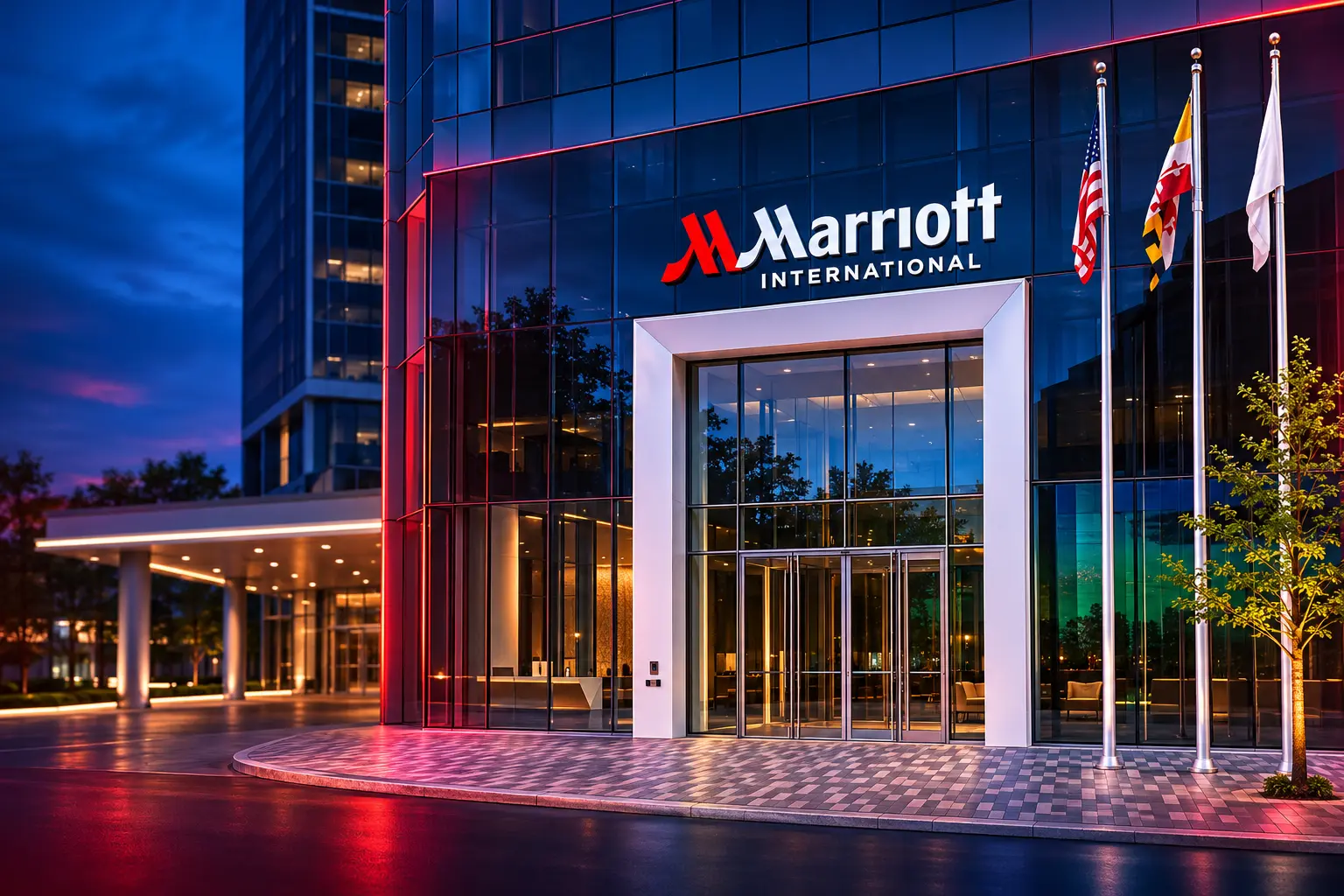
Most Marriott Hotels Are Not Run by Marriott
That split is the point of the model. At September 30 the system had 10,241 properties and 1,833,801 rooms. 8,092 of those hotels, with 1,241,202 rooms, sat in the franchised, licensed, and other column. Marriott managed 1,952 hotels and 562,461 rooms. Owned hotels, leases, residences, and a handful of other formats fill out the rest.
HOW THE SYSTEM WAS OWNED AT SEPTEMBER 30
| Category | Properties | Rooms |
|---|---|---|
| Franchised, licensed, and other | 8,092 | 1,241,202 |
| Managed | 1,952 | 562,461 |
Franchisees pay for the flag, the reservation pipe, and access to Marriott Bonvoy, which the company put at about 309 million members at quarter-end. They also fund centralized services. What they do not buy is a Marriott employee behind every front desk. Brand standards and the rare corporate override are how Bethesda keeps a Courtyard in one city from quietly becoming a different product from a Courtyard in the next.
Pull inspectors out of that circuit and the franchise contract does not change. The visit that tested the contract gets rarer. Pull the complaint desk and a guest who cannot get a promised upgrade still has a phone number, until that number routes back to the hotel that already refused.
Quality Inspectors Exit as the Pipeline Hits a Record
The same week employees were naming quality assurance, chief executive Anthony Capuano was telling investors the company had been making hotels cheaper and simpler to run. On the November 2 earnings call he listed lower loyalty charge-out rates, extra reimbursement for Bonvoy award nights on busy dates, flexible renovation scopes, streamlined brand standards, and an intent-to-recommend bonus in the U.S. and Canada.
WHAT CAPUANO SAID OWNERS ARE GETTING
- Loyalty fees: Lower charge-out rates on the Bonvoy program.
- Award nights: More reimbursement when members redeem on high-demand dates.
- Build-out: Flexible renovation scopes and streamlined brand standards.
- Guest scores: An intent-to-recommend incentive in the U.S. and Canada.
Streamlined standards and fewer auditors can travel together. Owners have asked for both. Guests meet the result as a shorter checklist and a thinner inspection calendar, at the same moment the system is adding hotels faster than Marriott can staff every corporate specialty.
Net rooms grew 4.6 percent from the end of the 2025 third quarter. The company added roughly 20,100 net rooms in the 2026 quarter, more than 13,400 of them outside the U.S. and Canada. The pipeline at September 30 was a record 4,209 properties and more than 634,000 rooms, with more than 278,000 rooms under construction or converting. Conversions supplied more than 40 percent of openings in the first nine months, a route that now includes a converted Guanacaste resort under the JW name.
Capuano also said more than 3,000 hotels had moved onto a new technology stack, with the rest of the waves running through 2027. The growth story is rooms, conversions, and software. The jobs coming out are the people who used to walk the rooms and take the calls those rooms generate.
What the Third Quarter Paid For
Worldwide revenue per available room rose 6.5 percent, with 7.4 percent growth in the U.S. and Canada and 4.4 percent abroad. Average rate was up 4.8 percent and occupancy was up 1.1 points. Revenue was $7.005 billion, against $6.489 billion a year earlier.
Gross fee revenue rose 14 percent to $1.52 billion. Franchise and base management fees were $1,341 million, up 13 percent. Incentive management fees were $181 million, up 22 percent. Chief financial officer Jen Mason said co-branded credit-card fees are on track to rise in the high 30 percent range for the full year. Reported net income was $794 million, up 9 percent from $728 million. Adjusted EBITDA was $1,512 million. Diluted earnings per share were $3.04, or $3.02 on an adjusted basis.
THE QUARTER BESIDE THE CUTS
| Figure | Q3 2026 | Q3 2025 |
|---|---|---|
| Worldwide RevPAR change | 6.5% | – |
| Gross fee revenue | $1.52 billion | $1.338 billion |
| Reported net income | $794 million | $728 million |
| General and administrative expense | $214 million | $210 million |
| Share repurchases | $1.3 billion | – |
General and administrative expense barely moved, because this round was confirmed after the quarter closed. The company guided full-year G&A to $880 million to $890 million. It repurchased 3.5 million shares for $1.3 billion in the quarter. Through October 28 it had bought 9.6 million shares for $3.4 billion and raised its full-year RevPAR outlook to 4.5 to 5 percent, and it now expects to return at least $4.8 billion to shareholders in 2026 after about $4.0 billion year-to-date.
The cuts are not a rescue. Fees are up, rooms are up, and the cash is going out as buybacks. What the budget cycle is doing is shrinking the corporate layer that stands between a franchised front desk and a Bonvoy member who wants that desk overruled.
A Third Round of the 2024 Efficiency Drive
Capuano has been on this path since late 2024. On the third-quarter 2024 call he said the company had started an enterprise-wide push to work better and cheaper, and that the work should yield $80 million to $90 million in annual G&A cuts beginning in 2025, plus savings for owners and franchisees. Then the state filings arrived.
THE BETHESDA AND SERVICE CUTS, IN ORDER
- September 3, 2020: Maryland records a mass layoff of 673 jobs at the old Fernwood Road headquarters, effective October 23, 2020.
- November 14, 2024: Maryland’s 2024 mass-layoff notice lists 833 jobs at 7750 Wisconsin Avenue in Bethesda, effective January 3, 2025.
- October 2025: Marriott confirms a smaller reduction in customer-engagement staffing and says artificial intelligence is not the driver.
- September 2026: The company confirms a review of its customer-engagement centers and says organizational changes are coming.
- October 28, 2026: Marriott confirms a new round of global corporate cuts and again withholds a headcount.
- November 2, 2026: Third-quarter results land, with higher fees, a larger system, and $1.3 billion in buybacks.
- November 13, 2026: Employees said this is the last day for the U.S. office of consumer affairs and customer relations.
The 2024 round was large enough to trip Maryland’s notice law. This round has not, at least on the log through late October. That does not make it small. It makes it dispersed, or just under the trigger, or both. Employees said global teams were going first and regional teams would follow in 2027, which is a design that can stay under any one state’s radar.
Where a Guest Complaint Goes Next
Frequent guests already treat the corporate complaint path as a loop, not a court of appeal. When a property refuses a late checkout or a status upgrade, the case often returns to the same general manager who refused it. The people who used to sit in the middle could listen, document, and sometimes nudge. They rarely had the power to force a franchisee’s hand. Removing them does not flip that power. It just takes the mailbox away.
We are not breaking out the number or specifics of impacted roles, but I can tell you that while some roles are being eliminated, many affected associates are expected to apply for and be selected for the new positions and will remain employed with the company.
Marriott spokesperson, company statement, October 2026
For anyone still holding Ambassador-level Bonvoy status, the pattern is familiar. During the 2020 crash the company cut Ambassador staffing, then told members to stop emailing assigned contacts because those inboxes would go dark, and dedicated Ambassadors did not return until 2023. Forum posts this fall again described Ambassador coverage shifting, including Anytime Ambassador work moving toward Cape Town. Marriott still advertises a personal Ambassador and an Anytime team for members who hit 100 qualifying nights and $23,000 of spend. The brochure has outlasted more than one staffing chart.
Hotel workers on property are supposed to be untouched. That is true as far as the company’s statement goes. The guest who needs a corporate adult in the room after the property has closed ranks is the one whose file now has fewer humans on it.
Bethesda Is Hiring Temporary Tech and Finance Roles
In the same stretch, Marriott’s careers site was advertising headquarters and remote jobs, including a large block under its contingent Flex program. Late October tallies around the confirmation put that Bethesda-or-remote board at 88 openings, many of them Flex. The temporary Flex talent listings include software and finance posts with end dates in 2027. One Flex software-engineer role, posted for Bethesda, is written around conversational AI and intelligent search, building agents and retrieval workflows for customer interactions, on an assignment running through September 11, 2027.
That is the replacement pattern in plain view. Permanent complaint and audit seats come out. Timed tech and finance seats go up, some of them aimed at the same guest questions a person in consumer affairs used to take. The spokesperson’s promise that many people will land new jobs can be true in headcount terms and still false in function. A Flex AI engineer is not a quality inspector. A procurement product manager is not a case-resolution specialist.
Capuano told investors travel demand stayed strong and that the company was raising its outlook again. He did not, in the published call, walk through the desks going dark in November. The budget did that talking. The rooms keep opening. The people who used to check those rooms, and the people who used to take the call when a room failed the guest, are the ones the plan no longer needs on staff.

Emirates Is Betting Hedges Will Outlast the Iran War

Booking.com Warns Costly Flights Are Slowing Holiday Demand

KLM Moves 5,000 Roles and Shrinks Its European Fleet

The FCDO’s 16-Country Alert Is Aimed at Hub Flyers

Dubai Hotels Wait as European Airlines Skip Winter

Flight Cancellations Rise While the FAA Shrinks Staffing Targets

United Folds Newark’s Lima Nonstop Into Its Houston Hub

Airbnb’s 6% Direct Links Undercut the Host Website Pitch

United Bets the A321XLR on 10 New International Cities

Hitachi’s Aurora Faults Drove the EMR Bank Holiday Strike
-
 AIRLINES3 months ago
Flight Cancellations Rise While the FAA Shrinks Staffing Targets
-
 AIRLINES3 months ago
United Folds Newark’s Lima Nonstop Into Its Houston Hub
-
 HOTELS3 months ago
Airbnb’s 6% Direct Links Undercut the Host Website Pitch
-
 AIRLINES3 months ago
United Bets the A321XLR on 10 New International Cities
-
 NEWS3 months ago
Hitachi’s Aurora Faults Drove the EMR Bank Holiday Strike
-

 HOTELS3 months ago
Grand Canyon Hotels Close After a Repeat Pipe Flood
-

 NEWS3 months ago
The EU Pulled the 2026 ETIAS Date After Border Chaos
-

 NEWS2 months ago
Brussels Closed the EES Pause as Kiosks Keep Failing