
AIRLINES
Emirates Is Betting Hedges Will Outlast the Iran War
Emirates stayed in profit only because AED 7.1 billion in fuel hedges paid out, while it kept taking A350s as Istanbul took the connecting traffic.

Emirates posted AED 3.3 billion ($903 million) in after-tax profit for the half to September 30, down 66%, only because fuel hedges paid AED 7.1 billion. At open-market jet prices after the U.S.-Iran war closed Gulf airspace, the airline would have lost money. Sheikh Ahmed bin Saeed Al Maktoum, chairman and chief executive, still refused to pause fleet spending.
Why Emirates Still Posted a Profit?
The hedge payout of AED 7.1 billion ($1.9 billion) was larger than Emirates airline’s entire pre-tax profit of AED 3.7 billion, which itself was down 68% from AED 11.4 billion a year earlier. Linus Bauer, founder of the Dubai consultancy BAA & Partners, said that without those contracts the half-year result would have been a loss. Passenger traffic fell 22% to 21.8 million, and the seat factor slipped to 72% from 79.5%.
The parent company, the Emirates Group, reported a profit before tax of AED 4.1 billion ($1.1 billion), also down 66%, on revenue of AED 66.2 billion, down 12%. After tax, the Group made AED 3.6 billion. Cash on September 30 was still AED 54.1 billion ($14.7 billion), down from AED 59.6 billion on March 31 after aircraft pre-delivery payments, debt service, and the remaining AED 2 billion dividend to its owner, the Investment Corporation of Dubai.
H1 AGAINST THE YEAR BEFORE
| Figure | This half | Year earlier | Change |
|---|---|---|---|
| Group profit before tax | AED 4.1 billion | down 66% | |
| Group revenue | AED 66.2 billion | AED 75.4 billion | down 12% |
| Emirates profit before tax | AED 3.7 billion | AED 11.4 billion | down 68% |
| Emirates revenue | AED 56.9 billion | AED 65.6 billion | down 13% |
| Passengers | 21.8 million | 27.8 million | down 22% |
| Seat factor | 72% | 79.5% | down 7.5 points |
| Cargo revenue | up 52% |
Empty cells are figures Emirates did not publish as a pair. The airline’s own account of the half is on its newsroom feed.
The Emirates Group has announced its results for the first six months of 2026-27. Emirates Airline reported a profit before tax of US$ 1.0 billion and revenue of US$ 15.5 billion. pic.twitter.com/OQJVmnNI3H
— Emirates (@emirates) November 5, 2026
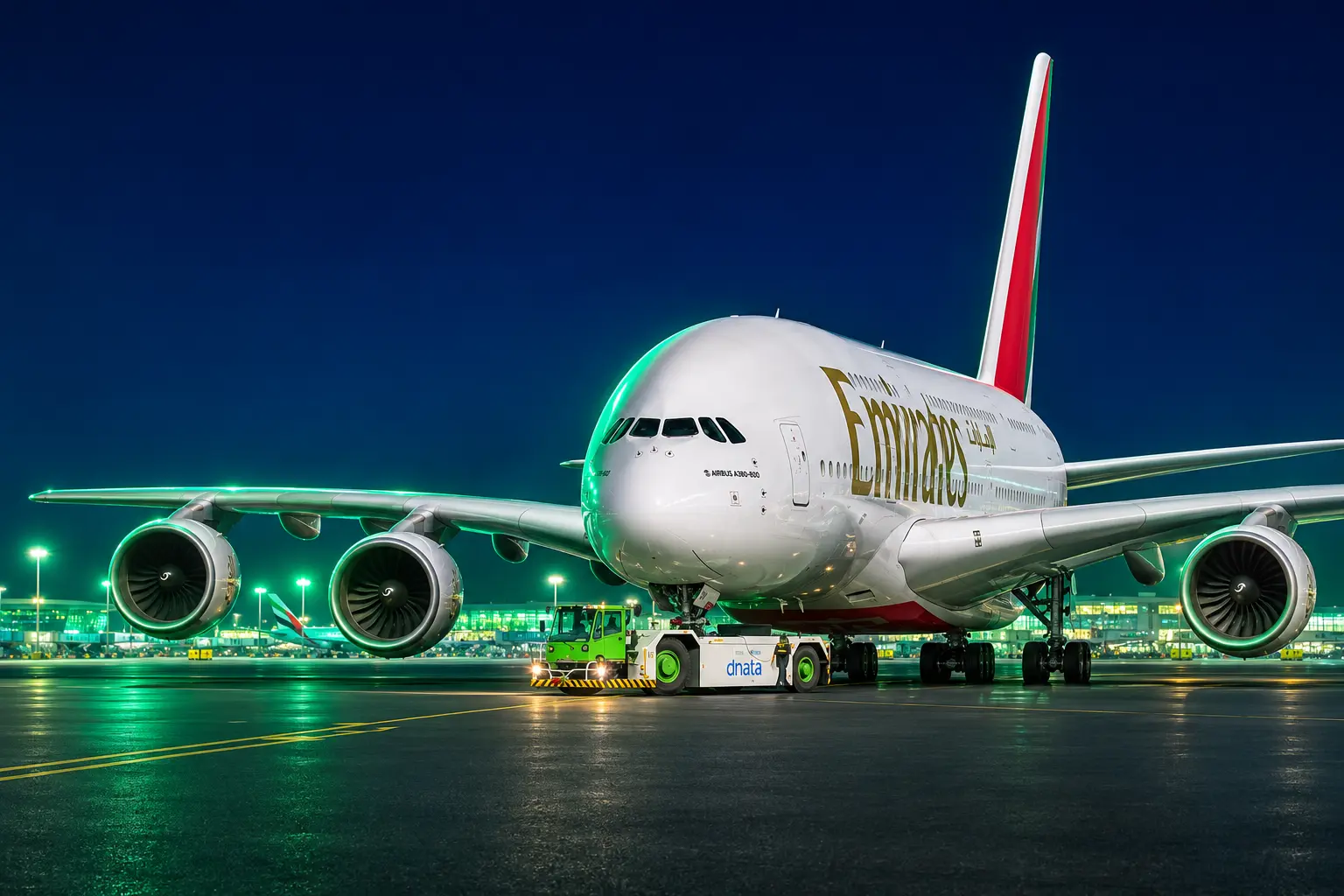
The Hedge Book Was Sized for a Bigger Airline
Emirates burned 12% less fuel than a year earlier because it flew less, yet the fuel bill before hedges still rose 60%. After the contracts paid out, the net increase was 13%. Fuel remained 34% of operating cost, the largest single item, even as total operating costs fell 2% with the smaller schedule.
A book written against a larger flying plan will pay out hard when prices jump and uplift shrinks. That is what happened. Sheikh Ahmed said global jet fuel prices doubled against the same months last year. IATA’s monitor recently put the global average jet fuel price at $178.95 a barrel, 6.6% lower than the week before but still far above last year’s level. The association has also said fuel now takes almost a third of airline costs worldwide, with carriers on course to spend $350 billion on jet fuel in 2026.
THE FUEL BILL INSIDE THE HALF
- Uplift: Fuel burned fell 12% on the smaller schedule.
- Gross cost: The bill before hedges rose 60%.
- After contracts: The net increase was 13%.
- Share of costs: Fuel was 34% of operating cost.
Emirates told analysts the $1.9 billion was cash from completed deals, not paper gains on contracts still running. A $1 move in the oil price, the airline has said, can shift its profit by about AED 327 million ($89 million). In May, after the record 2025-26 year, Sheikh Ahmed said the company was well hedged until 2028-29 and had locked volumes with suppliers. In November it refused to describe what cover is left for the winter.
The last full year shows why that silence matters. Emirates had raised protection to 69% of expected crude costs and 70% of refining costs, then recorded a loss of AED 146 million on those contracts. A separate AED 322 million gain appeared because grounded aircraft meant it used less fuel than the deals assumed. Hedging is not a one-way bet. John Grant, managing partner of Midas Aviation, put the cash requirement in plain terms.
Emirates are masters of hedging. It obviously allows airlines to plan with a little more confidence than would otherwise be the case in a very volatile world. But before being able to hedge you need the cash to be able to do it and Emirates certainly does.
John Grant, managing partner, Midas Aviation
Other carriers are already pushing the bill onto tickets. Delta absorbed $6 billion in fuel and held fares up, and Ryanair’s warning on summer oil fares treats passengers as the first shock absorber. Emirates has not said how much of its own fuel spike it recovered in the fare.
Istanbul Took the Connecting Passengers
The first six months of fiscal 2026-27, from April 1 to September 30, were the first full half sitting inside the war that began on February 28. Intermittent airspace closures and government travel advisories, Emirates said, reshaped where people were willing to change planes. Capacity in available seat kilometres fell 17%. Traffic in revenue passenger kilometres fell 25%. By September 30 the airline was back to 91% of its pre-disruption network, 150 airports in 78 countries, and the seats were still emptier.
The passengers who left Dubai did not stop flying. John Grant’s route work found Emirates lost about 271,000 connecting passengers between India and the United States, a 35% drop on that flow. Turkish Airlines added 16% capacity on East Asian routes and 6% on European routes, more than offsetting its own Middle East cuts. In July, Istanbul Airport handled more than 8 million travellers and overtook London Heathrow. Paul Chiambaretto of Montpellier Business School called Turkish Airlines “the big winner” and said Istanbul was becoming the global center of gravity for air transport.
Dubai International handled 31.5 million passengers in the first half of 2026, down 31.3%. Monthly traffic fell from 8.7 million in January to 3.5 million in April before recovering to 5 million by June. Paul Griffiths, chief executive of Dubai Airports, now expects the full year “in the 70 millions,” short of the old goal of 100 million. Singapore Airlines has pushed its Dubai return to February 28, 2027. Virgin Atlantic has Dubai closed until October 2027. Several European airlines, including the Lufthansa Group, have written Gulf returns into late winter and early spring.
WHO STEPPED AROUND DUBAI
- Istanbul: Turkish Airlines grew East Asia and Europe flying and took the connecting flow Emirates lost on India-United States.
- Singapore: Singapore Airlines has its Dubai service parked until February 28, 2027, so Europe-Asia traffic can skip the Gulf entirely.
- Europe’s majors: Virgin Atlantic is out of Dubai until October 2027, and Lufthansa Group suspensions run into March.
Chiambaretto’s line on the crisis is the one Emirates has to beat. He said a shock that first looked cyclical “is starting to become increasingly structural.” Griffiths asked his chairman whether the $35 billion expansion of Al Maktoum International, due to open in 2032, should change. “It was the shortest conversation,” he said, “and the answer was ‘absolutely not.’”
SkyCargo Raised Revenue 52% on Flat Tonnage
Emirates SkyCargo carried 1.2 million tonnes, down 1%, and raised revenue 52%. The war cut airfreight space and pushed shippers off the sea, so the same tonnes paid a lot more. The cargo division took five new Boeing 777 freighters and its first passenger-to-freighter conversion, added Almaty and Zhengzhou, and put dedicated freighter flights onto more than 15 existing passenger cities.
That mix is why revenue only fell 13% while passengers fell 22%. Sheikh Ahmed said demand held in premium cabins and cargo made a strong contribution. The Group’s catering and retail arms show the other side of a quieter Dubai. Emirates Flight Catering’s external revenue fell 51% to AED 273 million, with 4.5 million meals uplifted, down 41%. dnata’s pre-tax profit fell 51% to AED 410 million on revenue down 7% to AED 11.0 billion, with its overseas stations offsetting weaker UAE and UK volumes.
Premium seats and freight can pad a hub for a while. They do not replace 6 million missing passengers.
Nine A350s Arrived While Seats Sat Empty
Sheikh Ahmed’s own sentence is the wager. He thanked the UAE government for coordinating a safe restart and for easing travel advisories, then said the company had not paused its cheque book.
Throughout this time, we have not paused our investments. Emirates and dnata continue to commit significant resources to expand our fleet, enhance our products and services, and develop capabilities that will shape the future of our business. This is how we stay ahead and stay resilient to external challenges.
Sheikh Ahmed bin Saeed Al Maktoum, chairman and chief executive, Emirates Group half-year statement, November 5, 2026
The metal kept arriving in a half when the average Emirates seat was empty more often than at any recent peak.
WHAT STILL GOT FUNDED
- New widebodies: Nine Airbus A350s entered the fleet between April 1 and September 30, plus five Boeing 777 freighters.
- Cabin rebuild: Twelve aircraft, nine A380s and three Boeing 777s, received full cabin refits inside a programme budgeted at more than $7.0 billion.
- Starlink: High-speed Wi-Fi went onto 36 more aircraft, taking the equipped fleet to 57 by September 30.
- The hangar bet: In May the airline broke ground on a $5.1 billion engineering and MRO campus at Al Maktoum International, with completion expected in the mid-2030s.
- Brand contracts: Arsenal’s sponsorship was extended to 2033 and Real Madrid’s to 2031.
New Economy U-dream headrests and electrically controlled Premium Economy privacy dividers also went into service, and new-concept lounges opened in Munich, Frankfurt and Manchester. The Group’s headcount fell 2% to 128,237, with both Emirates and dnata still hiring for the recovery they have budgeted. That is a company spending as if the connecting traffic comes home.
How Much Hedge Cover Is Left for Winter?
Alok Anand, chief executive of Acumen Aviation, looked at the same 12% drop in fuel uplift against a 60% jump in the gross bill and asked the question Emirates would not answer: how much of that cover is still sitting on the second half. The May claim of cover through 2028-29 is the last public map. The November results give no fresh percentages, no remaining barrels, and no tenor.
Second-half flying will also meet a network that is still incomplete. Kuwait routes stayed down. Some Saudi flying has been chopped and restored in bursts after Houthi attacks. European carriers that used to feed Dubai are on calendars that run into 2027. Measured optimism, Sheikh Ahmed’s phrase for the winter, depends on fuel staying inside the hedge and on passengers deciding the Gulf is again a normal place to change planes.
FROM STRIKES TO THE RESULTS
- February 28, 2026: United States and Israeli strikes on Iran begin, and Gulf airspace starts to close in waves.
- May 2026: Sheikh Ahmed says Emirates is well hedged until 2028-29 and breaks ground on the $5.1 billion MRO plant.
- April 1 to September 30, 2026: The first full fiscal half inside the war; passengers fall to 21.8 million and the seat factor to 72%.
- September 30, 2026: 91% of the pre-disruption network is back; cash is AED 54.1 billion.
- November 5, 2026: Half-year results show AED 7.1 billion of hedge gains holding the airline above a loss.
- November 9, 2026: President Tim Clark, 76, says the war has delayed his retirement again.
The second half of fiscal 2026-27 runs to March 31. If the remaining contracts are thinner than May’s language implied, the passenger shortfall and the fuel price will show up in the same column.
Tim Clark Put Retirement on Hold
Clark had been ready to leave after the record year. Speaking on November 9 at the Süddeutsche Zeitung economic summit in Berlin, he said the war ended that plan, as Covid had ended the one before it in 2020. He has been at Emirates since 1985.
I thought now is the time and, bingo, the war started. So here we are again.
Tim Clark, president, Emirates, at the Süddeutsche Zeitung economic summit, Berlin, November 9, 2026
In October he told a Routes World audience there would be an end to the fighting, and that when it came the surge would follow, as it has before. People who sat out the war would travel again, he said, and Emirates would be there “come hell or high water.” That is the same bet as the A350 deliveries, the $7.0 billion cabin rebuild, and the $5.1 billion hangar in the desert. The hedge bought the time. The winter will show whether the time was spent on a detour or on a hub that has already moved north to Istanbul.

Emirates Is Betting Hedges Will Outlast the Iran War

Booking.com Warns Costly Flights Are Slowing Holiday Demand

KLM Moves 5,000 Roles and Shrinks Its European Fleet

The FCDO’s 16-Country Alert Is Aimed at Hub Flyers

Dubai Hotels Wait as European Airlines Skip Winter

Flight Cancellations Rise While the FAA Shrinks Staffing Targets

United Folds Newark’s Lima Nonstop Into Its Houston Hub

Airbnb’s 6% Direct Links Undercut the Host Website Pitch

United Bets the A321XLR on 10 New International Cities

Hitachi’s Aurora Faults Drove the EMR Bank Holiday Strike
-
 AIRLINES3 months ago
Flight Cancellations Rise While the FAA Shrinks Staffing Targets
-
 AIRLINES3 months ago
United Folds Newark’s Lima Nonstop Into Its Houston Hub
-
 HOTELS3 months ago
Airbnb’s 6% Direct Links Undercut the Host Website Pitch
-
 AIRLINES3 months ago
United Bets the A321XLR on 10 New International Cities
-
 NEWS3 months ago
Hitachi’s Aurora Faults Drove the EMR Bank Holiday Strike
-

 HOTELS3 months ago
Grand Canyon Hotels Close After a Repeat Pipe Flood
-
 NEWS3 months ago
The EU Pulled the 2026 ETIAS Date After Border Chaos
-

 NEWS2 months ago
Brussels Closed the EES Pause as Kiosks Keep Failing