
NEWS
Abta Wants the EES Off-Switch Kept Into 2027
Abta seeks a 2027 EES pause after a poll showed most UK users waited under an hour, while nine Schengen states already limit biometric checks.

Abta asked Brussels to keep Entry/Exit System pause powers into 2027, after its own poll found 87% of UK users waited under an hour. The UK travel body for agents and tour operators made the case at its Madeira convention on 13 October.
Nine Schengen states had already kept an unofficial brake on biometric checks past the 6 September legal deadline. Airport groups, in a separate 12 October warning, said peaks still hit five hours. The argument for another year is not that every British holidaymaker is stuck in a five-hour line. It is that the off-switch still has no home in law.
Half of EES Travellers Waited Under 30 Minutes
Abta’s survey of 2,082 UK adults this summer ran from 21 July to 6 August, in peak season, through The Nursery Research and Planning. Among people who had travelled to Europe, 46% said they had been through EES since the phased start in late 2025. Of those who had, half reported queues of less than 30 minutes.
Luke Petherbridge, Abta’s director of public affairs, told the Madeira hall that those who had used the system were not seeing large delays, then sent a warning the other way. “You cannot roll this out fully until it is stable and efficient, because we don’t want to see people being deterred,” he said.
6% of all respondents said EES had made them much less likely to travel to the EU. Eight in 10 respondents said the system had caused no knock-on issues for their plans. Holidaygoing itself held: 88% of UK adults took a holiday in the past 12 months, and 70% plan a trip abroad in the next 12. Abta’s Travel Confidence Index sits at +50, down from +53 a year earlier, after a dip to +26 in May when Middle East disruption, fuel talk and EES trouble landed together.
HOW THE WAIT LOOKS, DEPENDING ON WHO YOU ASK
| Measure | Abta UK holiday poll | ACI EUROPE and A4E |
|---|---|---|
| Who was counted | 2,082 UK adults, 21 July to 6 August 2026 | Airports and airlines across Schengen, 12 October 2026 statement |
| Typical wait | 50% of EES users under 30 minutes; 87% under an hour | Routinely over 2 hours |
| Worst case | Hours-long lines were the minority in the poll | Up to 5 hours at peak traffic in extreme cases |
| Knock-on | Eight in 10 respondents reported none | Missed flights, missed connections, congested terminals |
Those rows can both be true. Abta counted UK leisure travellers, many of them heading for Spain, which 36% had visited. The airport bodies are measuring the worst gates at the worst hours, for every non-EU nationality that hits them. A Schiphol arrival on 19 October described a 25-minute path from train to cleared passport control, with no EES queue. A Spain trip in August went the other way: about 90 minutes inbound and an hour out. The live question is which of those days a 2027 law is being written to prevent.
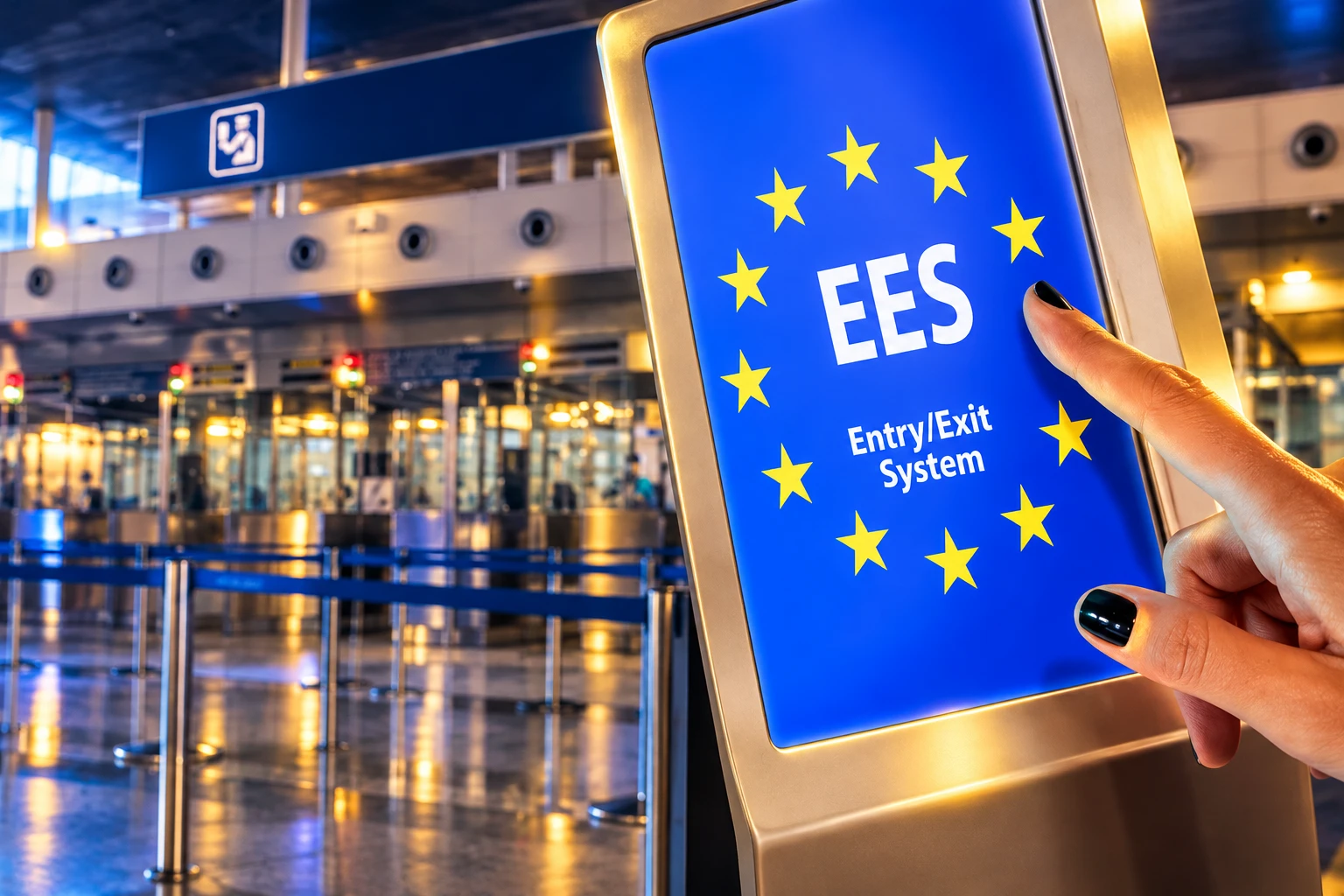
The Commission Calls EES Fully Operational
On paper the system is already finished. The Entry/Exit System is an automated register for non-EU nationals on short stays of 90 days in any 180-day period. It stores the name, travel document, fingerprints, a facial image, and the date and place of entry or exit. It also logs refusals. First enrolment is the slow pass. Later crossings are meant to be a check against the file.
The Commission says the system has been fully operational on 10 April 2026 at external border posts of 29 European countries, and that it replaced stamping, except in Cyprus and Ireland. eu-LISA, the agency that runs the central database, said the system was on more than 1,800 external Schengen crossing points by that date, with the core platform stable and staffed around the clock. Over 85% of carriers worldwide were onboarded, and 350 were sending data.
THE EES ROLLOUT CLOCK
- 12 October 2025: Progressive start begins under Regulation (EU) 2025/1534, with a 180-day path and stamps still used in parallel.
- 10 April 2026: Commission declares EES fully operational at external crossing points of the 29 countries.
- 6 September 2026: The legal power to suspend biometric registration at congested posts expires.
- 12 October 2026: ACI EUROPE and Airlines for Europe publish a six-point repair plan and ask for the suspend power back.
- 13 October 2026: Abta, at its Madeira convention, asks for contingency powers to be written on into 2027.
From October 2025 to the end of March 2026, eu-LISA counted 28,165 refused entries, including missing visas or permits, overstays and visits that did not match their stated purpose. Among those refusals the system raised 3,748 alerts in the Schengen Information System, and 737 people were denied entry on public security or public health grounds. Commission figures published at the end of March put registered crossings above 45 million. Security is the part of the brief Brussels will not reopen. Speed is the part the terminals say is still broken.
France, Germany and Seven Others Held the Pause
The summer safety valve was real. Member states could suspend EES, in full or in part, at named crossing points when queues built, for the shortest time needed. Partial suspension meant biometrics stopped. Full suspension meant nothing was written to the database. That legal valve closed on 6 September 2026. The Commission has said the rules themselves have not changed.
Practice did. At least nine countries told Brussels they would not run full biometric capture until the kit and the software worked, a list that matches the holiday map UK agents actually sell: France, Belgium, the Netherlands, Germany, Greece, Malta, Portugal, Italy and Switzerland. Portuguese airports including Lisbon, Faro and Porto used the summer flexibility. French interior officials kept extra room around kiosks and tablets toward year end. Checks can be stood down at a specific post, not across a whole country.
THE NINE STATES STILL LIMITING FULL CHECKS
- France: Airports and ferry posts, with interior officials keeping kiosk flexibility toward the end of 2026.
- Belgium and the Netherlands: High-volume hubs on the UK short-sea and air routes.
- Germany: Joined the informal pause after waits doubled at major airports.
- Greece, Italy, Malta and Portugal: Holiday gateways that used summer flexibility, including Lisbon, Faro and Porto.
- Switzerland: Schengen member, on the same nine-state list.
Gwendoline Cazenave, chief executive of Eurostar, put the working phrase after talks with French interior officials: “The phrase is ‘maintaining border fluidity’.” Petherbridge said in Madeira that the Commission had confirmed it would not open infringement cases against countries that stand down checks for the rest of 2026. Ryanair has asked for the legal waiver to run until at least April 2027, and has named Tenerife South, Palma, Alicante, Malaga, Milan Bergamo, Krakow and Paris Beauvais among the worst queues of the summer. Uku Särekanno, deputy executive director of Frontex, said earlier in 2026 that the border agency had no intention of easing EES rules further after the summer. The informal pause is how those two positions currently coexist.
Airports Clock Five-Hour Peaks at the Worst Gates
On 12 October, a year after the first kiosks went live and nearly six months after full rollout, ACI EUROPE and Airlines for Europe said waiting times remain unacceptably high, reaching up to five hours at peak traffic in the most extreme cases and still routinely exceeding two hours. They listed thin border staffing, unstable EES IT, limited self-service kiosks and automated gates, and a pre-registration app that few countries actually use. Brussels rejected a bid in July to restore a standing power to halt biometric registration when lines grow. Point six of the new plan asks for that power again, this time as a permanent tool.
The EES has strengthened the security of Europe’s external borders. But six months into its full rollout, the system is not delivering on efficient border crossings and the promise of faster, more seamless travel remains unmet. This is no longer a teething problem, nor can passengers, airports and airlines keep paying the price for avoidable disruption.
Olivier Jankovec, Director General, ACI EUROPE, and Ourania Georgoutsakou, Managing Director, A4E, joint statement, 12 October 2026
THE SIX FIXES AIRPORTS AND AIRLINES WANT
- Double verification: Stop making travellers prove the same identity twice in one crossing.
- Biometric pass: Shorten fingerprint and face capture at the desk.
- Duplicate files: Stop the system creating more than one EES record for the same person.
- The app and web portal: Rebuild Travel to Europe so more of the file is built before the traveller reaches the hall.
- Automated gates: Open and standardise automated border control for non-EU nationals.
- A permanent pause: Let posts drop biometric registration when waits become excessive.
Petherbridge’s own repair list is narrower and closer to the traveller: better triaging of people already on file, and an app that can do more of the check before arrival. “Until the system is operating effectively, Abta believes the ability to step down checks must be retained,” he said. “If legislation is needed, the Commission should act urgently to bring this forward to provide the certainty that industry and travellers require.” The airport plan wants the same brake, plus five changes to the plumbing. Neither list treats 10 April as the end of the job.
The Official App Works in Sweden and Portugal
The tool that was supposed to pull time out of the hall is still a two-country experiment. Travel to Europe, built by Frontex, lets non-EU travellers with a biometric passport pre-register passport data and a facial image and answer the entry questionnaire, within 72 hours of crossing. It does not replace the border check. Member states opt in, and they choose which functions to switch on.
Sweden uses the full set: passport data, face and questionnaire, including at Arlanda. Portugal uses the questionnaire only. Every other EES country may join later. The app needs NFC to read the passport chip, a front camera for a selfie, and, on Android, version 10 or later. Residence-permit holders and long-stay visa holders are outside EES and should not use it. Transit passengers who stay airside are not registered and should not pre-register either.
That is the gap Abta is pointing at. A first-time family of four can still lose minutes at a kiosk on questions the phone could have taken at the hotel. Return travellers can still be sent through the long path if the file does not come up, or if a duplicate record has been spun up on a previous trip. Petherbridge said border guards will often correct a bad record the next time a traveller appears, which is a fix that costs another queue. Until Sweden’s model is the default, the app cannot do the work the six-point plan assigns to it.
Which Countries Can Still Step Down EES Checks?
Abta is not asking Brussels to switch EES off. It is asking for the 2026 pragmatism, the quiet deal that let nine states keep border flow, to be written into 2027 so airports and agents can plan summer staffing against a rule rather than a rumour. The Commission can still say the system is live. Member states can still blink at the kiosk. Travellers find out which regime they are in when they reach the tape.
WHAT WE KNOW
- Legal valve: The written power to suspend EES at congested posts ended on 6 September 2026.
- Informal pause: France, Belgium, the Netherlands, Germany, Greece, Malta, Portugal, Italy and Switzerland have kept limits at some posts.
- Infringement: Petherbridge said the Commission will not bring cases against countries that stand down checks for the rest of 2026.
- Commission line: Officials say the EES rules have not changed and that they remain in contact with the few states still adjusting certain posts.
WHAT IS UNCONFIRMED
- A 2027 law: No new legal act has been published to extend contingency powers into next year.
- The airport list: There is still no public roster of which posts used the summer valve, or on which dates.
- A new deadline: The informal pause has no published end date.
For a UK traveller the practical split is blunt. Ireland is outside this system. Cyprus is outside it too. Spain, the top UK destination at 36%, is not on the nine-state pause list. France, Italy, Greece and Portugal are. A family flying to Faro and a couple on Eurostar to Paris can meet two different borders in the same week, both of them called EES.
ETIAS Stays Dark While the Border Database Wobbles
The next layer of the same architecture is still dark. ETIAS, the pre-travel authorisation for visa-free visitors including Britons, is not taking applications. Official pages no longer carry a launch window. The Commission has said it will set a date once the conditions are in place and will give several months’ notice. EU sequencing put ETIAS after EES, with a working assumption of at least six months of full EES before the authorisation went live. That would have pointed at late 2026. That date has been lifted.
Abta’s position is that ETIAS should not start until EES is working properly. Petherbridge also flagged more than 150 websites already offering to sell an authorisation that cannot be issued. Awareness of the coming border rules has risen from 41% in 2024 to 56% in the latest poll, which is still a lot of people who will meet the kiosk cold. The only official instruction that holds is to ignore anyone taking money for ETIAS now.
A 2027 EES contingency would not cancel fingerprinting. It would keep a lawful way to stop it when a hall seizes, and it would push ETIAS further from the calendar. The Commission can keep calling the database fully live. Abta’s 87% can keep clearing in under an hour. The five-hour peaks can keep happening at the worst gates. Until one of those facts is written into a new regulation, UK travellers are booking 2027 holidays into a border that is live, paused, or both, depending on the airport they cannot choose at the kiosk.

Ibiza Airport Flooded as Storm Adam Broke a 2005 Record

The Louvre Is Closed as France Runs Neighbourhood Curfews

UK Tells Travellers to Leave Saudi Arabia by Land

Southwest’s Record Fares Lose Ground to $4.55 Fuel

Leeds Bradford Airport Pauses Half-Term Strikes After Rejections

Flight Cancellations Rise While the FAA Shrinks Staffing Targets

United Folds Newark’s Lima Nonstop Into Its Houston Hub

Airbnb’s 6% Direct Links Undercut the Host Website Pitch

Hitachi’s Aurora Faults Drove the EMR Bank Holiday Strike

United Bets the A321XLR on 10 New International Cities
-
 AIRLINES2 months ago
Flight Cancellations Rise While the FAA Shrinks Staffing Targets
-
 AIRLINES2 months ago
United Folds Newark’s Lima Nonstop Into Its Houston Hub
-
 HOTELS2 months ago
Airbnb’s 6% Direct Links Undercut the Host Website Pitch
-
 NEWS2 months ago
Hitachi’s Aurora Faults Drove the EMR Bank Holiday Strike
-
 AIRLINES2 months ago
United Bets the A321XLR on 10 New International Cities
-

 HOTELS2 months ago
Grand Canyon Hotels Close After a Repeat Pipe Flood
-
 NEWS2 months ago
The EU Pulled the 2026 ETIAS Date After Border Chaos
-
 NEWS2 months ago
ATSB Opens Six Sydney Airport Ground Conflict Files