
AIRLINES
Lufthansa Buys TAP’s Brazil Gateway for €1.2 Billion
Portugal picked Lufthansa for TAP, selling Lisbon’s Brazil franchise in a €1.201 billion first slice while the state keeps control until 2028.

Portugal chose Lufthansa Group on 14 October 2026 to buy 44.9% of TAP Air Portugal, in a €1.201 billion first-phase package ($1.3 billion) if staff pass on their 5% slice. Prime Minister Luís Montenegro said the German cash bid beat Air France-KLM by 16% and carried less uncertainty. The state keeps 50.1%. European Commission clearance is still ahead, and Lufthansa itself does not expect the purchase to close before the first half of 2028.
TAP is already Star Alliance family, already the western-most big-network hub in the EU, and already the airline of record between Europe and Brazil. That is what changed hands. Porto, Faro, the Azores and Madeira are written into the industrial plan as the price of political consent, and TAP’s miles sit one regulatory nod away from Lufthansa’s transatlantic joint venture with United and Air Canada.
Lufthansa Pays €1.025 Billion for 44.9% of TAP
The Council of Ministers picked Deutsche Lufthansa after Air France-KLM and the German group filed improved final bids in late September. International Airlines Group, parent of British Airways and Iberia, had been invited into the process and did not put in a last-round offer. Parpública, the state holding company, will now finish the sale papers with Lufthansa.
Lufthansa’s headline price is €1.025 billion for 44.9%, on a locked-box drawn from TAP’s 2025 accounts, plus a 1.5% yearly ticking fee until close. Unbought staff shares go to Lufthansa at the same price per share, which is how the ticket can rise toward €1.201 billion and 49.9%. The government will still own 50.1% after that first slice.
HOW THE TWO BIDS COMPARED
| Item | Lufthansa Group | Air France-KLM |
|---|---|---|
| First-phase cash for 44.9% | €1.025 billion, all cash | Lower cash bid, 16% below Lufthansa’s package |
| Up to 49.9% including staff shares | €1.201 billion | A first-phase total the government called less certain |
| Strings attached | 1.5% yearly ticking fee until close | Part of the money hung on TAP hitting 2028 profit and debt tests |
| Offer for the remaining 50.1% | €1.351 billion more (€863 million cash plus €488 million in Lufthansa shares, about 5% of the combined group) | A firm majority bid was filed; Lisbon still ranked it below Lufthansa’s |
If that second sale happens, Lisbon values TAP at €2.552 billion in total and says the state would become the second-largest holder in the combined Lufthansa-TAP entity. Independent appraisals since 2023 had sat between €700 million and €1.7 billion. The government also pitched the first-phase multiple at 6.4 times 2025 EBITDA, about 80% above the 3.6 times multiple on Apollo’s easyJet deal, a comparison it used to argue the price was not a giveaway.
Finance Minister Joaquim Miranda Sarmento said the file lets the state recover far more than earlier public forecasts implied. The same briefing restated that Portuguese taxpayers put €3.2 billion into TAP over the past decade. Recovery, in the government’s own arithmetic, still depends on phase two, future dividends, and the value of any Lufthansa shares Lisbon might hold.
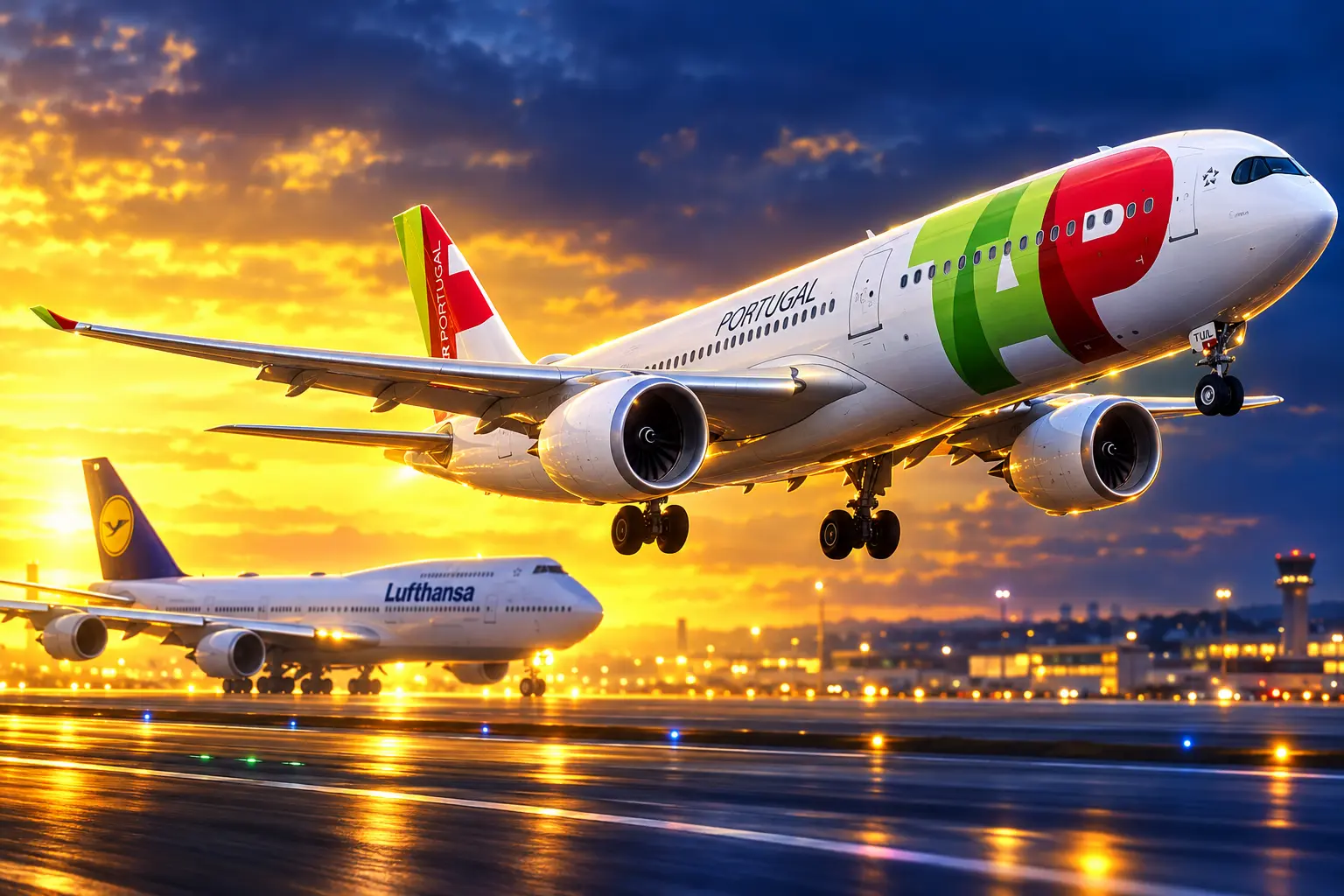
What the TAP Sale Means for Brazil Flights
Lufthansa is buying a South Atlantic factory. In a 15 October investor deck it put TAP at 26% of Europe-to-Brazil traffic and about 46% of seats at capacity-tight Lisbon. TAP’s own 2025 results, published in April, said two new Brazilian cities would take the map to 15 destinations, of which 10 are exclusive. Curitiba opened on 2 July 2026. São Luís do Maranhão is due to start on 26 October 2026, two flights a week on an Airbus A321LR, looping via Fortaleza.
That is the product Air France-KLM was bidding to house next to Paris and Amsterdam, and next to its North Atlantic partners Delta and Virgin Atlantic. Lisbon sits further west, which cuts block time toward Brazil, Portuguese-speaking Africa and parts of the United States. TAP has flown the Brazil market for 60 years in 2026 and still sells itself as the leading Europe-Brazil airline. Porto already feeds São Paulo and Rio as well.
Carsten Spohr, Lufthansa’s chief executive, treated that geography as the industrial point, not a side benefit.
TAP Air Portugal is a strong and profitable airline, our long-standing partner in Star Alliance and internationally successful as a leading carrier on South Atlantic routes. With today’s decision, the Portuguese government has paved the way for TAP Air Portugal to continue this success story together with Lufthansa Group. At the same time, this allows us to consistently pursue our internationalization strategy and sustainably strengthen our position in the South Atlantic market.
Carsten Spohr, CEO, Deutsche Lufthansa AG, 14 October 2026 statement
The same deck says TAP is meant to join the A++ transatlantic joint venture with United and Air Canada, so schedules, fares and mileage on Europe-North America flying can be coordinated inside Star Alliance rather than sold as a stand-alone Portuguese product. TAP CEO Luís Rodrigues, speaking in Lisbon before the cabinet vote, said a bigger group would let the airline “access a larger pool of resources at better value,” and he named loyalty and customer-experience programmes as the synergies he wants. He was already looking at ITA Airways. At the ALTA Forum on 19 October he said TAP would learn from ITA’s integration into Lufthansa, and that the two carriers sit closer together culturally than TAP does to the German parent.
Porto, the Islands and a Larger TAP Fleet
Lisbon did not sell the airline on price alone. Infrastructure Minister Miguel Pinto Luz said the industrial plan had to grow flying across Portugal’s airports, not only at the capital. Lufthansa’s bid writes that down as metal, bases and a new airport still on the drawing board.
TAP FLEET LUFTHANSA HAS PROMISED
- Now: 99 aircraft in TAP’s 2025 accounts and Lufthansa’s deck, 22 widebodies, 58 narrowbodies and 19 regional jets, average age under 10 years and more than 70% next-generation Airbus NEO family.
- By 2035: 117 aircraft, 18 more than today’s 99, inside a fleet spend the government put at €3 billion to €4 billion.
- After Luís de Camões Airport: 130 aircraft, 31 more than today, timed to the new Lisbon airport the government expects after 2035.
- Widebody feed: up to eight Airbus A350-900s transferred from Lufthansa to TAP after 2030.
- Porto: eight aircraft based at Francisco Sá Carneiro Airport, plus a long-haul secondary role Lufthansa called complementary to Lisbon.
The islands are a political lock, not a growth slogan. The government says links to the Azores and Madeira, the TAP brand, the Portuguese headquarters and a stronger Lisbon hub stay protected while the state holds its majority. Faro sits in the same connectivity brief. TAP has already been pushing flying out of the north: Porto-Boston is going year-round, and 2026 added Porto-Terceira, Porto-Praia and Porto-Tel Aviv on top of the Brazil feed.
For anyone booking this winter, the network is still moving under the Portuguese flag. TAP has published a new direct Lisbon to Orlando route from 29 October 2026, three times a week, and it has put winter 2026-27 at 1,125 weekly flights against 1,081 a year earlier, with South America rising from 93 to 99 weekly frequencies. Those are TAP’s own tables, not Lufthansa’s. Nothing in the sale papers changes a booking made this month.
TAP IN 2025, THE YEAR LISBON PUT ON THE BLOCK
- Passengers: 16.7 million, up 3.4%.
- Revenue: €4.313 billion, up 1.2%, with maintenance up 10.7%.
- Recurring EBITDA: €742.9 million, a 17.2% margin; recurring EBIT €243.4 million, a 5.6% margin.
- Net result: €4.1 million, the fourth straight profit year, or €46 million without a €42 million deferred-tax charge after parliament cut the corporate rate.
Liquidity at 31 December 2025 was €765.3 million. Net debt to EBITDA sat at 2.6 times. Unit passenger revenue slipped 2.3% as North America, Brazil and Europe all got more competitive. That is the airline Lufthansa called immediately value-accretive: thin at the bottom line, fat on cash generation, and scarce as a remaining European network carrier of this size.
Air France-KLM Wanted Lisbon as Its Southern Hub
Air France-KLM said it was disappointed and thanked Lisbon for a constructive process. The Franco-Dutch group had treated TAP as the last large long-haul flag still outside Europe’s three camps. In June, chief executive Ben Smith put TAP beside Finnair on that short list, after ITA went to Lufthansa and SAS moved toward Air France-KLM.
People close to the Portuguese evaluation said Paris and Amsterdam sit too near Lisbon for comfort, while Frankfurt is far enough that TAP’s Iberian connecting machine looked less likely to be hollowed out. Lufthansa also paid in cash up front. Part of the Air France-KLM money depended on TAP clearing 2028 EBITDA and net-debt tests, and Montenegro used that gap when he called the German file the lower-uncertainty bid.
The loss is geographic. Air France-KLM already has a South America franchise through Paris and Amsterdam. What it did not get is the Portuguese-speaking door, the diaspora flows, and a Star Alliance rival’s claim on Brazil from the western edge of Europe. Lufthansa Group airlines already run 353 weekly flights to six Portuguese airports, 75% more capacity than in 2019, and more than 500 people on the ground. A Lufthansa Technik plant at Santa Maria da Feira, with groundbreaking in June, is supposed to take that payroll above 1,000 direct jobs by 2030 on about €300 million of investment and 700 of those roles. Tancos is in the papers too, as a civil and military pilot school.
On combined 2025 figures the government put in its briefing, TAP plus Lufthansa would be Europe’s largest group by revenue and by aircraft, and the second-largest in Europe by passengers. Latin America would account for 20% of the combined group’s passengers. That is the scoreboard Air France-KLM is now watching from outside.
Who Runs TAP Until 2028?
The share register and the cockpit of the company are not the same thing. Lisbon keeps 50.1% and names five of nine board members, including the chair. Lufthansa names three executives and gets a leading role in day-to-day running, including the right to appoint the CEO; the state names one executive. Joint control is supposed to run through qualified majorities, which is another way of saying neither side can treat TAP as a branch office while the first-phase papers hold.
Up to 5% is reserved for TAP’s more than 9,000 employees at the same price Lufthansa is paying. Shares they do not take revert to the German group. That is the only immediate ownership question that does not sit in Brussels. A related-party committee is supposed to watch deals between TAP and the rest of the Lufthansa family, which is where fleet transfers, maintenance work and loyalty hook-ups will otherwise leak value in one direction.
The dividend design is the piece Portuguese critics have already isolated. Lufthansa’s deck includes a dividend step-up in the minority period, up to 75%. Hold 50.1% of the equity and you can still watch most of the cash leave as a contracted return to the minority industrial partner. That is why the €3.2 billion of public money and the €2.552 billion full-sale valuation are being read against each other in Lisbon even before a single share has transferred.
TAP’S ROAD BACK TO PRIVATE CAPITAL
- 1998: First modern attempt to sell a stake fails; the airline stays in the state’s orbit.
- 2015: A second sale attempt fails, and TAP is pulled back under Portuguese public ownership.
- 2020 to 2021: The pandemic grounds the fleet and the state takes the company back in full, then funds a European Commission restructuring.
- 2025: TAP finishes the operational and financial terms of that EU restructuring; Brussels accepts the airline is viable again. Net profit is €4.1 million on €4.313 billion of revenue.
- 14 August 2025: Decree-Law 92/2025 opens the first reprivatization phase, a direct sale of up to 49.9%.
- 29 July 2026: Lufthansa files its bid with Parpública. Air France-KLM is the other live finalist.
- 14 October 2026: The Council of Ministers selects Lufthansa. Signing is described as imminent; closing is not.
- First half of 2028: Lufthansa’s own timetable for close, matching the government’s 18 to 24 month Brussels clock, with a second-phase majority sale designed to finish around the same window.
Rodrigues has said joining a larger group does not rewrite TAP’s route strategy. It changes who pays for the next 18 aircraft, who buys the engines, and whose frequent-flyer currency sits on the boarding pass. Those are the traveler facts inside the shareholder diagram.
Brussels Has 18 to 24 Months With This File
No shares move until the European Commission is notified and finishes a merger review. A Commission spokesman said the deal had not been formally presented and that notification is the companies’ job when a transaction has an EU dimension. Portugal’s working estimate is 18 to 24 months. Lufthansa’s working estimate is close in the first half of 2028, funded from cash on hand, equity-accounted as a minority, and earnings-per-share accretive in the first full year after closing. It puts run-rate net synergies at up to €450 million across network, loyalty, procurement, maintenance and cargo, with more if it later owns 50.1%.
Aviation analyst John Strickland called Lisbon “an additional hub, albeit in a sphere of influence where they’ve lacked reach currently.” He has also said the German airline inside the group is still losing money and still has to put its own house in order, with an operating-margin aim of 8% to 10% between 2028 and 2030. ITA, bought into in 2025 with the majority option exercised on 12 May 2026, is the live rehearsal. TAP’s boss has already said he is watching that rehearsal on purpose.
German travelers have started asking the obvious network question: if Lisbon becomes the group’s South Atlantic machine, do some Frankfurt and Munich Brazil flights thin out? Nothing in the signed-but-not-closed papers answers that. Slot remedies in Lisbon, Porto or São Paulo are equally unwritten, because the Commission file is not open yet. Fares on Lisbon-São Paulo or Porto-Boston will not move on a press release.
WHAT WE KNOW
- Preferred bidder: Lufthansa Group, selected on 14 October 2026, €1.025 billion for 44.9% and up to €1.201 billion for 49.9%.
- Locks Lisbon wrote down: TAP brand, Portuguese headquarters, Lisbon hub, Azores and Madeira links, eight aircraft at Porto, fleet to 117 then 130.
- Clock: papers being finished with Parpública; close aimed at the first half of 2028 after EU review.
WHAT IS UNCONFIRMED
- Remedies: whether Brussels will demand slot or route give-ups on Brazil, Africa or US flying.
- Staff shares: how much of the 5% TAP employees actually buy.
- Phase two: whether the €1.351 billion majority sale, and the 5% Lufthansa share swap, ever launch.
- The joint venture: when, or whether, TAP is folded into A++ with United and Air Canada.
São Luís still starts on 26 October 2026 as a TAP flight under a Portuguese-majority owner. Orlando follows three days later. The German bid sits in a contract tray, then in a Brussels inbox, which is the actual timetable for anyone trying to read this sale onto a ticket.

Ibiza Airport Flooded as Storm Adam Broke a 2005 Record

The Louvre Is Closed as France Runs Neighbourhood Curfews

UK Tells Travellers to Leave Saudi Arabia by Land

Southwest’s Record Fares Lose Ground to $4.55 Fuel

Leeds Bradford Airport Pauses Half-Term Strikes After Rejections

Flight Cancellations Rise While the FAA Shrinks Staffing Targets

United Folds Newark’s Lima Nonstop Into Its Houston Hub

Airbnb’s 6% Direct Links Undercut the Host Website Pitch

Hitachi’s Aurora Faults Drove the EMR Bank Holiday Strike

United Bets the A321XLR on 10 New International Cities
-
 AIRLINES2 months ago
Flight Cancellations Rise While the FAA Shrinks Staffing Targets
-
 AIRLINES2 months ago
United Folds Newark’s Lima Nonstop Into Its Houston Hub
-
 HOTELS2 months ago
Airbnb’s 6% Direct Links Undercut the Host Website Pitch
-
 NEWS2 months ago
Hitachi’s Aurora Faults Drove the EMR Bank Holiday Strike
-
 AIRLINES2 months ago
United Bets the A321XLR on 10 New International Cities
-

 HOTELS2 months ago
Grand Canyon Hotels Close After a Repeat Pipe Flood
-
 NEWS2 months ago
The EU Pulled the 2026 ETIAS Date After Border Chaos
-
 NEWS2 months ago
ATSB Opens Six Sydney Airport Ground Conflict Files