
HOTELS
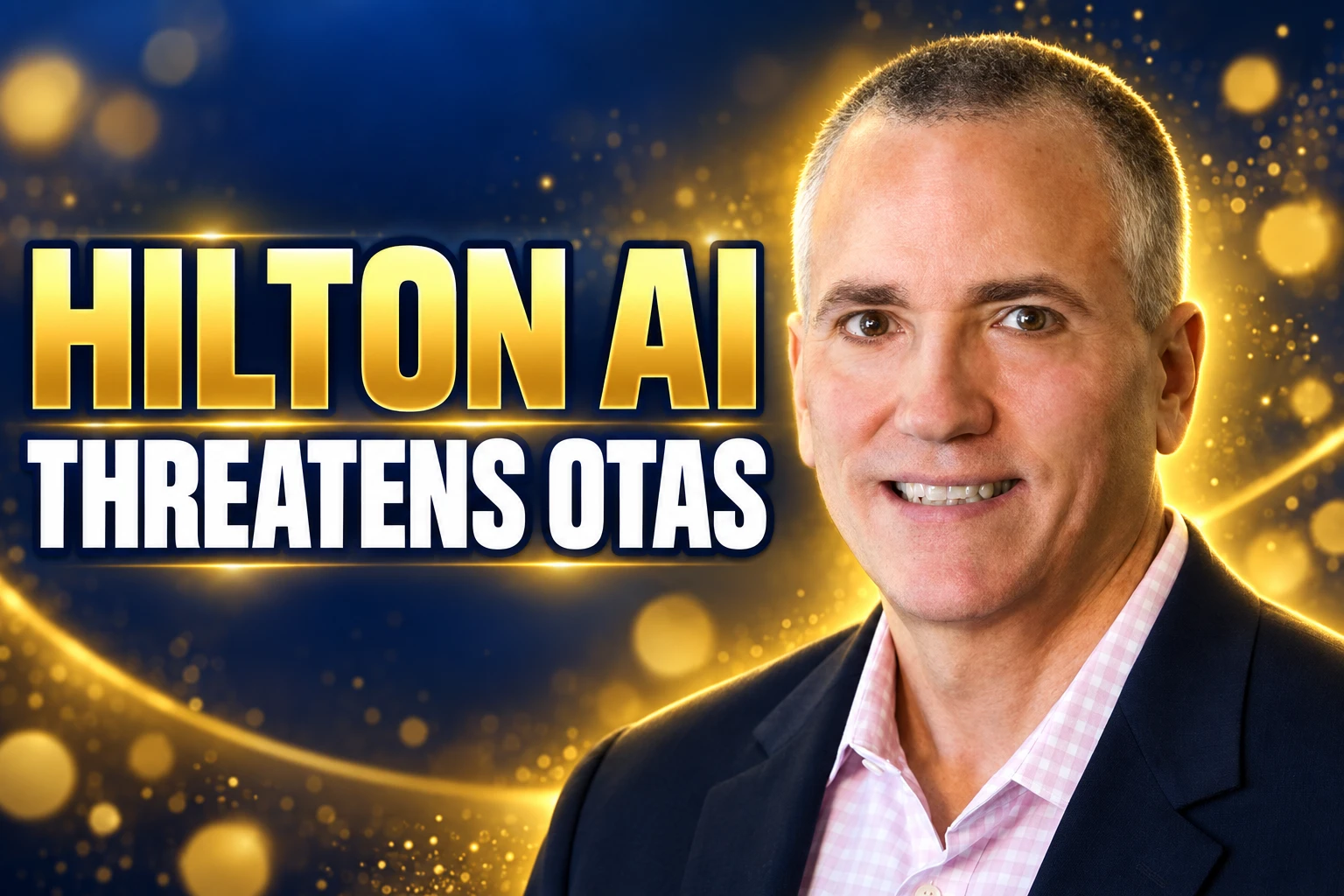
Hilton’s AI Push Trades OTA Fees for Agent Tolls
Hilton’s CIO says chatbots threaten OTAs, then concedes agents will take a cut and still fail to read Hilton rates.

Hilton’s technology chief said on Sept. 29 that large language models have put online travel agencies under real threat. Michael Leidinger told a Washington hotel-tech audience that chatbots now assemble the same fragmented hotel market the OTAs used to own.
He still expects the new agents to take a commission. Three days later, Meta’s Muse could not pull a Hilton room rate in analyst tests, a miss that sends the shopper back to Booking.com.
Hilton’s CIO Says Chatbots Now Do the OTA Job
Leidinger, Hilton’s senior vice president and chief information officer, sat with Greg Land, AWS’s global industry leader for hospitality, during a Destination AI session in Washington at the National Housing Center. The slot ran from 2:05 p.m. to 2:30 p.m. on the first afternoon of the Sept. 29-30 meeting.
It really, for the first time, puts the OTAs under real threat, because in many ways they were providing those aggregated views in this highly fragmented environment and now, the LLMs have kind of, they’re providing that.
Michael Leidinger, Hilton SVP and CIO, Destination AI, Washington, D.C.
Hilton’s view, he said, is that LLMs and agentic AI give the company “much more of an opportunity for us to drive greater direct bookings.” Years of ads aimed at pulling shoppers onto Hilton.com never quite broke that habit. A chatbot that can take a pile of constraints and spit out a workable trip, he argued, finally can.
Land put a number on how far that habit has already moved. More than half of U.S. leisure travelers are already using AI channels to plan trips, he said, and many of those prompts are turning into action. He cited research showing an 88% lift in customer satisfaction among travelers who plan on AI channels, and a 45% lower bounce rate. “That’s not good news for us,” he said of hotel websites and apps. “We’re not doing a good job putting all this information out there.”
The same panel kept circling a harder point. If the chatbot is now the storefront, hotels have to feed it. “Content is a space that hoteliers and hotel companies should own,” Leidinger said. “By having that content out there, you’re feeding the LLMs, the crawlers. You are helping to influence those recommendations.”
The Planner That Starts With a Bike Ride
Hilton is not only feeding other people’s models. It launched a generative AI planner on Hilton.com on March 10, and opened the tool to every visitor on March 17. Leidinger, an avid cyclist, tested it by asking for a hard ride in Oregon’s Cascades, with climbs and views. The planner proposed routes and nearby Hilton hotels. “That’s what helps drive that higher conversion,” he said.
The company now counts 28 brands, more than 9,400 properties, and nearly 1.4 million rooms in 144 countries and territories. The planner is built to start from an idea rather than a city-and-date box, then walk a guest toward a stay inside that system. Hilton has also begun rolling the same conversational search into the Hilton Honors app, and it is putting Honors points in Google AI Mode, so a guest can ask for San Diego or Miami dates that can be paid in points.
That is the direct-booking story Hilton wants. It is also a closed garden. The planner can recommend a Hilton next to a mountain road. It cannot, by design, put a Marriott across the street on the same list. The OTA’s old trick was showing both. The LLM’s new trick is showing both too, which is why Leidinger called the agencies threatened, and why Hilton is racing to stuff its own descriptions and photos into the models that write the answer.
On property, the company already lets bots take a large share of guest chat. Leidinger said those systems now handle 40% to 45% of incoming messages, so staff can take the problems that still need a person. “It’s how you’re implementing technology to further augment and enhance the human hospitality that we all provide,” he said.
Personal Agents Will Still Take a Cut
The catch Hilton is willing to say out loud is that the new path is not free. Leidinger expects personal agents, including Instinct and Meta’s Muse, to become commissionable channels of their own. Meta has already said it will eventually charge for transactions through Muse. Expedia has plugged travel booking into that agent, with Expedia remaining merchant of record. The room still changes hands through a middleman. The guest simply never opens the OTA tab.
Instinct, from Spear Street Technology, works the other way. You text or call it. It uses the guest’s own airline and hotel logins rather than an aggregator, then stays on the job after the phone goes down. Founder Noah Shinn has said more than half of the platform’s transactions are travel. That is closer to the “direct” outcome Hilton wants, and closer to a bot that lives inside Hilton Honors than to a bot that lives inside Booking.com. It is still a bot with the guest’s card, shopping on the guest’s behalf.
Leidinger said consumers are already handing agents payment card details, sooner than he expected. “You’re going to see more and more consumers that are just going to be turning over some of these final decisions to the agents,” he told the room. Land’s warning sat next to that. Hotels, he said, have to make sure AI platforms do not simply rebuild the OTA model, with hotels losing the guest file and paying a new toll. “Everybody’s got to completely rethink this because it’s just blown up everybody’s distribution strategies,” Land said.
Booking Holdings chief executive Glenn Fogel, speaking in New York on Sept. 23, was blunter about the copycat risk. Instinct, he said, would not be that hard to rebuild “if that’s all you had to do.” Trust is the part he does not think a new agent can fake. Travelers still want a human in the loop when a card number is on the line. Hilton is making the opposite bet: that guests will keep giving the agent the card, and that Hilton can live with a smaller cut on a booking that at least lands on its own site.
Why 49% of Hotel Bookings Do Not Stick
The cost Hilton cannot shrug off is the shopping itself. Leidinger described agents that keep reshopping a stay until departure, then cancel and rebook when the rate drops. Shopping requests, he said, will climb faster than purchases. Hotel systems get billed for look-to-book, not for loyalty.
McKinsey’s September survey of more than 1,000 U.S. travelers, backed by diaries of 211 real research sessions from 26 people, already shows how little a confirmation is worth. Travelers now move through roughly 65 touchpoints before a trip is booked, up from 45 in 2018. Seventy-eight percent keep researching after they book. Forty-one percent watch the price of a confirmed reservation.
HOW THE BOOKING PATH STRETCHED
| Measure | Figure |
|---|---|
| Touchpoints, 2018 | About 45 |
| Touchpoints, 2026 | Roughly 65 |
| Changed a booked hotel after a better option | 49% |
| Keep researching after they book | 78% |
| Monitor the price of a confirmed stay | 41% |
| Comfortable using AI for inspiration | 71% |
| Would consider letting AI book | 86% |
The load-bearing number for Hilton’s cost argument is 49%. That share of travelers has already changed a booked hotel after seeing a more attractive option. An agent that never sleeps, and that holds a card, will do that job without being asked twice. One in three moves in the diary study went outward, back into research, rather than inward toward a stay. The confirmation is a waypoint.
That is the bill hiding under Leidinger’s OTA headline. A human might check rates twice. An agent can check them every hour until check-in. Hilton still “wins” the booking on its own site, then pays to process the next look, then the cancel, then the rebook at a lower rate. Direct mix can rise and contribution per stay can fall at the same time.
Muse Still Can’t Always Read a Hilton Rate
The other hole in the story opened on Oct. 2. BTIG analyst Jake Fuller told clients his team had run Muse across a wide set of hotel searches and wrote that “Hilton blocked Muse.” A Hilton spokesperson said the company has not blocked Muse or other major agentic assistants, is “accepting bookings from various agents, including Muse,” and called the tools early. Independent searches hit similar speed bumps on Hilton, Marriott, and Hyatt sites. Instinct, run against the same three, pulled rates from all of them.
WHAT THE MUSE TESTS SHOWED
- The BTIG note: Jake Fuller’s team could not retrieve Hilton room rates through Meta’s Muse and described the result as a block.
- The chain’s reply: Hilton said it is not blocking Muse, wants agent bookings, and is already taking reservations from agents that include Muse.
- The split result: Muse also stumbled on Marriott and Hyatt, while Instinct pulled rates from Hilton, Marriott, and Hyatt, which undercuts the idea of a blanket hotel ban.
If the agent cannot get a price on Hilton.com, it will finish the job where the price is visible. That is still Booking.com or Expedia. Hilton’s AI-agent problem, in that case, is a gift to the OTAs it just declared threatened. The Hilton Honors app can still book a room in a few taps, as one reply to the test coverage pointed out, but that is not the path Leidinger was selling on Sept. 29. He was selling a future in which the guest never opens an app, and Hilton still catches the booking. The pipes are not there yet.
Land’s close to the Washington panel was a push, not a victory lap. “Be prepared. The consumer is there. We’ve got to meet them there,” he said. “If you haven’t already rethought your distribution strategy, start tomorrow.”
Hilton Holds Over 25% of U.S. Quality Rooms
Chris Nassetta, Hilton’s president and chief executive, is not waiting to pick a winner among the agents. On the company’s first-quarter earnings call he put Hilton at over 25% of the quality hotel market in the United States, and said it is the only company at that scale that controls rate, inventory, and availability. “Nobody can get it unless we give it to them,” he said. A product that is missing 25% or 30% of U.S. quality inventory, in his view, is not a full offering.
I think there’s gonna be more than one winner. That’s why we’re working with everybody. We realize the asset we have in the system and the control of the system, and given our scale, is really valuable, that effectively, people really do need us.
Chris Nassetta, Hilton president and CEO, first-quarter earnings call
That is a supply argument, not a distribution argument. It says Muse, Instinct, ChatGPT, and Booking’s own agent still need Hilton’s rooms. It does not say Hilton will collect those stays as direct, unpaid clicks. Leidinger already conceded the commission. The McKinsey figures already show the post-booking churn. The Muse tests already show that when the agent cannot read Hilton.com, the OTA is still the easier door.
Fogel’s point on trust sits on the other side of the same door. Copying a text-an-agent product is, in his words, not that hard. Holding the card, the cancellation, and the late-night rebook without burning the guest is. Hilton is building the planner, feeding the crawlers, and taking Muse bookings it says it wants. Instinct can already see the rate. Muse often cannot. Until that gap closes, the agency Leidinger put under real threat is still the one that can return a price.

Himlung Himal Avalanche Buried the Kitchen Crew First

Hilton’s AI Push Trades OTA Fees for Agent Tolls

The easyJet Portugal Strike Leaves Faro Holiday Flights Exposed

IHG’s $350 Card Keeps Platinum as Premier Drops to Gold

The UK Flood Warning Leaves Thailand Open to Travellers

Flight Cancellations Rise While the FAA Shrinks Staffing Targets

United Folds Newark’s Lima Nonstop Into Its Houston Hub

Airbnb’s 6% Direct Links Undercut the Host Website Pitch

United Bets the A321XLR on 10 New International Cities

Hitachi’s Aurora Faults Drove the EMR Bank Holiday Strike
-
 AIRLINES1 month ago
Flight Cancellations Rise While the FAA Shrinks Staffing Targets
-
 AIRLINES1 month ago
United Folds Newark’s Lima Nonstop Into Its Houston Hub
-
 HOTELS1 month ago
Airbnb’s 6% Direct Links Undercut the Host Website Pitch
-
 AIRLINES1 month ago
United Bets the A321XLR on 10 New International Cities
-
 NEWS1 month ago
Hitachi’s Aurora Faults Drove the EMR Bank Holiday Strike
-
 NEWS1 month ago
The EU Pulled the 2026 ETIAS Date After Border Chaos
-
 NEWS1 month ago
ATSB Opens Six Sydney Airport Ground Conflict Files
-

 NEWS1 month ago
Extra Months on Old UK Passports Still Block EU Entry