
DESTINATIONS
Venice Pushes a €30 Day Fee After Crowds Keep Paying
Venice wants a €30 peak-day access fee for 2027 after 679,553 day visitors paid the current ticket and still showed up.

Venice wants to lift its day-trip access fee to as much as €30 ($34) in 2027 after three seasons in which hundreds of thousands of visitors simply paid and came anyway. Budget councillor Michele Zuin said the current €5 to €10 ticket is now “affordable for virtually everyone,” and Mayor Simone Venturini, speaking on September 27, framed €30 as a peak-day ceiling that still needs a change in national law.
The city calls the charge a brake on hit-and-run crowds. The till says something quieter. In 2026 the ticket still sold 679,553 paid vouchers, and the single busiest day was more packed with paying day visitors than the peak a year earlier.
679,553 Tickets and a Quieter Calendar
The Comune’s provisional 2026 access fee results, released on July 29, put takings at €5,215,035 across 60 days from April 3 to July 26. The fee ran from 8:30 a.m. to 4 p.m. on those dates. The figures were still subject to checks.
Of those vouchers, 316,099 (46.5%) went at the €5 early rate for anyone who paid by the fourth last day before arrival. The other 363,454 (53.5%) went at €10 in the last three days. More than half the paying day visitors still bought late.
THREE SEASONS OF THE DAY TICKET
| Year | Chargeable days | Paid vouchers | Revenue | Daily average | Days with 20,000+ vouchers |
|---|---|---|---|---|---|
| 2024 | 29 | 485,062 | €2.4 million | 16,676 | 4 (13.8%) |
| 2025 | 54 | 723,497 | €5,421,425 | 13,046 | 3 (5.6%) |
| 2026 | 60 | 679,553 | €5,215,035 | 11,326 | 1 (1.7%) |
The daily average fell 32.3% from 2024, the Comune said, and the calendar of crush days thinned. Four days in the 29-day 2024 pilot topped 20,000 paid vouchers. Three days did so in 2025. Only one day did it in 2026.
That one day was Saturday, May 2, in the May Day holiday bridge, when 25,471 vouchers were sold. A year earlier, Friday, May 2, 2025, had been the peak at 24,951. The 2026 high was higher. The second-busiest 2026 day stopped at 18,969, a gap of 6,502 tickets, and the quietest chargeable day, Wednesday, April 29, sold 7,441. Saturdays still averaged about 13,661 payments. The whole-season average was 11,326.
June and July ran lighter than April and May, with daily averages of 13,940 in May, 10,179 in June, and 9,597 in July. Tourism councillor Silvia Peruzzo Meggetto said the fee is not a closed number on bodies in the city. She called it a tool for knowing the flows, planning them, and pushing people to book ahead, with further work due from CISET, the tourism-economics study centre.
📌Contributo di accesso, i dati provvisori del 2026!
📉Si è conclusa domenica 26 luglio la sperimentazione 2026 del Contributo di accesso a Venezia, avviata il 3 aprile e applicata per 60 giornate non consecutive, rispetto alle 54 dell’anno precedente.
🔎I dati, ancora… pic.twitter.com/ibx7KJTO2v
— Comune di Venezia (@comunevenezia) July 29, 2026
Compared with 2025, 2026 sold 43,944 fewer paid vouchers and took in €206,390 less, even with six extra chargeable days. Local police wrote 2,642 reports, still under review. More than 150 staff, stewards, checkers, and officers worked the gates each day with Vela Spa and the city’s Smart Control Room.
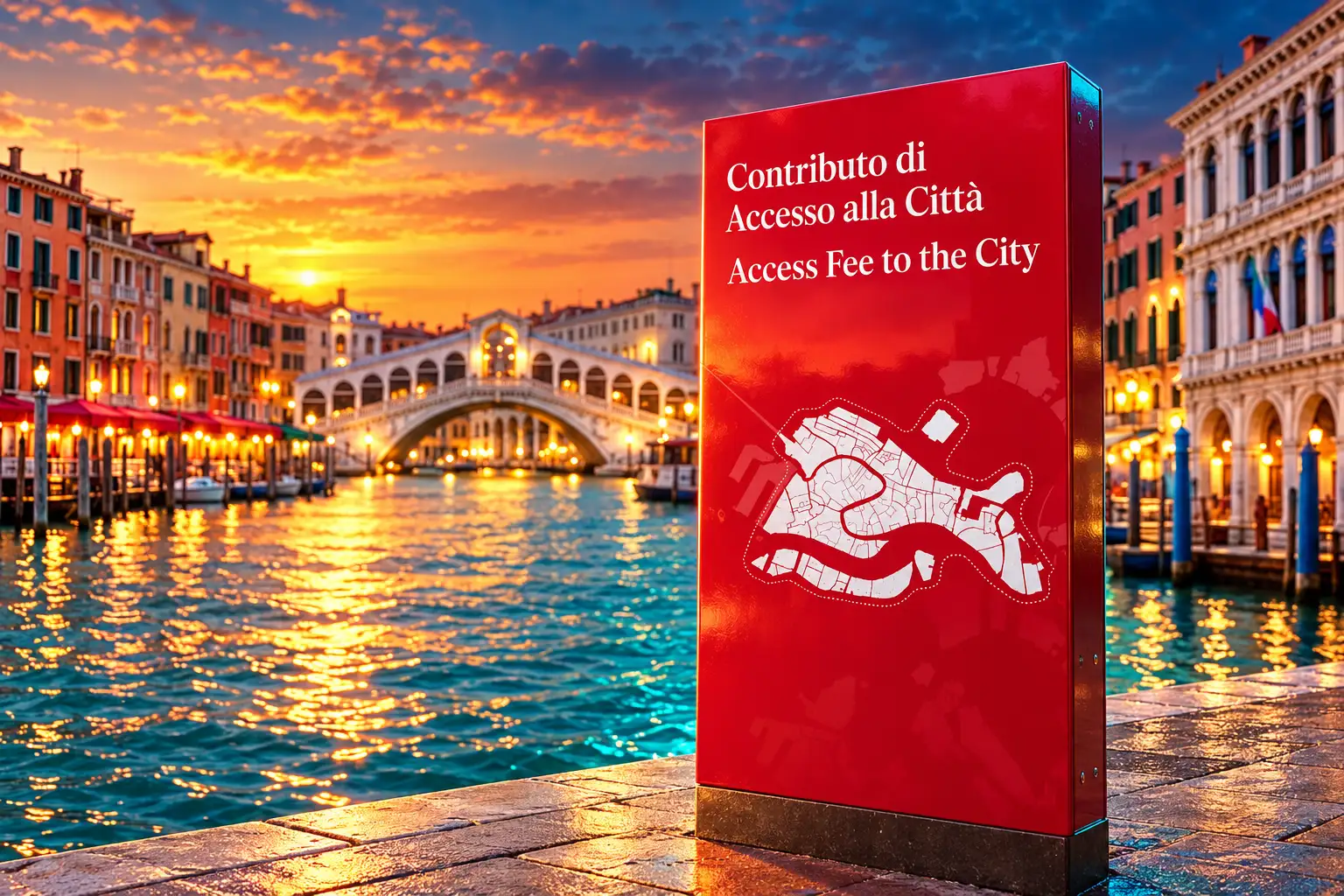
Zuin Asks Rome for a Heavier Day Ticket
Zuin, who has carried the fee from the Luigi Brugnaro years into Venturini’s term, said after three experimental seasons the 2027 edition should become a standing instrument, with a longer calendar on the table. He also said the €5 to €10 band no longer does the job it was hired to do.
The current €5-10 charge is affordable for virtually everyone; the risk is that it no longer has the deterrent effect that this measure is supposed to have.
Michele Zuin, budget and tax councillor, City of Venice
He said the request to the government for a heavier fee is not a bid to raise cash. There had been talk of €50. The working figure he named was €30. The point, as he put it, is to make a repeat visitor think twice about coming on a day such as May 1 and pick some other outing instead.
That argument sits beside the city’s own cash sheet. After the cost of running the checkpoints, Zuin said €1,771,000 from the 2026 take had already been earmarked to hold down the waste bill. The gross haul of €5,215,035 is the number that travels. The sum left for residents is the smaller one.
Venturini, elected in June after running tourism when the ticket launched in 2024, has pushed the same line in louder form. In July he said the €10 last-minute rate had not done enough on peak days and asked for surge pricing that would rise with demand, up to €50 in the version he took to national officials. On September 27 he narrowed the public figure to a €30 ceiling, reached only when the city is already full, and said a higher ticket could be tied to cheaper museums, toilets, and city merchandise.
Who Pays the Venice Access Fee?
The municipal page on who must pay the access fee is blunt. Anyone over 14 who enters the historic city on a listed day pays, unless they fall under an exclusion or exemption. Overnight guests inside the Comune do not pay it. They pay the hotel tax instead. The 2026 trial ended on July 27, so from that morning visitors have entered without paying or proving a waiver, until the council sets a new season.
Minor islands were left out of the 2026 charge, as was a strip of Riva degli Schiavoni used by Gran Turismo boats. The fee is due once per person per day. It is not due on the Liberty Bridge, at Tronchetto, or in the station and Piazzale Roma zones if a traveller never walks into the old city.
WHO GETS IN WITHOUT PAYING
- Residents and locals: People who live in or were born in the Comune, plus residents of the Veneto region, show identity papers and do not buy a voucher.
- Children under 14: They enter free, and the booking form simply records them.
- Overnight guests: Anyone staying in a registered lodging in the municipality is exempt from arrival through departure because they already sit on the hotel-tax roll.
- Work and study: Employees, the self-employed, commuters, and students at schools or universities in the historic city or lesser islands are excluded.
- Property and family: People who pay IMU in Venice, and close relatives of residents visiting the old city, sit on the waiver list, with other narrow cases for care, sport, and funerals.
The full list of fee exemptions is long enough that the paying visitor is a specific type: a day tripper from outside the Veneto, over 14, with no hotel booking in the Comune. That is the person a €30 peak rate would hit. The guest in a palazzo hotel would still walk past the checkpoint on a free QR code.
The Hotel Tax Already Dwarfs the Day Ticket
Zuin put the overnight tax, the imposta di soggiorno, at €39 million a year. Dropping it, he said, would blow a hole in cleaning, security, transport, the city offices, and events. The day ticket’s €5,215,035 is a fraction of that, and a still smaller share of the physical upkeep bill Venturini cites.
The overnight levy last moved in 2015. Zuin noted that Rome, Milan, Florence, Naples, and Bologna have already reset theirs. Venice has been talking about lifting the historic-center night tax from the present €1 to €5 band, with an idea of €9 at the top end for five-star rooms, still under the national €10 ceiling. In other words, the city is trying to squeeze both the day visitor and the staying guest, while telling Rome the day ticket is not about cash.
A higher day fee would also finish a job the overnight tax already does: it would make a hotel bed the cheaper way, on paper, to be in Venice on a red-flag day. That is a gift to rooms inside the Comune, including mainland Mestre, Marghera, and the Lido, whose guests skip the access charge. It is a cost to the coach and train day trip, the visitor who eats a sandwich and leaves, and the operator who sells that trip.
Historic Venice Now Has 47,625 Residents
The fee is sold as a livability tool. The census is the harder document. The historic center, islands excluded, had 47,625 registered residents on December 31, 2025, down 864 from 48,489 a year earlier. The estuary islands lost 409 more. The water city shed 1,273 people in a year. The Comune as a whole stood at 251,294, almost flat, and only because the mainland gained foreigners.
THE CITY THE TICKET IS MEANT TO PROTECT
- Registered residents: 47,625 people in the historic center at the end of 2025.
- Tourist beds: More than 51,500 in the center, per the Ocio housing group’s January count, a line first crossed in 2023.
- Earlier city: More than 174,000 residents in the 1950s.
- Upkeep: €100 million a year, Venturini said, just to keep Venice standing.
On May 2, 25,471 paying day visitors equaled more than half of those 47,625 registered residents, before hotel guests and exempt Veneto visitors were even counted. UNESCO’s Venice and its Lagoon listing already flags the swap of residents’ houses for lodging as a threat to the site’s identity, across 118 islands in a lagoon of 70,176.4 hectares.
The access fee did one job the housing groups can see. Illegal tourist lodgings found by the local-police tax unit in the lagoon fell from 202 in 2023 to 63 in 2024 and 6 in 2025, a drop Venturini, then tourism councillor, tied in part to hosts having to surface if they wanted their guests exempted.
A Law in Rome Still Caps the Charge at €10
None of the €30 talk is live law. The 2019 budget rule that created the access fee stops it from exceeding the hotel tax, which is why the city cannot go past €10 today. Venturini said as much on September 27: for now the ticket stays at that ceiling, and Venice has put the question to Rome. A surge-price system would also need an amendment to the special law on Venice.
We spend 100 million euros a year just to maintain Venice physically, and nobody gives us that money. Not Europe. Not the Italian state.
Simone Venturini, mayor of Venice, in July
Tourism minister Gianmarco Mazzi, in Venice on September 24, said he is against creating taxes even when tourists pay them, and he said the same about raising the hotel tax. He also said Venice is a case apart and that talks with the mayor continue. Veneto president Alberto Stefani said the region is not looking at a €30 ticket of its own and wants the territory usable by anyone. Zuin’s reply was that no other Veneto town runs an access fee because no other Veneto town is Venice, and that the extra money would apply only on certain days or above a flow threshold.
Venturini, after that ministerial visit, said Mazzi had called Venice a city on its own and that there was no split with the government. The split is in the numbers. Mazzi’s brief is national arrivals. Venturini’s brief is a historic center whose resident roll keeps shrinking while the May Day bridge still puts 25,471 paying day visitors on the stones.
Peak Days Would Carry the €30 Ceiling
If Rome ever writes the higher cap, the product on sale would still be the same QR voucher, aimed at the same person, on a longer list of dates. Officials have talked about stretching the season past the April-to-July window. Zuin has already said 2026’s 60 days left other parts of the year uncovered. A €30 top rate on a day like May 2 would turn a couple’s last-minute entry into a €60 line item before a coffee, while a family that books a Mestre hotel would still walk in on the overnight exemption.
That is the political objection waiting in Rome, and it is the practical one on the platforms. A peak price of €30 would fall on the visitor who does not take a room, which is the visitor the city says it wants fewer of. The five-star guest remains outside the access fee. Whether that split actually clears a campo on a holiday Saturday is the test the first three seasons did not pass on the worst day of the year.
Even a sold-out peak at €30 would not close Venturini’s €100 million maintenance gap. The 2026 ticket, at €5 to €10, raised €5,215,035 and left €1,771,000 for the waste bill once the gates were paid for. The overnight tax remains the large tourism levy. The day fee remains the loud one. Until parliament moves, the loud one is still €10, and the city that wants €30 is still selling a warning, not a new price.

Ibiza Airport Flooded as Storm Adam Broke a 2005 Record

The Louvre Is Closed as France Runs Neighbourhood Curfews

UK Tells Travellers to Leave Saudi Arabia by Land

Southwest’s Record Fares Lose Ground to $4.55 Fuel

Leeds Bradford Airport Pauses Half-Term Strikes After Rejections

Flight Cancellations Rise While the FAA Shrinks Staffing Targets

United Folds Newark’s Lima Nonstop Into Its Houston Hub

Airbnb’s 6% Direct Links Undercut the Host Website Pitch

Hitachi’s Aurora Faults Drove the EMR Bank Holiday Strike

United Bets the A321XLR on 10 New International Cities
-
 AIRLINES2 months ago
Flight Cancellations Rise While the FAA Shrinks Staffing Targets
-
 AIRLINES2 months ago
United Folds Newark’s Lima Nonstop Into Its Houston Hub
-
 HOTELS2 months ago
Airbnb’s 6% Direct Links Undercut the Host Website Pitch
-
 NEWS2 months ago
Hitachi’s Aurora Faults Drove the EMR Bank Holiday Strike
-
 AIRLINES2 months ago
United Bets the A321XLR on 10 New International Cities
-

 HOTELS2 months ago
Grand Canyon Hotels Close After a Repeat Pipe Flood
-
 NEWS2 months ago
The EU Pulled the 2026 ETIAS Date After Border Chaos
-
 NEWS2 months ago
ATSB Opens Six Sydney Airport Ground Conflict Files