
AIRLINES
Flight Cancellations Hit a Four-Year High as Hotel Help Shrinks
U.S. airlines canceled 2.31% of flights through July, the most since 2022, and on October 19 hotel and meal pledges will no longer cover many mechanical delays.

U.S. airlines canceled 2.31% of marketing-carrier flights from January through July 2026, the highest share since 2022, according to Bureau of Transportation Statistics records. On October 19, a new delay-cause rule will pull unscheduled maintenance and nine other events out of the bucket that triggers meal and hotel promises.
The cancellation rate is the number everyone has. The cost shift is the part that lands on the next missed connection.
U.S. Airlines Have Canceled 2.31% of Flights in 2026
Federal marketing-carrier files count 105,436 canceled flights out of 4,554,659 scheduled operations through July. That is 2.31 percent of marketing-carrier flights, up from 1.72% in the same months of 2025, when 77,557 flights never left. The 2026 tally is 27,879 more canceled flights than a year earlier, and it is the worst January-through-July rate since 2022, when carriers scrapped 3.02% of the schedule.
Completed trips did not fall apart at the same pace. On-time arrivals sat at 75.12%, a hair under 75.52% a year earlier, and the delayed share was 22.24% against 22.45%. More flights are dying on the ground. The ones that push back are about as late as they were last year.
THE CANCELLATION RATE BY YEAR
| Year (Jan-Jul, marketing carriers) | Flights canceled | Cancel rate | On-time share |
|---|---|---|---|
| 2022 | 123,192 | 3.02% | 75.79% |
| 2023 | 71,452 | 1.70% | 75.44% |
| 2024 | 72,107 | 1.65% | 75.61% |
| 2025 | 77,557 | 1.72% | 75.52% |
| 2026 | 105,436 | 2.31% | 75.12% |
FlightAware’s live tracker, which runs past the Bureau’s July close, put summer canceled-flight counts about 15% above last year. There is no single cause. January storms hammered several hubs, including what American Airlines called the worst weather disruption in its history. Reporting carriers canceled 25,635 flights that month, 4.71% of 544,003 operations. Federal records show 8,681 U.S. flights canceled on January 25 alone, 46.5% of that day’s schedule, the most on any single day since March 31, 2020.
Runway work at San Francisco International, packed schedules at New York and Washington, and ordinary summer storms stacked on top. Then the radios went out.
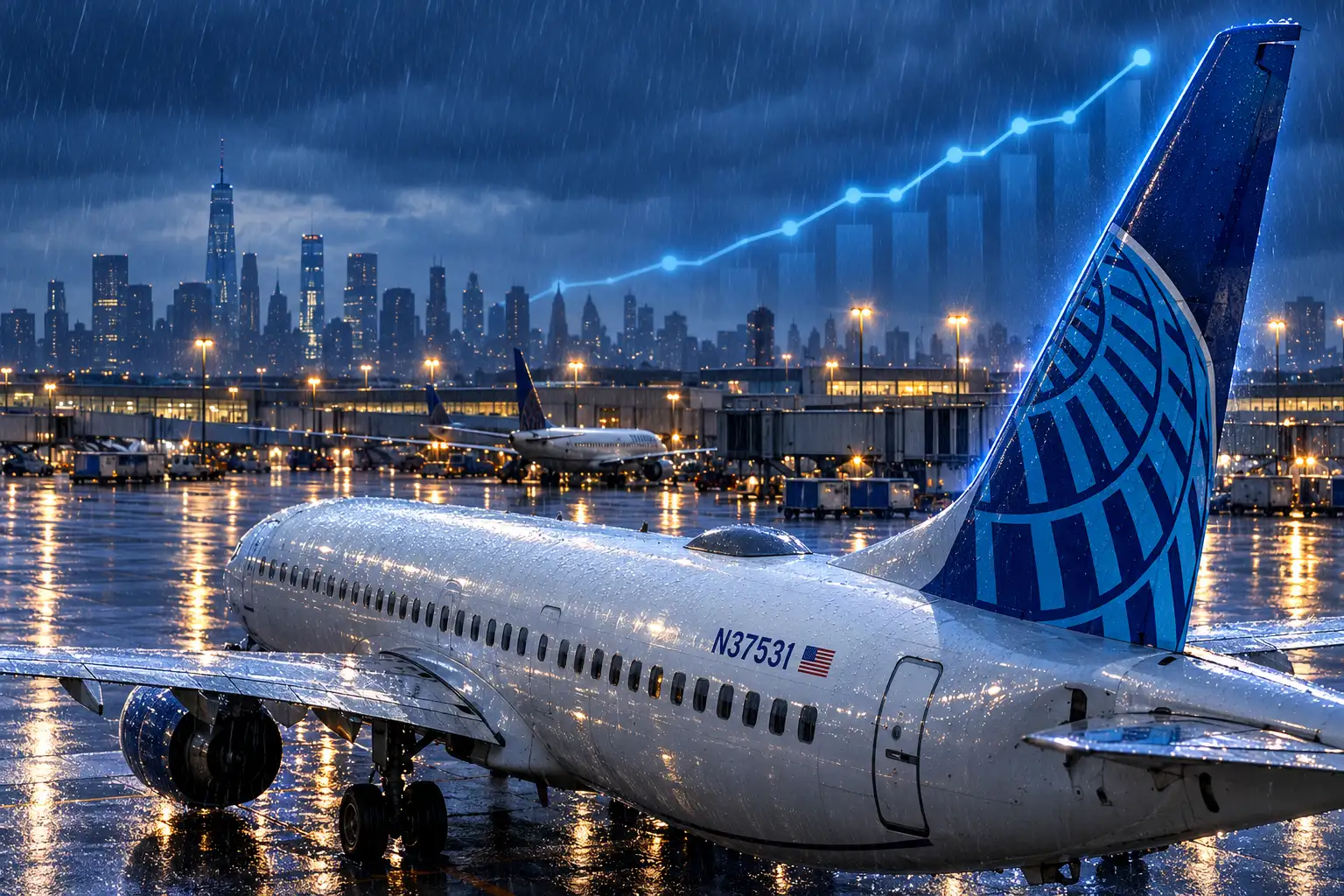
A Cut Fiber Line Stopped the Northeast
On September 21, a switch on the primary communications line failed at the FAA’s Philadelphia Terminal Radar Approach Control. When the system flipped to the backup fiber, railroad construction workers had already severed it. Controllers lost radar and radio for hours. Newark Liberty International Airport took no commercial landings from about 9:40 a.m. until just after 5:20 p.m., per Flightradar24. More than 200 flights into and out of Philadelphia International were canceled, and LaGuardia and Kennedy were pulled into the same ground stops.
Airlines shuttered more than 1,000 departures. FlightAware counted about 7,000 delayed or canceled flights that day, including about 1,400 at the three New York-area airports. The next midday, nearly 100 more flights were still canceled because aircraft and crews sat in the wrong cities.
THE 2026 BREAK POINTS
- January 25, 2026: 8,681 U.S. flights are canceled, 46.5% of the day’s schedule, the most since March 31, 2020.
- Memorial Day through Labor Day: Cirium’s summer sample puts LaGuardia at 6.5% canceled, the worst large U.S. airport in the set.
- September 3, 2026: The Department of Transportation publishes the Section 511(b) final rule in the Federal Register.
- September 21, 2026: Philadelphia TRACON loses its primary circuit and its backup fiber, and Newark goes without commercial landings for 7 hours 40 minutes.
- October 19, 2026: The new delay category takes effect, and meal and hotel pledges no longer attach to the 10 excluded events.
Congress already sent the FAA $12.5 billion last year after the Potomac River collision that killed 67 people and after radar failures at the same Philadelphia facility in spring 2025. The agency says it has replaced 3,346 communications lines and 190 voice switches. Transportation Secretary Sean Duffy used the September outage to ask Congress for $20 billion more for a new telecom design, not another copper-to-fiber swap.
I have money for some of the telecom replacing old copper wires. Bringing in new fiber so it’s faster. The problem is this is a 40-year-old architecture or design.
Sean Duffy, Transportation Secretary, on Fox News
The National Air Traffic Controllers Association said the people on duty kept the airspace safe after the radios died. Sheldon Jacobson, an engineering professor at the University of Illinois whose work fed the TSA PreCheck design, said a hub outage does not stay local, because it strands aircraft that other cities need later in the day. In the days after the source numbers landed, Duffy began pitching SMART, an AI tool he says will help managers reopen restricted airspace once weather clears. Software does not splice a fiber that a work crew already cut.
Hotel Vouchers Shrink on October 19
The Department of Transportation published a final rule on September 3 that takes effect Monday, October 19. It carries out Section 511(b) of the FAA Reauthorization Act of 2024. Carriers must move ten events out of the Air Carrier category used in 14 CFR 234.4, the code reserved for problems inside the airline’s control, and report them in a new Section 511(b) bucket instead.
That sounds like a statistics tweak. It is not, because the large carriers wrote their customer-service plans against the old code. Since 2022 they have promised meals, and in most cases hotels, when a cancellation or long delay is coded as controllable. Pull an event out of that code and the promise no longer attaches. The department said so in the rule text.
The number of delays and cancellations for which air carriers provide amenities and compensation to consumers is expected to be reduced.
U.S. Department of Transportation, final rule on delay-cause categories
The broadest carve-out is unscheduled maintenance, including work done for an airworthiness directive, that shows up outside a scheduled program and cannot be deferred before the aircraft flies. Hydraulic leaks found on arrival, engine warnings, cockpit failures, and emergency directives sit inside that definition when the fault cannot wait. Scheduled, deferrable work stays in the Air Carrier column. The line that matters at the hotel desk is whether the airline codes the break as non-deferrable.
Weather, air traffic control, and airport congestion were already outside the controllable bucket. Those remain the passenger’s problem for meals and rooms, as they were last summer. What changes is the mechanical overnight that used to look like the airline’s mess.
The 10 Events Airlines Will No Longer Own
The statute lists the events. Several are rare. Unscheduled maintenance is not. A government-system failure that stops safe flying is the category that would have covered a facility like Philadelphia TRACON if the rule had already been live on September 21; ATC constraints were already treated as uncontrollable, and this clause writes that reading into the new code.
THE 10 SECTION 511(B) EVENTS
- Passenger death cleaning: Aircraft cleaning required after a passenger dies onboard.
- External aircraft damage: Damage from extreme weather, foreign object debris, or sabotage.
- Bag-system outage: Baggage or cargo loading delayed by a bag system the carrier and its contractor do not control.
- Cyberattack: A cybersecurity attack, if the carrier was in compliance with applicable rules.
- Government system failure: A shutdown or failure of government systems that directly and unexpectedly blocks safe flight.
- Overheated brakes: Brakes overheated after a safety incident that required emergency procedures.
- Unscheduled maintenance: Unplanned work, including for an airworthiness directive, outside the scheduled program, that cannot be deferred or must be fixed before flight.
- Medical emergency: An onboard medical emergency through no fault of the carrier.
- Unruly passenger: Time lost removing an unruly passenger.
- Airport closure: An airport closed by volcanic ash, wind, or wind shear.
Airlines can still hand out rooms and meal vouchers if they want to. The federal dashboard will no longer treat those 10 causes as the kind of failure the pledges were written to cover. No U.S. carrier on that board promises cash when a controllable delay runs past three hours, so the money that actually moved was the hotel night and the meal voucher.
LaGuardia Still Leads a Northeast Cluster
Cirium’s summer sample, limited to U.S. airports with at least 30,000 flights between Memorial Day and Labor Day, puts the cancellation pain on the same corridor the September outage hit. LaGuardia canceled 6.5% of flights, Reagan National 5.8%, Kennedy 4.2%, Boston Logan 3.8%, and Newark 3.7%. After a brutal 2025 at Newark, that 3.7% made it the most reliable of the three New York airports this summer. It was still among the five worst large airports in the country.
Delay ranks tell a different map. Nashville led at 35.3% of flights delayed, then Baltimore/Washington at 34.6%, San Diego at 33.6%, Dallas Fort Worth at 33.4%, and San Francisco at 32.1%. About one in four U.S. departures ran late nationwide in that window. The delay share did not jump the way cancellations did.
SUMMER 2026 HUBS, CIRIUM
| Rank | Worst for cancellations | Share canceled | Best on-time hubs | On-time share |
|---|---|---|---|---|
| 1 | LaGuardia (LGA) | 6.5% | Salt Lake City (SLC) | 82% |
| 2 | Reagan National (DCA) | 5.8% | Minneapolis-St. Paul (MSP) | 80.1% |
| 3 | Kennedy (JFK) | 4.2% | Dulles (IAD) | 79.4% |
| 4 | Boston Logan (BOS) | 3.8% | Los Angeles (LAX) | 78% |
| 5 | Newark (EWR) | 3.7% | Houston Intercontinental (IAH) | 77.5% |
Salt Lake City, Minneapolis-St. Paul, Dulles, Los Angeles, and Houston Intercontinental are all hubs for Delta Air Lines, United Airlines, or both. A connecting itinerary that can use those five still has a cleaner summer record than one that has to touch LaGuardia or Reagan National. Geography is doing as much work as the brand on the ticket.
What Still Gets You a Refund After a Cancellation?
If an airline cancels your flight or makes a significant change, you are still owed a prompt refund regardless of the reason if you decline rebooking, including on a nonrefundable fare. That right does not move on October 19. Meal and hotel help is the piece that shrinks, and only for the 10 newly excluded causes.
The department’s cancellation-and-delay board still shows what the 10 large U.S. airlines, about 96% of domestic scheduled passenger traffic with their regional partners, promise when a disruption stays inside their control. All of them pledge a meal or meal cash when a controllable cancellation or delay leaves you waiting three hours or more. All except Frontier pledge a hotel and ground transport for a controllable overnight. None pledge cash. Those meal and hotel pledges for controllable delays remain binding when the airline still codes the failure as its own.
WHAT STILL COVERS YOU
- The refund: Decline the new flight after a cancel or a significant change and the carrier owes the money back, weather and maintenance included.
- Controllable delays: Crew, fueling, cabin cleaning, baggage loading, and deferrable maintenance still sit inside the dashboard pledges.
- Travel cards: Weather was already outside airline hotel cover; after October 19, more mechanical overnights will be too, so trip-delay insurance on the card that paid the ticket does more of the work.
- Morning departures: Problems compound after midday storms and late inbound aircraft, so the first wave still clears more often than the last.
Frontier Airlines CEO Jimmy Dempsey put the morning case in one line this summer: “If you start cleanly in the morning, the airline tends to run on time for the rest of the day.” A late connection through LaGuardia or Reagan National in thunderstorm season remains the itinerary most likely to leave you buying the room yourself, especially after October 19, when an unplanned repair can be coded out of the hotel pledge.
Airline apps now rebook and track bags without a ticket counter. Load the reservation before you need it. Pack water and a snack, because a one-hour hop can become three hours on a taxiway when lightning or a ground stop hits, and the seat-belt sign stays on. The federal rule does not change any of that muscle memory. It changes who pays when the overnight is blamed on a fault that could not wait until morning.
October 19 does not fix Philadelphia’s fiber, and it does not put 105,436 canceled flights back on the board. It decides which of the next ones come with a room key.
Disclaimer: This article is news reporting on federal delay statistics and a Department of Transportation rule, and it is for information only. It is not legal advice, insurance advice, or a recommendation to buy or decline any credit card, travel policy, or airline ticket. Readers who need help with a claim, a refund, or coverage should speak with the airline, the card issuer, and a qualified consumer-law or insurance professional before they spend money or waive a right. Figures and carrier pledges reflect the Bureau of Transportation Statistics files, Cirium’s summer sample, FlightAware’s counts, and the federal dashboard as published through late September 2026, and those numbers and commitments can change.

Ibiza Airport Flooded as Storm Adam Broke a 2005 Record

The Louvre Is Closed as France Runs Neighbourhood Curfews

UK Tells Travellers to Leave Saudi Arabia by Land

Southwest’s Record Fares Lose Ground to $4.55 Fuel

Leeds Bradford Airport Pauses Half-Term Strikes After Rejections

Flight Cancellations Rise While the FAA Shrinks Staffing Targets

United Folds Newark’s Lima Nonstop Into Its Houston Hub

Airbnb’s 6% Direct Links Undercut the Host Website Pitch

Hitachi’s Aurora Faults Drove the EMR Bank Holiday Strike

United Bets the A321XLR on 10 New International Cities
-
 AIRLINES2 months ago
Flight Cancellations Rise While the FAA Shrinks Staffing Targets
-
 AIRLINES2 months ago
United Folds Newark’s Lima Nonstop Into Its Houston Hub
-
 HOTELS2 months ago
Airbnb’s 6% Direct Links Undercut the Host Website Pitch
-
 NEWS2 months ago
Hitachi’s Aurora Faults Drove the EMR Bank Holiday Strike
-
 AIRLINES2 months ago
United Bets the A321XLR on 10 New International Cities
-

 HOTELS2 months ago
Grand Canyon Hotels Close After a Repeat Pipe Flood
-
 NEWS2 months ago
The EU Pulled the 2026 ETIAS Date After Border Chaos
-
 NEWS2 months ago
ATSB Opens Six Sydney Airport Ground Conflict Files