
AIRLINES
Etna Ash Keeps Closing the Airport Sicily Sells
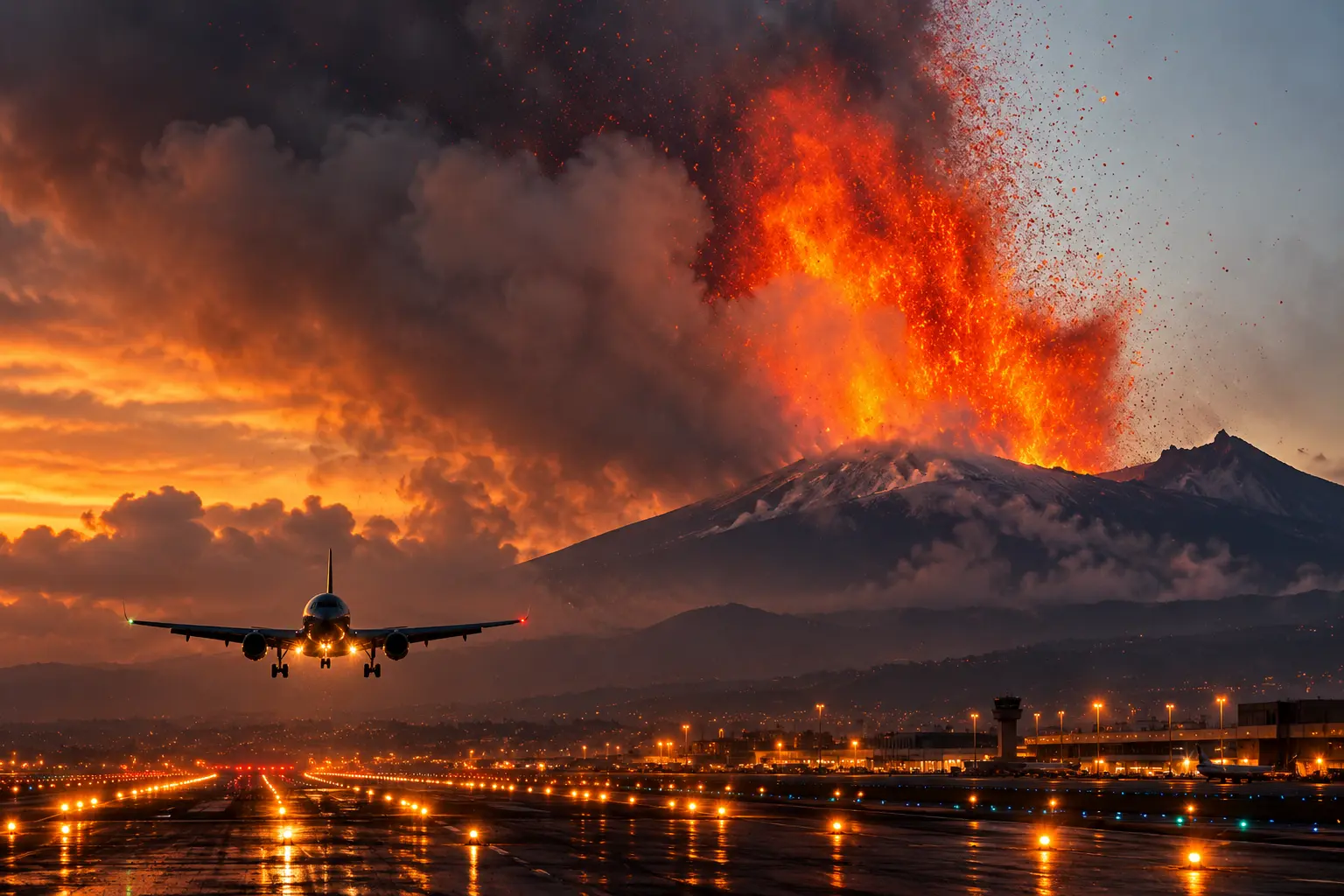
Catania Airport reopened after a three-day Etna ash halt, then stopped again the next morning, leaving Sicily’s busiest gateway on a stop-go timetable.

Catania Airport resumed flights on 29 September after Mount Etna ash had shut Italy’s fifth-busiest hub for three days, then stopped again before lunch. Operator SAC restored arrivals and departures once the aviation alert dropped from red to orange, hours after a full shutdown that had run through 26, 27 and 28 September.
The mountain that fills those planes is the same one that keeps grounding them. Eastern Sicily sells Etna. The airport sits in the ash path.
Catania Reopened, Then Stopped Again Before Lunch
SAC had already told passengers the alert was over on the evening of 28 September, writing that ordinary status had been restored and full services had resumed. Overnight the Northeast Crater picked up again. Italy’s National Institute of Geophysics and Volcanology raised the Volcano Observatory Notice for Aviation to red at 05:25 UTC on 29 September, with an ash cloud estimated at 4 kilometres and moving south, the direction that feeds Fontanarossa’s approach.
The ground stop was short. INGV cut its own notice to orange at 07:51 UTC, describing a weak ash emission still under way. Minutes later Toulouse cut Etna’s colour to orange in advisory 2026/195, with a dilute cloud still visible on satellite, tops near flight level 140, and a southbound drift at 25 knots. SAC then resumed arrivals and departures with immediate effect. The halt lasted less than an hour.
It was still long enough to break the morning bank. Two Rome Fiumicino arrivals, one ITA Airways and one Ryanair, were cancelled. Twelve other inbound flights were diverted, 10 of them to Palermo, one to Comiso and one to Trapani. Twelve departures were cancelled. A Volotea service to Olbia and a Lufthansa flight to Munich left from Palermo instead. Air Canada cancelled Catania flights through 30 September, after the three-day closure had already forced a Delta Air Lines New York service into Rome Fiumicino and shifted Aeroitalia’s Rome link onto Comiso.
THE SEPTEMBER STOP-GO
- 26 September 2026: SAC suspends all arrivals and departures at Fontanarossa after Etna ash and the wind close the airspace, then extends the halt through the next day.
- 27 September 2026: The shutdown holds for a second full day, with early diversions already running into Palermo, Trapani and Comiso.
- 28 September 2026: Third consecutive day. Operations stay down until late evening, when SAC says the alert has ended and full service is back.
- 29 September 2026: INGV goes red before dawn, the airport stops again, then orange restores flights before lunch. Long-haul and some European carriers keep cancelling into 30 September.
Fontanarossa’s own site was listing live movements again on 30 September, under few clouds and 22 C. The aviation colour stayed orange after the morning flip, which is the setting that lets the airport open while Etna is still putting ash into the air.
Fontanarossa Handled 12 Million Passengers on an Ash Path
SAC’s 2026 service charter records 12,369,485 passengers through Fontanarossa in 2025, with 81,003 aircraft movements, against 12,330,654 passengers the year before. That volume keeps Catania fifth among Italian airports, behind Rome Fiumicino, Milan Malpensa, Bergamo and Naples, and on the order of 5% of national traffic. In 2025 the airport also added a summer daily Delta link to New York JFK, a route that now has to live with the same red-orange switch that emptied the terminal in late September.
Those passengers are not an accident of geography. Taormina, Syracuse and the south-side cable-car terrace at Rifugio Sapienza are sold as day trips from Catania. The volcano is the postcard. It is also, in a 2026 paper in the Journal of Applied Volcanology, the most ash-hit airport in a global study of 334 volcano-related airport events between 1944 and 2024. Catania-Fontanarossa logged 20 impact events, ahead of Puebla (15) and La Nubia (12). Etna itself accounted for 24 airport-impact events, the most of any volcano in that set aside from Eyjafjallajökull.
FONTANAROSSA IN HARD NUMBERS
- 2025 traffic: 12,369,485 passengers and 81,003 movements, fifth in Italy.
- Ash record: 20 documented ashfall-related airport impacts from 1944 to 2024, the highest count in the dataset.
- Trace ash: the same study puts the chance of a closure of any length above 80% once about 0.1 mm of ash is on the ground.
- Summit: 3,357 metres, with Toulouse still tracking a southbound cloud after the 29 September emission.
Trace ash is enough because cleanup, not lava, is what keeps a runway closed. Particles that look like dust on a car roof are glass and rock. They cut traction, score windscreens and have to be swept before a jet can use the pavement. That work repeats if the wind turns or the crater pulses again, which is how a morning that looks clear on the ground still reads as a red notice in the tower.
August Already Set the Record Since 2002
The late-September stop-go sat on a summer that had already broken the modern record. SAC said 36% of nearly 2,000 arrivals due into Catania between 6 and 12 August were cancelled, with more than 600 flights diverted to Palermo, Trapani, Comiso and Lamezia Terme. The Ferragosto emergency lasted five days, the longest since Etna’s 2002-2003 eruption, when ash reached as far as Libya and the Greek islands and Catania had to close for safety after the runway disappeared under a grey blanket.
A separate halt on 14 September showed the pattern was not a one-week freak. Even a quieter day can clip the schedule. On 24 September INGV went red again on a 4,000-metre plume moving south-southeast, and coordinators capped Catania at 10 landings an hour instead of 12 until 17:00, with airspace sector B1 shut over the volcano. The airport stayed open that day. The margin was already gone.
ETNA AND CATANIA IN 2026
| Period | Airport status | Scale |
|---|---|---|
| 6-12 August | Five-day emergency, longest since 2002 | 36% of nearly 2,000 arrivals cancelled; more than 600 diverted |
| 14 September | Flights suspended again | Fresh ash on the same approach path |
| 24 September | Airport open, capacity cut | 10 landings an hour, down from 12; sector B1 closed |
| 26-28 September | Full shutdown, three days | Thousands of passengers moved or stranded; long-haul sent to Rome |
| 29 September | Red, then orange; halt under an hour | 2 Rome arrivals cancelled; 12 inbound diversions, 10 of them to Palermo |
Etna’s 2002-2003 crisis ran from 27 October 2002 to 29 January 2003, a three-month eruption that buried tourist plant at Piano Provenzana and kept dumping ash on the city. The 2026 problem is shorter bursts stacked on a much busier airport. Fontanarossa now moves more than 12 million people a year through the same corridor that 2002 closed with a shovel.
Backup Runways From Palermo to Lamezia Terme
When Fontanarossa goes dark, Sicily does not stop receiving aircraft. It receives them in the wrong place. Palermo took 10 of the 12 inbound diversions on 29 September. Trapani and Comiso took one each. In August the net also included Lamezia Terme, on the Calabrian mainland. A New York arrival that cannot risk the ash simply ends the day in Rome.
Comiso is not a random overflow strip. SAC already manages Catania and Comiso as a group, which is why Aeroitalia could slide a Rome service across the island and still be on the same operator’s concrete. Civil Protection Minister Nello Musumeci has argued that any lasting fix has to treat Comiso, Palermo, Trapani and Reggio Calabria as a standing alternative, not a weekend improvisation. Five Star deputies in August asked for Comiso to be funded as a structural reserve, which is another way of saying the backup already exists and is still too small.
WHERE THE PLANES ACTUALLY WENT
- Palermo Punta Raisi: The default overflow. It took 10 of 12 diverted arrivals on 29 September and absorbed a large share of the August wave, including Volotea and Lufthansa departures that could not wait in Catania.
- Comiso: SAC’s sister airport in Ragusa province. Aeroitalia moved Rome-Catania here while Fontanarossa was shut, which is the closest thing eastern Sicily has to a planned spare gate.
- Trapani: Western Sicily’s third option, used for a handful of narrow-body diversions when Palermo is full.
- Lamezia Terme: Mainland Calabria, used in August when the island’s own spares ran out of stands and slots.
- Rome Fiumicino: The long-haul dump. Delta’s New York-Catania flight ended there rather than circling an ash cloud.
The hidden cost is the ground move after landing. A traveler booked to Taormina or Syracuse who steps off in Palermo still has a cross-island transfer ahead, and crews have to be restaged before the next rotation can leave Catania even after the colour code drops. That is why a one-hour halt still cancelled a dozen departures: the aircraft were not there.
Why Volcanic Ash Grounds a Jet in Minutes
Ash looks like smoke from a hillside. Inside a turbine it behaves like melted glass. The particles are rock and volcanic glass, abrasive on leading edges and windscreens, and they soften in the hot section, then stick to blades and can starve the engine of air. That is the stall risk, and it is why a red VONA is treated as a hard stop rather than a visibility problem.
Volcanic ash can be a great risk for aircraft. It can be sucked into the motors, and force them to stall. This is why everyone is so very cautious with aircraft when there is a volcanic ash emission.
Boris Behncke, researcher, INGV Etna Observatory
Wind at different heights decides who pays. A plume can leave the Northeast Crater and ride south onto Catania while villages on the north slope stay clean. Toulouse’s 29 September advisory still showed the cloud drifting south hours after the emission weakened, which is why SAC can reopen the airport and still tell passengers to check with the airline before they leave for Fontanarossa. The crater does not have to be in full paroxysm. A dilute cloud at flight level 140 is enough if it sits in the arrival corridor.
People still go up the mountain while the airport below is arguing about colours. In August a 29-year-old American from Kansas was killed by lightning on Etna while hiking in an area closed because of volcanic activity. Eruption deaths on Etna last stacked up in 1987. Lightning has killed more recently than lava. The tourist draw does not switch off when the VONA goes red. The jets do.
Rome Wants a New Airport; Catania Is Building This One
On 12 August, with Fontanarossa again shut in the Ferragosto crush, Civil Protection Minister Nello Musumeci put the location itself on the table. He was president of Catania province from 1994 to 2003 and later governor of Sicily. In 1999 his office wrote a relocation into the provincial plan and commissioned a preliminary study for a new airport on the plain between Catania and Enna, meant to serve seven of the island’s nine provinces. It never left the paper.
It is not the volcano that is in the wrong place but the airport.
Nello Musumeci, Civil Protection Minister, 12 August 2026
He has said the idea met hostility from the management company and indifference from local authorities when he revived it as regional president. In late August he also ruled out turning Fontanarossa into an intercontinental hub, arguing the site is squeezed between the Santa Maria Goretti district 320 metres from the runway and Librino 840 metres away, and called for a permanent ash plan built around a stronger Comiso. Catania mayor Enrico Trantino pushed the other way. He said there has never been a real feasibility study, the transfer is not on the agenda, and the airport’s value is that it is five minutes from the city. He is betting on privatisation, and on future tools that might pick ash corridors so the present runway can keep working.
SAC is spending as if Fontanarossa stays. The 2030 Masterplan sets €500 million of work on the current site, including a new 3,000-metre runway, a rebuilt Terminal C, and a link between Terminals A and B. Demolition of the Morandi Terminal began on 20 December 2025 to clear space for a new Terminal B. That is a bet that the volcano can be managed with sweepers, colour codes and a longer strip, not a new map.
Airlines Still Owe Care, Not Cash
A volcanic closure is a safety stop, and under EU law it is also a special kind of delay. Commission guidance on Regulation 261/2004 treats volcano eruptions as extraordinary circumstances, using the 2010 Eyjafjallajökull airspace shutdown as the example. That usually takes cash compensation off the table if the airline can show the ash, not a crew roster, caused the cancellation. It does not take away the duty of care. Meals, communications and a hotel when the halt runs overnight still sit with the carrier, and rerouting to Palermo, Comiso or Rome is the practical substitute for a Catania arrival that cannot happen.
The working habit, after this summer, is to treat Fontanarossa as provisional even when the board is green. Check the airline first. Keep a backup that assumes Palermo. Do not count on a same-day recovery after a red VONA, because aircraft and crews will be on the wrong side of the island. Catania Airport’s live flight tracker was running on 30 September, which is the most that orange can promise: the runway is open until the next southbound cloud.
Air Canada still listed Catania as cancelled through 30 September. The airport that sold those seats sits where it has always sat, under a 3,357-metre crater that does not care about summer schedules.
Disclaimer: This article is news reporting on airport closures and published passenger-rights rules. It is informational only and is not legal advice, a claim assessment, or a recommendation to buy, change or cancel a ticket. Readers who need a decision on compensation, rerouting or refunds should consult a qualified travel-law adviser or the airline’s complaints unit with their booking in hand. Figures, alert colours and flight statuses reflect the official notices and company statements cited here and can change with the next VONA.

Ibiza Airport Flooded as Storm Adam Broke a 2005 Record

The Louvre Is Closed as France Runs Neighbourhood Curfews

UK Tells Travellers to Leave Saudi Arabia by Land

Southwest’s Record Fares Lose Ground to $4.55 Fuel

Leeds Bradford Airport Pauses Half-Term Strikes After Rejections

Flight Cancellations Rise While the FAA Shrinks Staffing Targets

United Folds Newark’s Lima Nonstop Into Its Houston Hub

Airbnb’s 6% Direct Links Undercut the Host Website Pitch

Hitachi’s Aurora Faults Drove the EMR Bank Holiday Strike

United Bets the A321XLR on 10 New International Cities
-
 AIRLINES2 months ago
Flight Cancellations Rise While the FAA Shrinks Staffing Targets
-
 AIRLINES2 months ago
United Folds Newark’s Lima Nonstop Into Its Houston Hub
-
 HOTELS2 months ago
Airbnb’s 6% Direct Links Undercut the Host Website Pitch
-
 NEWS2 months ago
Hitachi’s Aurora Faults Drove the EMR Bank Holiday Strike
-
 AIRLINES2 months ago
United Bets the A321XLR on 10 New International Cities
-
 HOTELS2 months ago
Grand Canyon Hotels Close After a Repeat Pipe Flood
-

 NEWS2 months ago
The EU Pulled the 2026 ETIAS Date After Border Chaos
-
 NEWS2 months ago
ATSB Opens Six Sydney Airport Ground Conflict Files