
AIRLINES
UK eGates Start Letting British Passengers Skip the Passport Scan
British citizens can skip the eGate passport reader from 6 October 2026, but other nationalities still scan and everyone must still carry a passport.

British citizens can skip the passport reader at some UK eGates from 6 October 2026, after Border Force switched on contactless facial checks at East Midlands Airport. The Home Office says testing found the process is up to 25% faster than using a passport. For now the new lane is for British citizens, and every passenger must still travel with a valid passport.
The booklet is no longer what you present at those gates. A live photo is, checked against official immigration, travel and passport records before the barrier opens.
East Midlands Goes First, and Only for British Passports
A small number of contactless eGates are in use at East Midlands Airport as of 6 October 2026. Border Force is updating software on the existing machines rather than ripping them out, with every eGate due to be upgraded by early 2027. Other UK eGates, including those at rail ports, keep working as they do now until their turn comes.
Chris Wilson, Head of Terminal and Capacity Planning at Birmingham Airport, said the airport is “one of the first” to introduce the Border Force system. Official passenger guidance still lists East Midlands as the site where contactless gates are currently available. Birmingham sits in the first wave; it is not named as live in that guidance.
THE SWITCH IN NUMBERS
- Who is cleared first: Contactless use is limited to British citizens, with other eGate nationalities due later.
- How many machines: There are over 290 eGates at 15 air and rail ports.
- Airport sites: Standard eGates already run at 13 UK airports, from Heathrow and Gatwick to Cardiff and Newcastle.
- Age and height: The usual eGate rules still apply, including a minimum age of 8 and a height of at least 120cm (3ft 11in).
Phil Douglas, Director General of Border Force, tied the launch to the age change that let accompanied children aged 8 and over use eGates in July 2026. Karen Dee, chief executive of AirportsUK, called the contactless move “excellent news for the passenger” and said airports would work with government officials on the rollout.
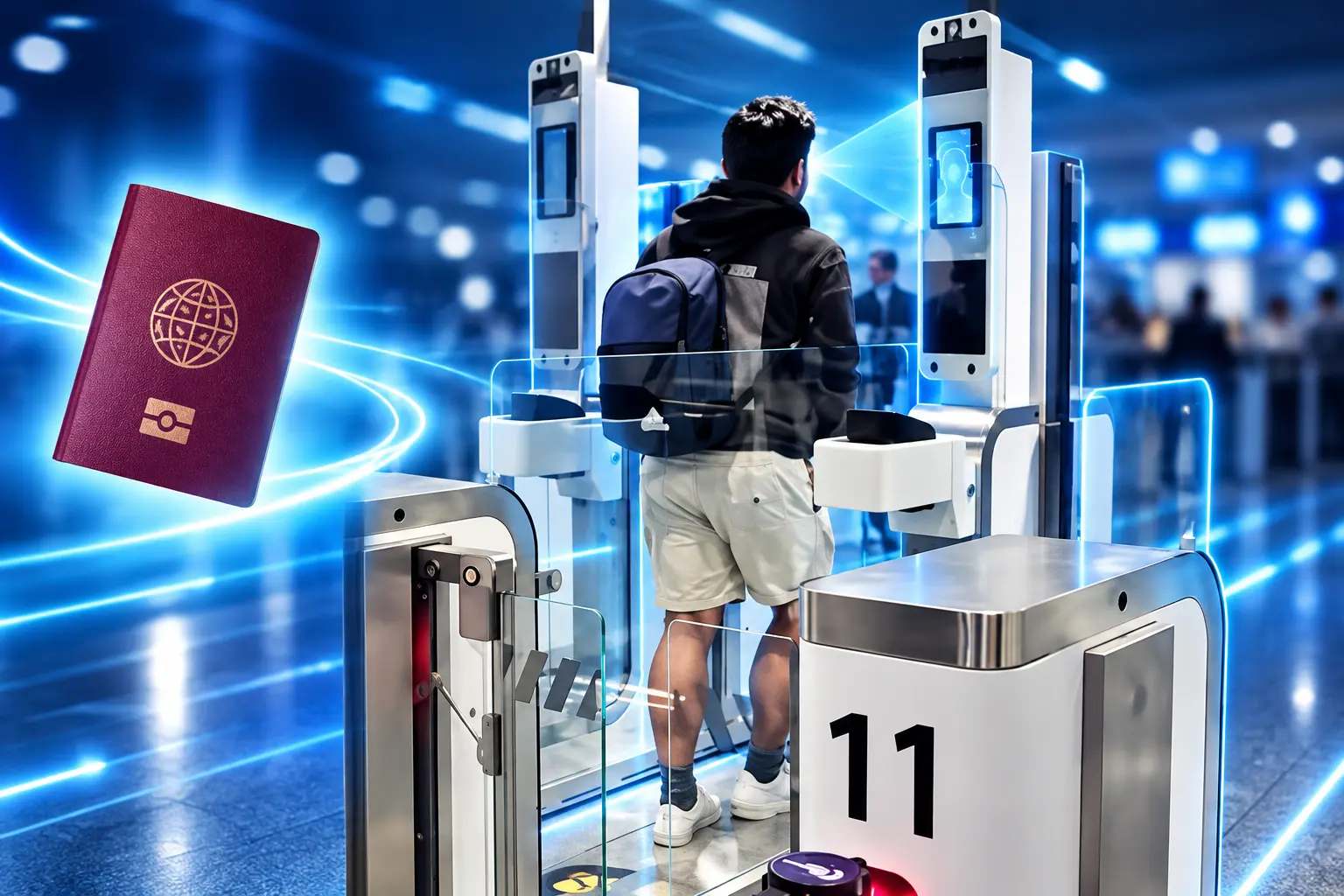
How a Contactless eGate Clears You
Border Force describes contactless travel as facial comparison technology at airport eGates. You no longer put a passport on the reader if the face check passes. Immigration and security checks still run in the background. Signage is supposed to tell you which lane to use.
HOW THE FACE CHECK RUNS
- The approach: You walk up to an eGate and a camera takes your photo.
- The match: The system checks that live image against verified immigration, travel and passport information.
- The barrier: The gate opens on its own once those checks finish, with no need to place the passport on the reader.
That is the same order the Home Office set out when it announced the switch. The speed claim is a test result, not a queue-time guarantee at Heathrow on a bank holiday. Hats, headphones and sunglasses still need to come off at the border, because the camera has to see a face it can compare.
Steve Griffiths, Managing Director of East Midlands Airport, said the airport was “delighted to be the first” to get the gates, and that the change sits alongside recent work on its immigration hall to move arriving passengers through more quickly.
The Passport Stays in Your Pocket Until the Match Fails
Passengers must continue to travel with a valid passport. Border Force officers will keep watching the gates and offering help. If the face check cannot finish, you are told to put the passport on the reader, or you are sent to an officer, which is already what happens when an eGate refuses someone.
This is a win for travellers coming to our brilliant country. By using state-of-the-art technology, we are making journeys smoother and faster, all while fully maintaining the UK’s robust border security.
Phil Douglas, Director General of Border Force, Home Office announcement
There is no published way to refuse the camera and still use the contactless lane. The fallback is the old reader or a staffed desk. Officials also warn that extra checks can follow if your appearance has changed since the passport photo was taken, or if a document is damaged. The face is now the first credential for British arrivals on those gates. The booklet is what you produce when the face is not enough.
Who Still Walks Up to a Border Officer
Standard eGate access has not changed. You normally need a biometric passport, a valid immigration status, and to be 8 or over and at least 120cm tall. British and Irish passport holders qualify, as do nationals of EU countries, Australia, Canada, Iceland, Japan, Liechtenstein, New Zealand, Norway, Singapore, South Korea, Switzerland and the USA, plus members of the Registered Traveller Service. ID cards still cannot be used in the gates.
Contactless sits on top of that list and is narrower. Border Force says it is limited to British citizens only at the start, with other eGate-eligible nationalities to follow. Irish citizens can keep using ordinary eGates. They cannot yet skip the reader. Visitors who already hold an Electronic Travel Authorisation still scan unless and until that later phase opens.
WHO GETS THE FAST LANE
| Traveller | Contactless eGate now | Ordinary eGate | If the check fails |
|---|---|---|---|
| British citizen on a British passport | Yes, at East Midlands, then a phased rollout | Yes | Passport on the reader, or a Border Force officer |
| Irish citizen | No | Yes | Staffed desk if the eGate refuses |
| EU, US, Australian and other listed eGate nationalities | Not yet | Yes, with a biometric passport and valid status such as an ETA | Reader or officer |
| Registered Traveller from another country | No | Yes | Reader or officer |
| Child under 8, or under 120cm | No | No | Must see an officer |
| Someone travelling on an ID card | No | No | Staffed desk |
Border Force also says it is exploring ways to open eGates to most passenger arrivals, with more detail only when decisions are made. Until that happens, plenty of visitors still end at a desk even if they already paid for an ETA and uploaded a face photo to get it.
Children Aged 8 Already Use the Old Gates
Contactless is the latest step in a border that has been moving off the ink stamp for years. Accompanied children aged 8 and 9 became eligible for ordinary eGates from 8 July 2026 if they are at least 120cm tall. The Home Office estimated 1.5 million more children would qualify over the following year, based on 2025 UK arrival figures.
Mike Tapp, then Minister for Migration and Citizenship, said travel with young children “can be stressful for parents” and that wider eGate access would give families a swifter journey home. Adults travelling alone with children under 18 are told to use the eGates first. When two adults travel with children, the published order is first adult, then the child or children, then the second adult.
THE DIGITAL BORDER TIMELINE
- 14 May 2026: Home Office announces eGate access for accompanied 8 and 9 year olds and says 24.8 million ETAs have been issued since the scheme began, calling ETA a step toward a contactless border.
- 8 July 2026: The age change takes effect across more than 290 eGates at UK and juxtaposed ports.
- 6 October 2026: Contactless facial comparison goes live on a small number of eGates at East Midlands Airport, for British citizens.
- Early 2027: Every eGate is due to be upgraded, with other eligible nationalities added over the months after the East Midlands start.
An ETA, which British and Irish passport holders do not need, is linked to the passport used in the application and lasts 2 years or until that passport expires, whichever is sooner. The May 2026 notice said the scheme lets officials look at people before they travel. Contactless then tries to confirm, on the day, that the person in the lane is the person in the file.
Dual Nationals Need a British Passport
The Home Office added a blunt note for people who hold more than one nationality. Dual nationals should travel on a valid British passport, or hold a Certificate of Entitlement, “to minimise any potential delay at the border.” Contactless is built around a British identity in the records. Arrive on the other passport and you can fall out of the fast path even if you are British.
That is the quiet split inside a launch billed as smoother for everyone coming in. A British citizen whose live face matches the file can walk through without touching the reader. A dual national on a foreign booklet, a visitor whose ETA photo is on file but whose nationality is not yet in the contactless cohort, or anyone the camera cannot match, still does the slower thing. The officer desk becomes more visible as the place where exceptions pile up.
Families feel that split in sequence. A British parent might clear a contactless gate while a non-British partner still uses the reader, and a child under 8 still has to see an officer. The group is told to stay together. The machines still take one person at a time.
Every eGate Is Due an Upgrade by Early 2027
The Home Office presented the change as part of its wider border modernisation, including the ETA scheme, and as delivering on the Immigration White Paper. Immigration lawyers had already flagged the facial comparison plan in the White Paper as a move away from matching a face to the chip in a passport held in the reader, toward matching a face to a stored digital file.
Until the software lands at the big hubs, most arriving passengers will still put a book on a glass plate. The 13 airports that already have eGates are the ones named for the contactless upgrade.
THE 13 EGATE AIRPORTS
- Birmingham
- Bristol
- Cardiff
- East Midlands
- Edinburgh
- Gatwick
- Glasgow
- Heathrow
- London City
- Luton
- Manchester
- Newcastle
- Stansted
Other eGates, including rail sites, keep operating as they do today until they are switched. Keep the passport to hand for check-in, boarding and the fallback at arrivals. If the camera knows you, the gate opens. If it does not, you are back to the reader, or to the officer who was always going to have the final say.

Marriott Stakes the JW Name on a Converted Guanacaste Resort

Alaska Stakes Aurora Suites on an Uncertified 737-10

Leeds Bradford Strike Puts Aena Between Two Airports

United Bets on Flagstaff Again With Denver Flights

UK eGates Start Letting British Passengers Skip the Passport Scan

Flight Cancellations Rise While the FAA Shrinks Staffing Targets

United Folds Newark’s Lima Nonstop Into Its Houston Hub

Hitachi’s Aurora Faults Drove the EMR Bank Holiday Strike

Airbnb’s 6% Direct Links Undercut the Host Website Pitch

United Bets the A321XLR on 10 New International Cities
-
 AIRLINES1 month ago
Flight Cancellations Rise While the FAA Shrinks Staffing Targets
-
 AIRLINES1 month ago
United Folds Newark’s Lima Nonstop Into Its Houston Hub
-
 NEWS1 month ago
Hitachi’s Aurora Faults Drove the EMR Bank Holiday Strike
-
 HOTELS1 month ago
Airbnb’s 6% Direct Links Undercut the Host Website Pitch
-
 AIRLINES1 month ago
United Bets the A321XLR on 10 New International Cities
-
 NEWS1 month ago
ATSB Opens Six Sydney Airport Ground Conflict Files
-

 HOTELS1 month ago
Grand Canyon Hotels Close After a Repeat Pipe Flood
-
 NEWS1 month ago
Extra Months on Old UK Passports Still Block EU Entry