
AIRLINES
Lufthansa Cuts 1,000 Hub Jobs to Shield Group Profit
Lufthansa Airlines will cut 1,000 jobs at Frankfurt and Munich while Cargo, Technik and cheaper group airlines keep the parent in profit.

Lufthansa Airlines will cut 1,000 full-time jobs at Frankfurt and Munich after a €180 million ($197 million) nine-month operating loss. The letter from airline chief Jens Ritter and four other managers, dated November 20, told staff the core brand is not competitive on cost, efficiency or productivity. The wider Lufthansa Group had just booked a record quarter.
The posts sit on the German flagship. Cargo, Technik, SWISS and the lower-cost City Airlines and Discover units are the ones making the parent work.
Cargo and Technik Carried the Record Quarter
On November 3 the group published an adjusted operating profit of 1.4 billion euros for the third quarter, up 6 percent from €1.3 billion a year earlier. Revenue was €12.2 billion, the strongest quarter the company has recorded, up 9 percent from €11.2 billion. Fuel costs in the quarter ran €543 million higher than the year before.
Carsten Spohr, the group chief executive, put the weight back on the core brand in that same statement, after praising demand and cost control.
The focus remains on Lufthansa Airlines. Following the successful turnaround in reliability and customer satisfaction, we must now accelerate the financial turnaround of our core brand through both previously planned and additional measures.
Carsten Spohr, CEO of Deutsche Lufthansa AG, Q3 2026 results statement
Network airlines still made money, but less of it. Their adjusted EBIT was €853 million, down €108 million, even though SWISS, Austrian Airlines and Brussels Airlines beat their own prior-year results. Fuel at the network carriers rose by more than €400 million. Unit costs excluding fuel and emissions rose 0.5 percent. Yields rose 6.8 percent, helped by premium tickets and routes to Asia and North America. Available seats grew 1.6 percent, mostly on long haul.
Q3 2026 ADJUSTED EBIT INSIDE THE GROUP
| Unit | Q3 2026 | Versus Q3 2025 |
|---|---|---|
| Lufthansa Group | €1.4 billion | up 6 percent |
| Network airlines | €853 million | down €108 million |
| Lufthansa Cargo | €162 million | tripled from €49 million |
| Lufthansa Technik | €200 million | up 54 percent from €130 million |
| Point-to-point airlines | €214 million | up €16 million |
The nine-month picture is colder. Group adjusted EBIT was €1,178 million, 20 percent below €1,480 million a year earlier. Middle East flying, higher kerosene and strikes in February, March and April all sat on the result. Lufthansa Airlines carried about €65 million of strike cost from the first half into its own line. Till Streichert, the group chief financial officer, narrowed full-year adjusted EBIT guidance to €1.7 billion to €2.0 billion, from an upper end of €2.2 billion, and raised the expected fuel bill to €9.3 billion, some €600 million more than the figure from three months earlier.
Passenger airlines are about 86 percent hedged for 2026 and more than 60 percent for 2027, Streichert said, the same Middle East shock that has pushed other carriers toward fuel hedges through the Iran war. High German fares have not closed the hole. The letter names cost, efficiency and productivity, not empty cabins, as the problem the flagship still has not fixed.
Cheaper Crews at City Airlines and Discover
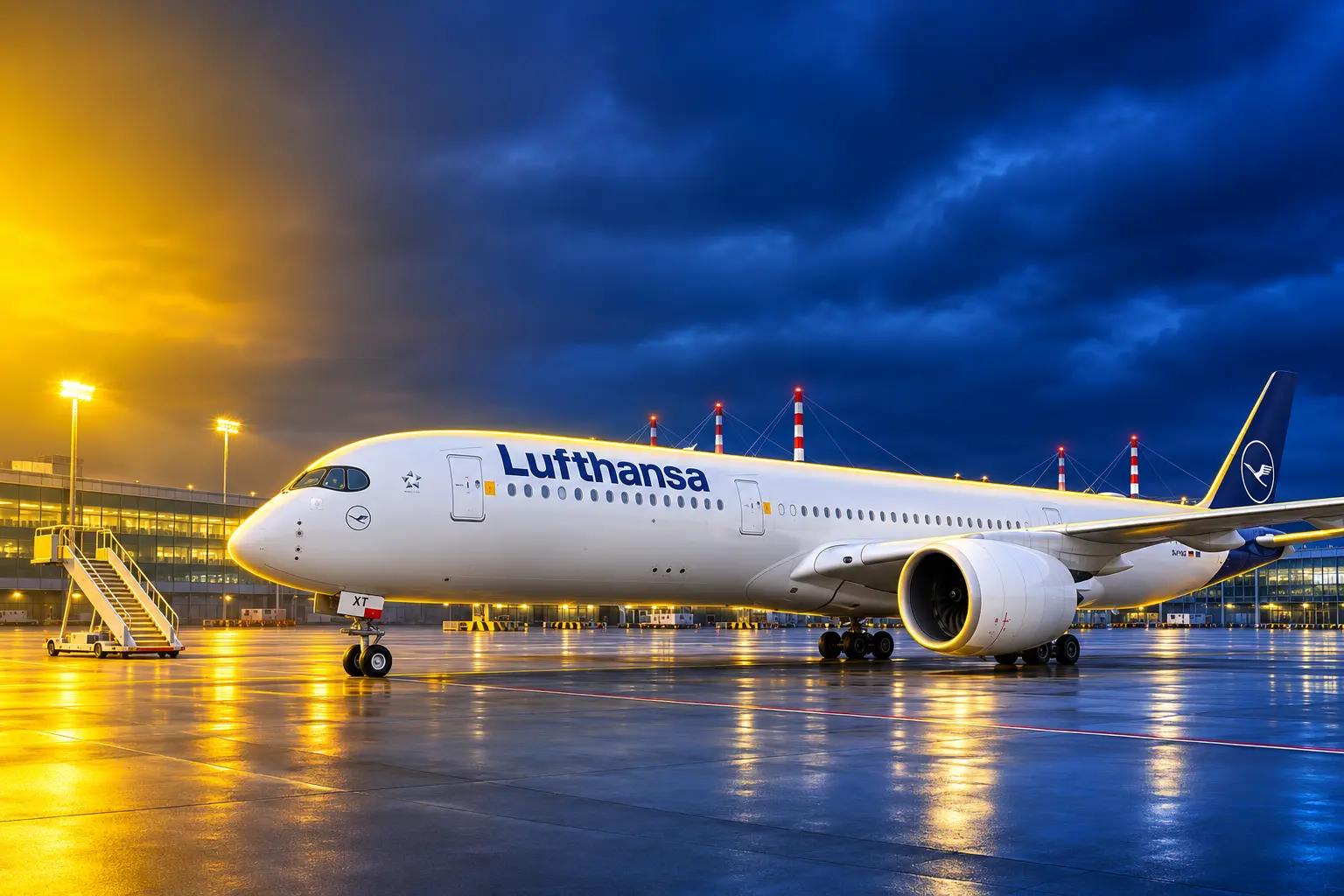
Spohr has already said the group wants more flying moved off the mainline onto Discover Airlines and Lufthansa City Airlines, where crew costs can run as much as 40 percent lower. That is the transfer sitting under the new letter. The Lufthansa Airlines sub-group in the accounts includes Discover and City Airlines, so a profitable summer at that combined unit can still hide a mainline that does not pay its way on short haul.
The letter says the sub-group will cut short- and medium-haul capacity further and reduce Airbus A320-family jets, with some of that flying replaced by Airbus A220s. Lufthansa’s core brand does not operate the A220. City Airlines does. The group has ordered 40 A220-300s for that carrier, laid out with 148 seats, and still expects the first airframe this year even after the planned January 5, 2027 line launch slipped. Across the North Sea, KLM is shrinking its European fleet and moving thousands of roles in the same direction: keep the hub, put the thin European metal on a cheaper contract.
Growth at City Airlines and Discover, which work on lower labor terms, is already the offset the core brand is using while it trims A320 flying. FAZ reporting on the letter made that split explicit. The 1,000 posts at the two German hubs are how that split shows up in headcount.
1,000 Full-Time Posts at Frankfurt and Munich
The sentence in the letter is blunt. “At our Frankfurt and Munich hubs, we now plan to reduce a total of 1,000 full-time positions across Lufthansa Airlines.” Ritter signed it with Jörg Beißel, Astrid Neben, Heiko Reitz and Francesco Sciortino. The board wrote that this is the third year in a row of not being financially successful, and that “on average, over the first nine months, we were losing 20 million euros monthly.”
The quarterly report puts the Lufthansa Airlines unit at an adjusted loss of €180 million for January through September, against a profit of €147 million a year earlier. The third quarter itself still made €300 million, down from €454 million. A profitable summer and a nine-month loss sat in the same set of books. Unadjusted EBIT for those nine months was a positive €41 million, mainly from book gains on two Boeing 747-8 sales, so the €180 million is the adjusted figure the letter used, not every accounting line.
WHAT WE KNOW
- The number: 1,000 full-time posts at Frankfurt and Munich, inside the Lufthansa Airlines sub-group.
- The loss: €180 million adjusted EBIT for the first nine months of 2026, €20 million a month.
- The prior plan: 250 core-brand posts had already been flagged; a spokeswoman said the 1,000 are additional.
- Germany headcount: about 67,100 Lufthansa Group staff in Germany at the end of 2025.
WHAT IS UNCONFIRMED
- The clock: the letter does not say when the posts come out or whether anyone is dismissed.
- The desks: no split between Frankfurt and Munich, and no named job families in the text.
- The 4,000: the letter does not say whether these 1,000 sit inside the group’s older administrative cuts.
A company spokeswoman said the 1,000 posts are extra, and that they cover administration and operations at the two hubs. A spokesman, asked about the letter, said the company had nothing to add to the board’s own words. Full-time posts are not the same as heads: part-time rosters would pull more people into any later social-plan count. The letter still gives no method, no year, and no department list.
What the Letter Changes for Crews Overnight
Jobs are only the first of six steps the board set out. The rest rewrites how the hubs run, who sleeps abroad, and who still flies cheap on a staff ticket.
THE SIX STEPS IN THE LETTER
- Headcount: 1,000 full-time posts come out at Frankfurt and Munich.
- Capacity: short- and medium-haul flying is cut again on the core brand.
- Fleet: A320-family jets in the sub-group fall, with A220s taking part of the work.
- Staff travel: companion tickets on ID-Travel are subsidized less, and Family Plus is under review.
- Waves: Frankfurt’s bank structure is recast so fewer crews night-stop abroad; Munich’s recast is already in motion.
- Cabin Wi-Fi: ten aircraft a month get Starlink, and the airline wants extra revenue from onboard internet.
Frankfurt still runs four long-haul arrival and departure banks a day. The point of moving those banks is not a new discovery about hotels. Night-stops generate allowances and rooms. Munich is the template. Vereinigung Cockpit, the German pilots’ union, called it absurd to dress a basic scheduling fact up as a crisis measure, and said optimized waves and expensive crew overnights should not surprise an airline board.
ID-Travel is the other quiet cut. Private trips by companions who do not work for the airline will be less heavily subsidized. Family Plus, the extra offer for relatives, is being reviewed. Those perks sit on the same letter as the 1,000 posts, and they hit people who keep their jobs as well as people who do not.
Starlink Goes In as Staff Travel Is Trimmed
The same board that is thinning companion tickets is speeding up cabin internet. Ten aircraft a month are to be fitted with SpaceX’s Starlink, the letter says, so the airline can sell connectivity. That is a faster clip than the first-wave plan, which had up to ten more A320-family jets at Lufthansa and City Airlines getting the kit before the end of 2026.
Group product policy still points the other way for members. The company has said Starlink Wi-Fi on 850 aircraft will be in place by 2029, free for Miles & More members and Travel ID users across cabins. Installers put two Starlink systems per A320neo, with antennas fore and aft. Dieter Vranckx, the group commercial chief, has called connectivity part of the premium promise. The letter’s line about extra internet revenue is the flagship looking for a till on a product the group has already advertised as free for status customers.
After two years of the turnaround, the managers wrote, the original measures are no longer enough to secure the future. 2026 set them back, they said: the war in the Middle East, persistently high fuel costs, nine days of strikes, and an already very high cost base.
Lufthansa Airlines is currently not competitive in terms of its cost structure, efficiency and productivity.
Lufthansa Airlines management letter to staff, November 20, 2026
Vereinigung Cockpit Calls the Letter a Pressure Play
The timing is not lost on the unions. Mediation with Vereinigung Cockpit ended without a deal on November 17. Days earlier the company had offered to hire up to 1,000 pilots by the end of 2033, with extra captain promotions, in a bid to settle pay, pensions and the future size of the core airline. The union has a deadline of November 23. The hub-jobs letter arrived in between.
Cockpit said dark scenarios were being used to stir uncertainty and put pressure on staff, and that the November 3 results presentation had drawn a different picture from the one staff were now reading. It also said the letter left unclear whether the 1,000 posts sit inside the earlier 4,000 or on top of them. On the wave plan, the union’s verdict was that this was a game with people’s fear about their futures, not responsible management.
ver.di, which represents ground staff at the core brand and cockpit and cabin crews at City Airlines and Discover, called it irresponsible to go to the workforce with a vague “we’ll just cut 1,000 full-time posts.” Concrete plans that a works council can answer are what it asked for, not intranet shock. The union said it knows the sub-group has been posting losses for years, and that it still wants to shape the change rather than read it on a staff portal. UFO, the cabin-crew union, was already on the 2026 strike ledger that the quarterly report names alongside Cockpit.
Lufthansa Airlines has set a staff briefing for November 24 to take questions on the plans. That date does not fix the roster, the city split, or the year the posts actually leave.
Turnaround Gains Still Leave the Flagship Short
The letter itself concedes the last program did not finish the job. Managers wrote that the turnaround has booked more than €1.5 billion of result contribution since 2024 and is aimed at €2.5 billion by 2028, and that this is no longer enough. Spohr told the Q3 call that reliability and customer scores had come back, and that the money had not.
THE CUTS ALREADY ON THE CLOCK
- September 29, 2025: The group, at its capital markets day, plans 4,000 administrative jobs by 2030, about 20 percent of admin roles, mostly in Germany, with about 1,500 admin hires abroad.
- November 3, 2026: Third-quarter results show a record group quarter and a flagship still carrying strike costs and a nine-month adjusted loss.
- November 17, 2026: Mediation with Vereinigung Cockpit ends with no deal; the company floats up to 1,000 pilot hires through 2033.
- November 20, 2026: Ritter’s letter sets out 1,000 hub posts, fewer A320s, thinner staff travel and a faster Starlink fit.
- November 23, 2026: Cockpit’s deadline on the failed mediation lands.
- November 24, 2026: Lufthansa Airlines briefs staff on the hub plan.
The 4,000-job track was sold as digitalisation, automation and less duplicate work between group companies. The new 1,000 sit on the two German hubs of the airline that still cannot make a nine-month profit, while Cargo, Technik and the cheaper sister brands carry the parent. How those 1,000 posts come out, and from which buildings, is the question the November 24 briefing has to answer. Cockpit’s November 23 deadline is the other clock in the same week.

The Fiber Swap Behind the FAA Nationwide Ground Stop

Skeyes Strike Grounds Brussels and Charleroi for 14 Hours

Australia Adds 120 Farm Days, Except for UK Backpackers

Lufthansa Cuts 1,000 Hub Jobs to Shield Group Profit

The Malpensa Strike Hits the Unprotected Afternoon Hours

United Folds Newark’s Lima Nonstop Into Its Houston Hub

Flight Cancellations Rise While the FAA Shrinks Staffing Targets

Airbnb’s 6% Direct Links Undercut the Host Website Pitch

United Bets the A321XLR on 10 New International Cities

Hitachi’s Aurora Faults Drove the EMR Bank Holiday Strike
-
 AIRLINES3 months ago
United Folds Newark’s Lima Nonstop Into Its Houston Hub
-
 AIRLINES3 months ago
Flight Cancellations Rise While the FAA Shrinks Staffing Targets
-
 HOTELS3 months ago
Airbnb’s 6% Direct Links Undercut the Host Website Pitch
-
 AIRLINES3 months ago
United Bets the A321XLR on 10 New International Cities
-
 NEWS3 months ago
Hitachi’s Aurora Faults Drove the EMR Bank Holiday Strike
-

 HOTELS3 months ago
Grand Canyon Hotels Close After a Repeat Pipe Flood
-

 NEWS3 months ago
The EU Pulled the 2026 ETIAS Date After Border Chaos
-

 NEWS3 months ago
Brussels Closed the EES Pause as Kiosks Keep Failing