
NEWS
The UK Flood Warning Leaves Thailand Open to Travellers
UK flood advice still describes Bangkok’s 50-district peak, but 29 districts remain listed, the islands stayed open.

The UK Foreign Office has not advised against travel to Thailand over the floods, even after all 50 Bangkok districts were declared disaster areas. Its Thailand page, still current on 1 October and last updated on 28 September, warns of road closures and water in low ground. It does not treat the capital as a no-go zone.
That gap is the trap for anyone holding a ticket. Bangkok has already shrunk the disaster map, the beach provinces were never in this pulse, and insurers will not treat a weather warning as a ban. The pinch for visitors is getting through Suvarnabhumi, then moving around the east of the city.
The Foreign Office Warning Still Describes the 50-District Peak
The Foreign, Commonwealth and Development Office posted updated Thailand travel advice on flooding on 28 September. The note names Bangkok, Nonthaburi, Pathum Thani and Samut Prakan, and it still says all 50 districts of Bangkok have been declared disaster-affected areas. It flags possible road closures and flooded low ground, and it tells travellers to follow local officials.
The same page records the Thai government’s special public holidays on 28 and 29 September in those four provinces, with government offices closed or running thin. Those two days have already passed. The flood paragraph has not been rewritten to match what Bangkok announced the next evening.
The actual against-travel zones on that page are older, and they are not this storm. FCDO still advises against all but essential travel to Pattani, Yala and Narathiwat, and to the Chana, Thepa, Na Thawi and Saba Yoi districts of Songkhla, because of attacks near the Malaysia border. It also advises against all but essential travel within 20 km of the land border with Cambodia. Insurance can fail if you go into those strips. The Bangkok flood text is a warning, not that kind of ban.
A U.S. Embassy weather alert for Thailand on 26 September asked people to postpone non-essential trips in affected areas until the rain eased, stay off small boats in the upper Gulf and upper Andaman Sea, and watch Thai Meteorological Department updates on 1182. That notice was written at the height of the downpour, not after the holidays.
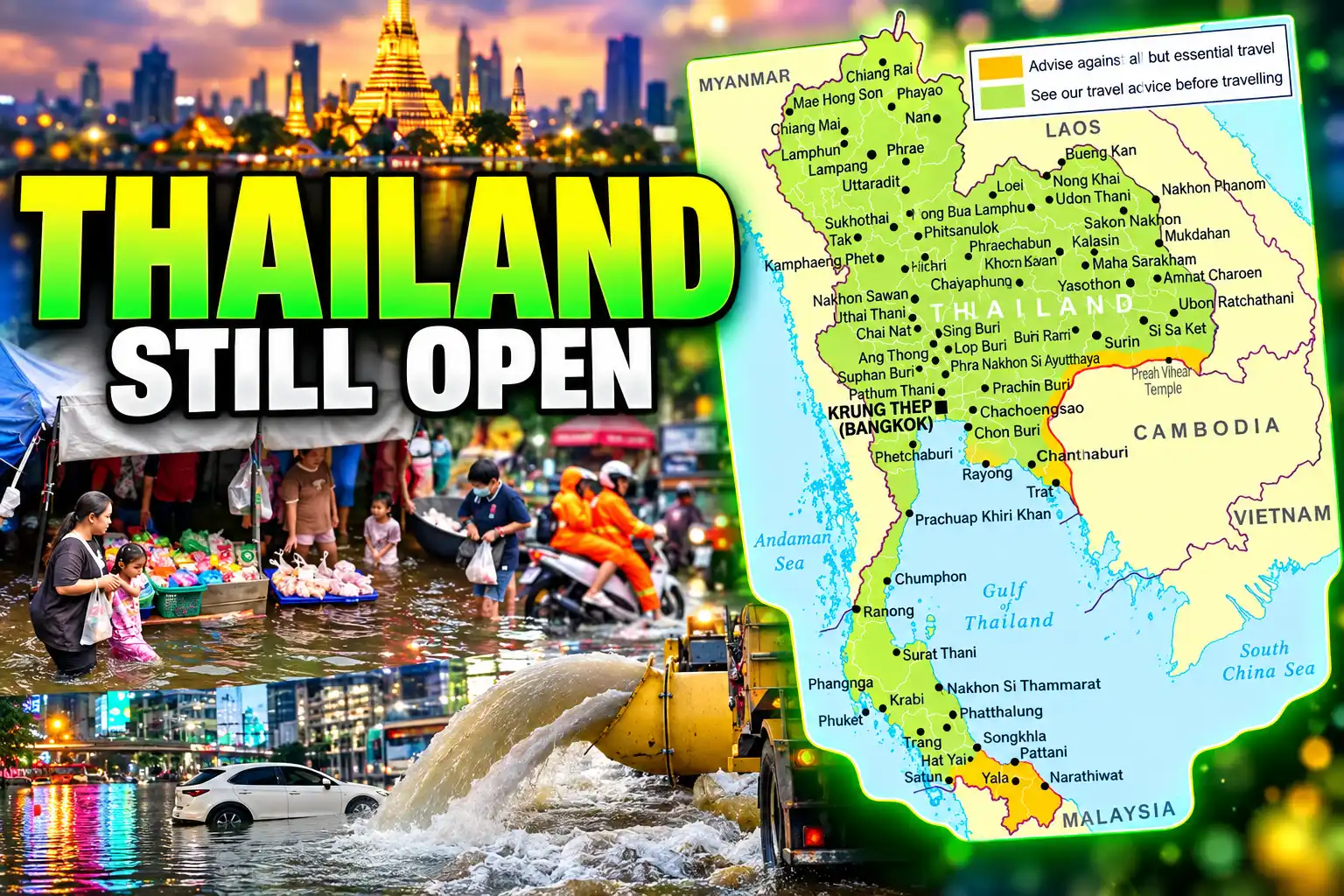
Bangkok Cut Its Disaster Zone to 29 Districts
The Bangkok Metropolitan Administration named all 50 districts a disaster on 25 September after a weekend of rain that put about 320 mm on the city in three days, close to a normal September total. Governor Chadchart Sittipunt said he expected floodwater off major roads within two days of 29 September, and up to a week in other flooded pockets. “Recovery efforts are under way in areas where the water has gone down,” he said.
On the evening of 29 September the city ended the disaster in 21 districts. A field check found 21 districts unaffected, 14 moderately hit and 15 hard hit, so the declaration stays on 29 districts. The remaining list is heavy on the east and north, including Lat Krabang, Min Buri, Khlong Sam Wa, Saphan Sung, Bang Kapi, Sai Mai and Nong Chok. Siam and the old city are not the same story as those roads.
THE FLOOD IN FIGURES
- Deaths: The Interior Ministry on 29 September put the toll at 23 since 16 September, including 4 in Bangkok.
- Bangkok households: About 329,000 households, or around 700,000 people, were hit in the capital.
- Countrywide on 1 October: The Department of Disaster Prevention and Mitigation counted 1,177,404 households and 3.35 million people still affected across 30 provinces.
- Shelter: Thai Red Cross reporting compiled by the IFRC put about 8,000 people displaced, with 233 temporary shelters in Bangkok.
Those national numbers grew after the capital’s rain stopped, because river water was still rising in the Central Plains and the east. Samut Prakan, Pathum Thani, Ayutthaya and Sa Kaeo sat in that wider count. This is a basin flood, not a shutdown of every tourist postcode.
WHERE THE WATER SAT AGAINST THE VISITOR MAP
| Area | Flood role | Visitor picture |
|---|---|---|
| Bangkok tourist core | Patchy roads, centre not the worst | Grand Palace, Wat Pho, Wat Arun, Siam, Chinatown open |
| Eastern Bangkok | Hardest hit; Lat Krabang still 40 cm on 1 October | Avoid small cars on low roads; allow extra airport time |
| Suvarnabhumi and Don Mueang | Airports stayed open; staff could not get in | Flights ran with delays, cuts and a bag pile |
| Phuket, Krabi, Koh Samui | Not in this Chao Phraya pulse | TAT said they kept receiving visitors |
| Chiang Mai and Chiang Rai | Outside this Bangkok event | Open; earlier hill rain was a separate local risk |
| Far south and Cambodia strip | Not this flood | FCDO still advises against all but essential travel |
The Tourism Authority of Thailand said on 29 September that overall weather and travel conditions in Bangkok and nearby provinces had improved, and that major Bangkok sights remain accessible. It named Siam and Ratchaprasong, Yaowarat, Talat Noi and Song Wat, plus the Grand Palace and the Temple of the Emerald Buddha, Wat Pho and Wat Arun. The Airport Rail Link, the Red Line, BTS and MRT were running, which is the practical way around flooded streets.
Phuket, Chiang Mai and the Islands Stayed Open
TAT’s Chengdu office spent 28 September trying to kill a “perception crisis” on Chinese social media. Airports were open. Phuket, Krabi, Koh Samui, Chiang Mai and Chiang Rai were not under the Bangkok disaster order. The fear was the pictures, not a closed south.
That split matters if your itinerary only connects in Bangkok. Pattaya and Hua Hin sit on the same road and rail web as the capital, so a slow transfer can still wreck a day even when those towns are dry. Island trips that never needed a Bangkok hotel are a different product.
IF YOUR PLANS ARE OUTSIDE THE CAPITAL
- Andaman and Gulf islands: Phuket, Krabi and Koh Samui were not in the 50-district order and kept taking visitors, per TAT.
- The north: Chiang Mai and Chiang Rai were classed as low impact for this event and could pick up travellers rerouting around Bangkok.
- Hill rain, separate file: Mae Hong Son and Chiang Mai saw landslide and flash-flood incidents in mid-September, including closed waterfall sites at Doi Suthep-Pui. That is monsoon hill risk, not the capital’s canal flood.
- Khao Sok: Rescuers pulled residents and foreign tourists from riverside resorts in Phanom, Surat Thani, on 19 September after the Sok River rose. Check park notices before a jungle stay.
Clips of a drowned terminal kept spreading on 1 and 2 October, days after both international airports had stayed open. Some of those clips show metal carts riding water in a way that does not match a working baggage hall. The official problem at Suvarnabhumi was staff who could not reach the building, not a closed runway under the Gulf of Thailand.
Why Suvarnabhumi Became the Choke Point
Both of Bangkok’s international airports stayed open. The failure was on the ground. Thai Airways said about half of its people could not get to work, which wrecked bag handling and the departure bank. Tourism minister Surasak Phancharoenworakul accused the airline of sending staff to contracted ground jobs for other carriers to avoid penalty fees, and said, “This damages the country’s image.”
Almost 100% of flights over the past two days were delayed, with fewer than 3% on schedule as operational capacity could not be sustained.
Chai Eamsiri, chief executive, Thai Airways, speaking in Bangkok on 29 September 2026
The carrier planned to cut about 30 flights, about 30% of planned Bangkok departures, on 29 September, and said the thinner schedule would last at least three days. About 5,600 bags from Thai Airways flights sat at Suvarnabhumi. Chai said the pile would be cleared within 72 hours, with air force personnel brought in to sort it. Extra cancellations later in that window included Phuket, Chiang Mai, London, Amsterdam, Frankfurt and Singapore sectors.
TAT told passengers to skip the Lat Krabang road in to Suvarnabhumi because of standing water, and to use Motorway No. 7 or the Burapha Withi Expressway. It asked for at least three hours before an international flight and two hours before a domestic one. Don Mueang stayed open, though metered taxis at that terminal were suspended for a stretch, which pushed people onto the SRT Red Line.
On 1 October, the Bangkok Flood Prevention Center still listed water on Phahonyothin, Lat Krabang and Luang Paeng, with 40 cm in front of Lotus Lat Krabang and traffic stopped there. Elevated rail remained the reliable move. A city that can flood a frontage road can still run a skytrain.
Can You Cancel a Thailand Holiday for the Floods?
No special full-refund rule kicked in for UK travellers, because FCDO did not warn against travel to Bangkok or to Thailand as a whole over the water. If you cancel for comfort, that is a contract fight with your airline or tour firm, not a government trigger. Travel insurance that follows FCDO advice will not treat this flood note like the south-border ban.
Several carriers did offer their own relief around 26 to 29 September. Thai Airways pointed to one free date change on the same route and class, and a full refund if it cancelled the flight. Bangkok Airways, Thai AirAsia, AirAsia X, Nok Air, Thai Vietjet and Thai Lion Air posted short-window changes or credits with different cut-offs. Those windows were tied to the holiday dates, so a ticket in mid-October is a different ask.
BEFORE YOU CHANGE A PAID TRIP
- Read the FCDO page, not the clip: The flood text is a disruption warning. The against-travel list is still the far south and the Cambodia strip.
- Ask the operator first: Hotels in central Bangkok largely avoided direct inundation, and the Thai Hotels Association expected occupancy in the capital to fall by less than 10% across September and October.
- Build the airport transfer around rail: BTS, MRT, the Airport Rail Link and the Red Line kept running when frontage roads did not.
- File delayed bags before you leave the hall: The 5,600-bag pile was a ground-staff failure, and it outlasted the heaviest rain.
Prime Minister Anutin Charnvirakul said cabinet approved more than 4 billion baht ($119 million) in flood aid, plus a 160 billion baht drainage project for the central region and Bangkok that will take eight years. That is a long civic job. It is not a reason an insurer has to unwind a Phuket week.
Golden Week Crowds Arrived Anyway
China’s National Day holiday runs 1 to 7 October. TAT had already sold the longer Mid-Autumn plus National Day window, 25 September to 7 October, as a 250,000 Chinese arrivals over Golden Week, up 24%, with about 11.5 billion baht in tourism revenue, up 37%. For 1 to 7 October alone it forecast about 137,000 arrivals, up 21%, and about 4.2 billion baht, up 35%. ForwardKeys showed October bookings to Thailand up 16% and flight searches from China up 24%.
On 28 September, TAT’s Chengdu office still put a 5-10% miss on the table if the images kept circulating. By 1 October the tone had flipped. Yolrawee Sittichai, director of the TAT Beijing office, said Chinese tour operators were sticking with planned trips as baggage handling eased. Lerdchai Wangtrakoondee, director of the TAT Shanghai office, said most Chinese visitors fly Chinese airlines, which cut the Thai Airways mess out of their day. TAT put more than 22,000 Chinese arrivals on that Wednesday, against a usual daily level of more than 10,000, and said Chinese arrivals this year were up 15%.
The wider foreign market is softer. Foreign arrivals from January to September were 21.28 million, down 3.12% year on year. China is still the arrival engine TAT is trying to protect, which is why a week of flood video in the capital is treated as a commercial event, not only a drainage one.
Eastern Roads and High Tides Through 4 October
The Office of the National Water Resources warned of high tides from 29 September to 4 October in Bangkok and seven other provinces along the Bang Pakong, Chao Phraya, Tha Chin and Mae Klong. Communities outside flood walls, and stretches of Sukhumvit, Suksawat and Rama II, were named. That window was still open after the public holidays ended.
THE WEEK THE CITY WENT UNDER
- 16 September 2026: DDPM’s running flood-death count begins; the later Interior Ministry total is 23, with 4 of those in Bangkok.
- 24 to 27 September 2026: About 320 mm of rain hits Bangkok in three days. The city names all 50 districts a disaster on 25 September.
- 28 to 29 September 2026: Special public holidays in Bangkok, Nonthaburi, Pathum Thani and Samut Prakan. Thai Airways cuts about 30% of Bangkok departures and works a 5,600-bag pile.
- 29 September 2026: BMA ends the disaster in 21 districts and keeps it on 29. TAT says core sights and mass transit are open.
- 1 October 2026: DDPM still lists 30 provinces and 3,352,395 people affected. Eastern Bangkok roads remain wet. Golden Week begins.
In 2011, World Bank assessment work put more than 13 million people in the flood zone and more than 680 deaths, with months of water on industrial estates north of the capital. This September event is smaller and shorter, and the visitor core kept its doors open. It is still large enough that 29 districts remain listed, river levels are not finished, and a UK advice page dated 28 September still leads on all 50.
If you fly in before 4 October, treat eastern Bangkok as wet ground, build the airport transfer on rail, and read the FCDO flood paragraph as a lagging snapshot of the peak, not as a ban. The holidays are over. The high-tide window is not.
Disclaimer: This article is news reporting on official travel notices, airline operations and flood bulletins. It is informational only and is not legal, insurance or booking advice, and it does not instruct anyone to cancel or keep a trip. Speak with your airline or tour operator, and with a qualified insurance broker or travel lawyer, before you change paid plans. Figures and warnings reflect the official notices dated through 1 October 2026 and may change with the next weather or FCDO update.

IHG’s $350 Card Keeps Platinum as Premier Drops to Gold

The UK Flood Warning Leaves Thailand Open to Travellers

TSA Pulls Checkpoint Chairs and Calls It Hospitality

The World Cup Ended and U.S. Arrivals Fell Harder

Royal Caribbean Buys Half of Sandals and the Storm Risk

Flight Cancellations Rise While the FAA Shrinks Staffing Targets

United Folds Newark’s Lima Nonstop Into Its Houston Hub

United Bets the A321XLR on 10 New International Cities

Hitachi’s Aurora Faults Drove the EMR Bank Holiday Strike

Airbnb’s 6% Direct Links Undercut the Host Website Pitch
-
 AIRLINES1 month ago
Flight Cancellations Rise While the FAA Shrinks Staffing Targets
-
 AIRLINES1 month ago
United Folds Newark’s Lima Nonstop Into Its Houston Hub
-
 AIRLINES1 month ago
United Bets the A321XLR on 10 New International Cities
-
 NEWS1 month ago
Hitachi’s Aurora Faults Drove the EMR Bank Holiday Strike
-
 HOTELS1 month ago
Airbnb’s 6% Direct Links Undercut the Host Website Pitch
-

 NEWS1 month ago
ATSB Opens Six Sydney Airport Ground Conflict Files
-

 NEWS1 month ago
The EU Pulled the 2026 ETIAS Date After Border Chaos
-

 NEWS1 month ago
Extra Months on Old UK Passports Still Block EU Entry