HOTELS
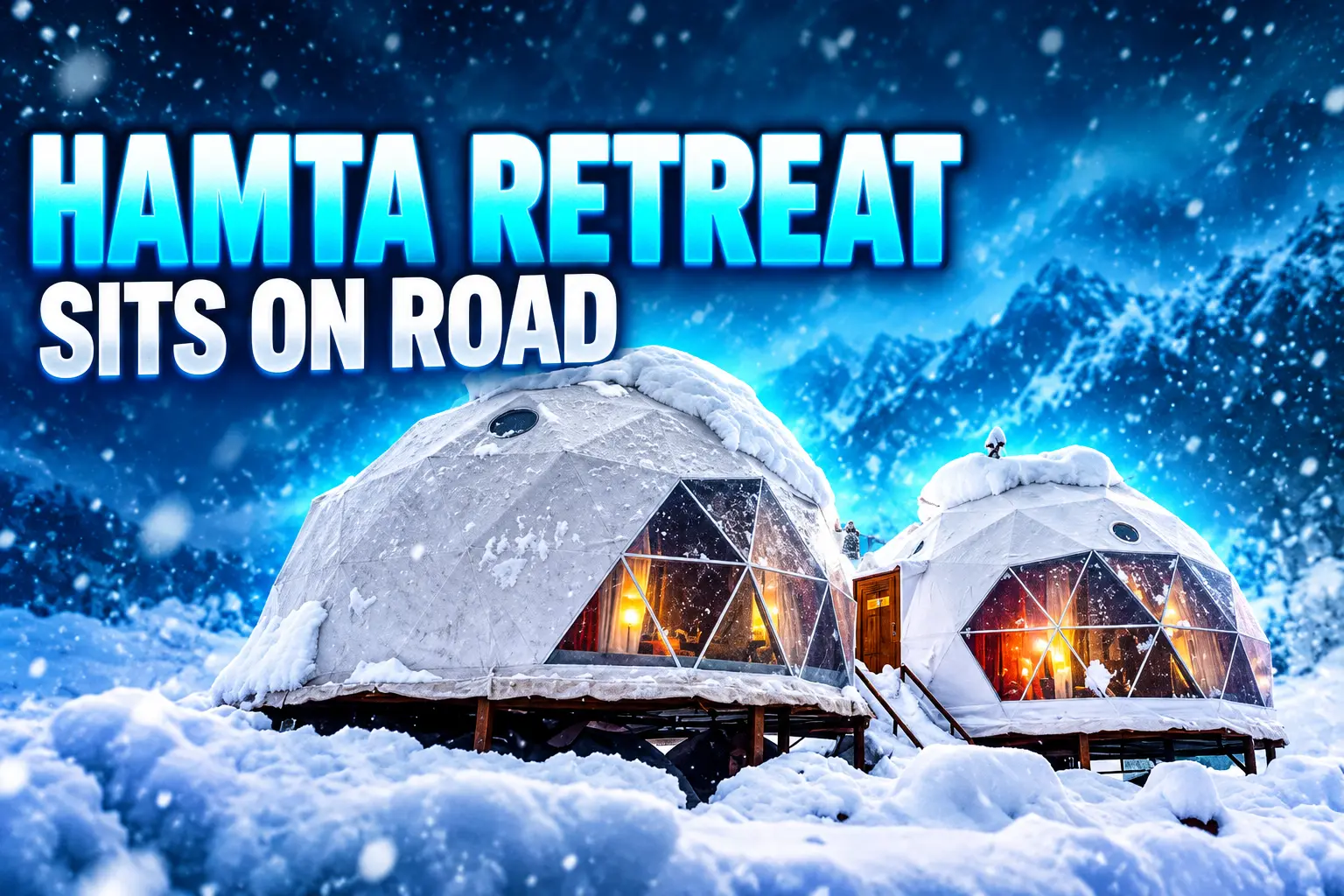
Nirvana Hamta Retreat Sits on a Built Hydel Road
Nirvana Hamta Retreat’s glass cottages sit on a Hamta hydel-road glamping strip 12 km above crowded Manali, with nights listed from ₹8,000.

Nirvana Hamta Retreat lists luxury glamping from ₹8,000 a night on Curve 30 of the Hamta hydel road, 12 km above Manali. An August 15 note from the property calls the stay a quieter side of the hill town. The same road already holds geodesic camps, glass houses, and a winter igloo trade that local crews have sold for a decade.
Curve 30 Above the Kullu Valley
The retreat sits on Hampta Pass Hydel Project Road near Sethan Igloo Village, in Prini, at a claimed 2,000 ft (600 m) above town. Its own page names three paid products: Beas and Raavi double-storey glass cottages with bathtubs, Shell cocoon glamps with a private jacuzzi, and a Zanskar family dome. The listing on Google Hotels shows a 4.6 score from 745 reviews, which is the record of a camp that has been taking guests for years, not a new flag on a blank slope.
A spokesperson for Nirvana Hamta Retreat said travelers now pick the bed as part of the trip, not only the viewpoint.
Modern travelers are no longer choosing destinations based solely on sightseeing opportunities. Many guests are looking for memorable places to stay that become part of the travel experience itself.
Spokesperson, Nirvana Hamta Retreat, August 15 statement
Guest notes on the site are more practical than that line. Anushka Tiwari named the owners as Sagar and Dipshika and wrote that they “will make this a place a living heaven for you.” Nitin Varghese praised hot water at all hours, food, the campfire, and the dome. Ayush Srivastava called the hospitality excellent. Those are comfort scores, and they match what the rate card is selling: a jacuzzi and a glass wall, not a blank meadow.
Hamta Road Already Hosts a Glamping Strip
Sethan is a small Buddhist hamlet of about 10 to 15 Khampa families at 2,700 m, on the approach to Hampta Pass. The village itself sits around curves 35 and 36 of a road with about 38 bends. An operator who ran a rented hotel in the valley wrote that nearly 90 percent of guesthouses stand before the village, because phone signal dies around curve 35, even for BSNL. Nirvana’s pin is Curve 30, which places it on the built approach, not inside the hamlet.
Travelers already treat that approach as a product map. One December 2025 note from the road named Kalzang Dhaba and then “the jacuzzi wala property” as Nirvana’s dome, which is how the stay is found in practice: a known tub on a known curve, beside a known dhaba.
CAMPS ON THE SAME HYDEL ROAD
- Curve 23: Hamta Orchard and Resort, about 8 km from Manali’s private bus stand, sells geodesic domes, a glass house, mud rooms, and bunks.
- Curve 29: Glamping Club lists a luxury dome on AD Hydro Project Road in Hamta village.
- Curve 30: Nirvana Hamta Retreat, glass cottages, shell glamps, and the jumbo dome.
- Curves 32 and 33: GlampEco Stays markets geodesic domes on the same hydro road, with a 4.9 score from 1,609 reviews on its Google listing.
- Named neighbors: Dream Hamta Cafe, Awe Glamping, The White Musk, and Mystic Heist sit on the same climb, along with Infinity Sky’s glass igloos advertised from ₹4,940 a night.
That cluster is the story the August note does not tell. A guest who wants a dome with a tub is choosing among several pins on one hydel alignment, not discovering an empty valley.
What a Night in a Glass Cottage Costs
A night in Nirvana’s glass cottage is listed at ₹8,000 for four people, with a monsoon sale at ₹3,599; the jumbo dome is ₹14,000 for six, and the shell jacuzzi glamp is ₹12,000 for four. Those figures sit in the same band as other Hamta glass and dome products, and they sit far above village homestays that still quote ₹800 to ₹1,500 with meals.
The property’s own site has listed glass cottages from ₹8,000 a night, with the monsoon cut marked beside the rack rate. Families can book the Zanskar family dome with five-seat jacuzzi at ₹14,000, or ₹9,699 on the sale line. Down-slope, Hamta Orchard publishes geodesic domes from ₹7,500 a night, with its Jupiter 8 m dome at ₹13,099 and a glass house at ₹13,999.
NIGHTLY RATES ON THE HAMTA CLIMB
| Stay | Pin | Listed night rate | Sleeps |
|---|---|---|---|
| Beas and Raavi glass cottages | Nirvana, Curve 30 | ₹8,000 (₹3,599 sale) | 4 |
| Zanskar jumbo dome | Nirvana, Curve 30 | ₹14,000 (₹9,699 sale) | 6 |
| Shell jacuzzi glamp | Nirvana, Curve 30 | ₹12,000 (₹6,999 sale) | 4 |
| Mars 6 m dome | Hamta Orchard, Curve 23 | ₹7,500 | 2+1 |
| Jupiter 8 m dome | Hamta Orchard, Curve 23 | ₹13,099 | 2+1 |
| Snow igloo, meals included | Sethan / Hamta, winter only | ₹11,000 per couple | 2 |
| Village homestay | Sethan | ₹800 to ₹1,500 | varies |
Winter snow igloos, when they stand, undercut the jacuzzi rack rates if you count per couple, and they include meals and snow play in the packages local operators quote. They are also a different night: sleeping bags, a short season, and no claim of a five-seat tub. Homestays remain the local-price floor. The glass and dome tier is a ₹7,500 to ₹14,000 product aimed at couples and small groups who will pay to look at Manali from above it.
₹9 Lakh Now Buys One Biswa
The people with the oldest claim on this hillside are not the dome brands. Sethan’s households are described as Khampa families with Buddhist practice, many of them wintering down in the Kullu Valley when snow closes the benches. They were given land in Hamta when Himachal was still part of Punjab, after arriving as herders and traders from Tibet and Spiti. Less than 20 houses still make the village, and most original families still move lower when winter hardens.
Money moved faster than that calendar. An operator who began running a rented hotel near Sethan in 2021 wrote that one biswa (about 40 square metres) then cost less than ₹3 lakh, and that by 2025 the same unit cost ₹9 lakh. That is a threefold rise in four years, and the same account flags forest encroachments beside the legal plots. Everyone in paid lodging, the operator added, was making “big money throughout the season.”
Kundan Lal, former pradhan of Prini panchayat, has said Hamta and Sethan only grew as a visitor zone after the Allain Duhangan hydroelectric project built the road. The climb that the camps now sell as scenery was a project access line first. Land at ₹9 lakh a biswa is what that access did when Mall Road filled up.
Tashi, Vikas and the Igloo Season
Glass walls are the new photograph. Snow houses were the first paid novelty, and they still return every winter on the same slopes.
HOW SETHAN LEARNED TO SELL A NIGHT IN SNOW
- 2012: Local youths Tashi (also named Tashi Dorji) and Vikas build a first igloo in Sethan, first as a stunt among friends.
- 2016: Commercial igloo stays begin, which several later guides still call India’s first paid igloo night.
- Winter 2026: Operators put up more than 20 snow igloos around Hamta and Sethan at about 9,000 ft; Tashi and Vikas built nine of them on two sites.
- February 2026: Local quotes put a couple’s igloo night, with meals and snow activities, around ₹11,000; another operator, Negi, quoted ₹5,500 per person including meals and skiing.
- Mid-March: Camps come down as the structures soften; by late March the igloos are gone.
A season account from the valley said Tashi and Vikas now employ about 15 young people and take in ₹25 lakh to ₹30 lakh in a season. That is village-scale winter work, and it started years before anyone listed a five-seat jacuzzi. The August glamping note arrives on top of that older trade, not in place of it. Guests who want snow still book the ice huts. Guests who want a tub book Curve 30. Both products use the same hydel road and the same “not Mall Road” line.
How You Reach Sethan From Manali
From Mall Road the climb is about 12 km via Prini and takes 35 to 45 minutes in summer, or one to two hours when ice sits on the bends. The road from Prini runs about 35 hairpin turns. Trip notes put a one-way taxi at ₹1,200 to ₹2,000 in ordinary weather, and operators in the valley have seen quotes of ₹2,000 to ₹7,000 in peak winter, when only 4x4s are much use. Limited HRTC buses cover the route at about ₹150 and about 45 minutes; frequency is thin, so the Himachal roadways bus schedule pages are worth a look before you count on a bus.
You need a permit. Sethan and Hamta Valley are treated as a protected zone, and the hydro checkpost at Prini stops vehicles. 2026 trip notes list ₹100 per person, with Aadhaar, the vehicle RC, and a PUC certificate; an operator account also quotes ₹250 for cars and ₹100 for motorcycles. The amounts do not match across those notes, but the barricade is not optional. There is no fuel pump and no ATM in the village. The last of both sit in Manali, 12 km below. Inside Sethan, mobile coverage is described as nil, which is why so many camps stopped short of the last curves.
Self-drive works in summer in an ordinary car if you can handle the hairpins. In winter, high clearance and 4×4 are the local advice. Peak monsoon is the window several guides tell visitors to skip, because the same narrow road sheds rock and mud. Bhuntar airport is about 50 km from Manali, with patchy flights; most people still roll in by road from Chandigarh or Delhi.
Peak Traffic Now Climbs the Same Hairpins
Manali town is why this road has a rate card. The state Economic Survey 2025-26 put domestic tourist arrivals at 311.47 lakh in 2025, up from 32.13 lakh in 2020, against a state population of about 75 to 76 lakh. A written assembly reply counted 1,06,28,706 arrivals in 2026 by August 1. Manali itself holds more than 1,000 registered hotels and 300 homestays.
MANALI ON A PEAK SUMMER DAY
- Inflow: Police said more than 3,000 tourist vehicles entered daily in June 2026, on top of Volvo buses.
- Town movement: Manali DSP KD Sharma said 12,000 to 15,000 vehicles move in town in season, with slow traffic taking about three hours to clear toward Rohtang and the Atal Tunnel.
- Beds: Roshan Thakur, president of the Manali Hoteliers’ Association, said occupancy in June 2026 sat around 80% to 90%.
- Tunnel: Atal Tunnel was built for 4,500 vehicles a day; traffic counts in the 2026 season have run near 11,000, with more than 45,760 tourist vehicles in one May week.
That load is what sends paid nights up the hydro hairpins. The operator who left the valley described kilometre-long winter jams at the snow point, dusty summer construction, late-night music from hotels, and plastic without a proper dump. He stopped recommending Sethan and shut his own dome camp. Other guides still send people up for stars, bouldering, and a quieter slope than Solang. Both can be true on the same road: quieter than Mall Road, and no longer empty.
On the retreat’s booking page, glass cottages still show a monsoon rate of ₹3,599 and the jumbo dome ₹9,699. The climb from Prini is the same 35 hairpins either way.


Marriott Stakes the JW Name on a Converted Guanacaste Resort

Alaska Stakes Aurora Suites on an Uncertified 737-10

Leeds Bradford Strike Puts Aena Between Two Airports

United Bets on Flagstaff Again With Denver Flights

UK eGates Start Letting British Passengers Skip the Passport Scan

Flight Cancellations Rise While the FAA Shrinks Staffing Targets

United Folds Newark’s Lima Nonstop Into Its Houston Hub

Hitachi’s Aurora Faults Drove the EMR Bank Holiday Strike

Airbnb’s 6% Direct Links Undercut the Host Website Pitch

United Bets the A321XLR on 10 New International Cities
-
 AIRLINES1 month ago
Flight Cancellations Rise While the FAA Shrinks Staffing Targets
-
 AIRLINES1 month ago
United Folds Newark’s Lima Nonstop Into Its Houston Hub
-
 NEWS1 month ago
Hitachi’s Aurora Faults Drove the EMR Bank Holiday Strike
-
 HOTELS1 month ago
Airbnb’s 6% Direct Links Undercut the Host Website Pitch
-
 AIRLINES1 month ago
United Bets the A321XLR on 10 New International Cities
-

 HOTELS1 month ago
Grand Canyon Hotels Close After a Repeat Pipe Flood
-

 NEWS1 month ago
The EU Pulled the 2026 ETIAS Date After Border Chaos
-

 NEWS1 month ago
ATSB Opens Six Sydney Airport Ground Conflict Files