
NEWS
ATSB Opens Six Sydney Airport Ground Conflict Files
ATSB has six Sydney Airport ground files open, yet only one is an accident, and CASA had already cleared the training.

The Australian Transport Safety Bureau opened a short investigation into a Qantas taxiway conflict at Sydney Airport on 18 August, classing it as an incident with no injuries.
The A321 bound for Melbourne stopped after its crew saw a Gold Coast 737 approaching from the left. Investigators now have six Sydney ground files open since 27 July, and only one is classed as an accident.
Two Qantas Jets, One Taxiway Intersection
The 18 August taxiing conflict began at 0809 Australian Eastern Standard Time, after a Boeing 737-838 registered VH-VXL landed on runway 34 right as Qantas flight QF589 from the Gold Coast.
That crew taxied west along taxiway L with a clearance to turn right at taxiway B. At the same time an Airbus A321-271NY, VH-OGA, operating QF405 to Melbourne, taxied south along taxiway C with a clearance to turn right onto taxiway L.
As the Airbus approached taxiway L, the crew saw the Boeing coming from the left and stopped. ATSB said there was no immediate risk of collision and that the A321 braked normally. It labelled the event a safety incident rather than a serious incident, under investigation AO-2026-091, with highest injury none and damage nil on both airframes.
Qantas said both of its aircraft on an earlier July file had been cleared to proceed on air traffic control instructions and that it would support the bureau. The same posture has followed the later Qantas ground events: crews following clearances, and the airline waiting on investigators.
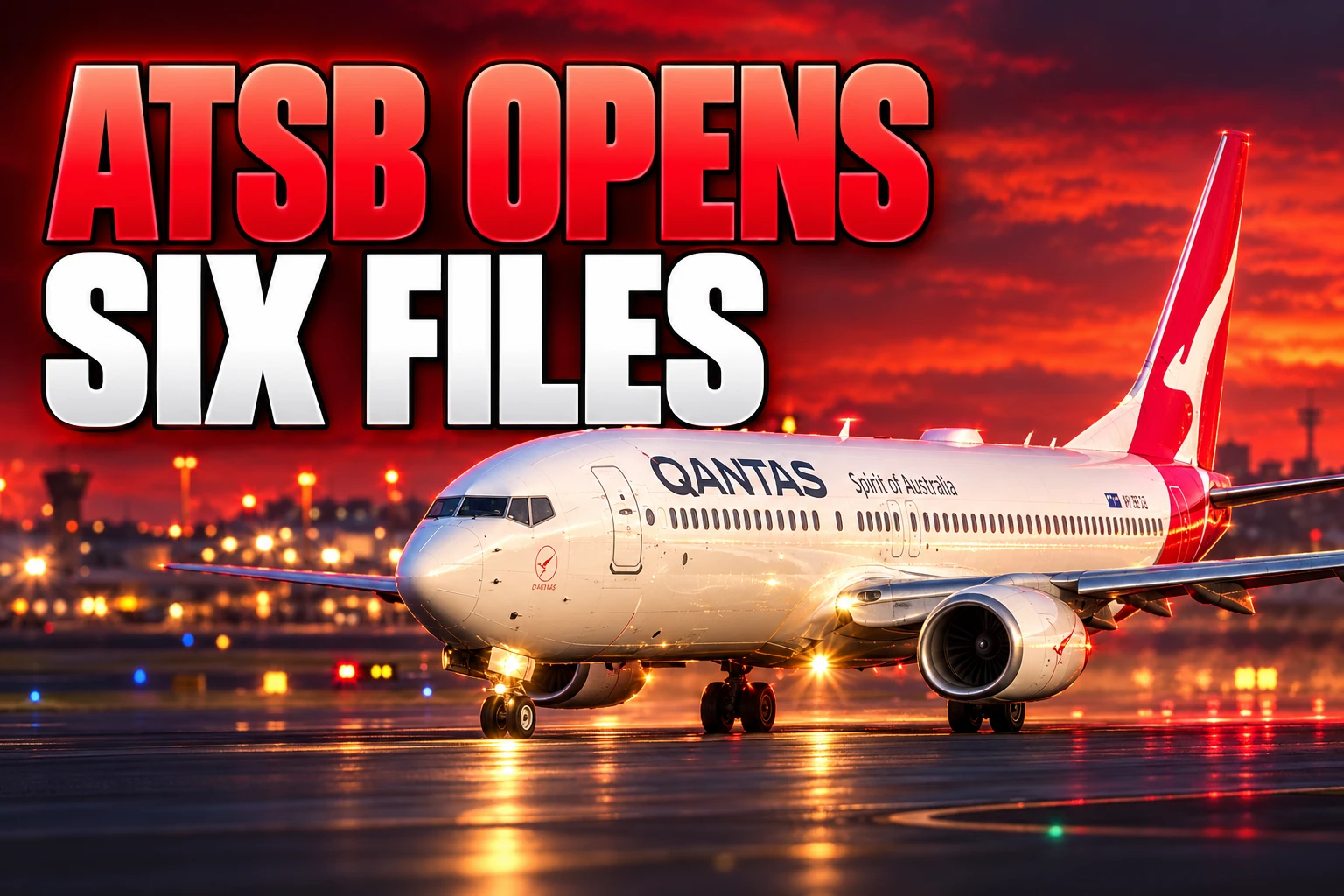
ATSB Split the Files by Class
The 18 August file is the one that produced the “fourth close call in a month” framing. By 26 August the bureau had opened two more taxiing inquiries and said it was still running each Sydney event as a separate investigation, with teams coordinating, and would only widen or combine them after the evidence is in.
The labels already differ. One file is an accident with a serious crew injury. Several later ones are incidents the bureau has expressly declined to call near collisions, because flight and ground crews stopped in time and, in its words, key safety defences remained in place.
THE SIX SYDNEY GROUND FILES
| Date and time | Aircraft and flights | ATSB opening label | Highest injury |
|---|---|---|---|
| 27 July, 0814 | QantasLink Dash 8 QLK424D (Canberra) and Qantas 737 QFA124 (Queenstown) | Runway incursion, breakdown of coordination (AO-2026-086) | None |
| 9 August, 0720 | Jetstar A320 JQ402 (Gold Coast) and Qatar 777 A7-BEU under tow | Accident, taxiing proximity (AO-2026-087) | Serious, one cabin crew |
| 9 August, about 1000 | Virgin 737 VA555 (Perth) and Qantas 737 QF728 (Ayers Rock) | Runway incursion and rejected take-off (AO-2026-090) | None reported |
| 17 August | Virgin 737 (runway 16 left) and Qantas 737 (runway 16 right) | Incident, not a near collision (AO-2026-093) | None stated |
| 18 August, 0809 | Qantas A321 QF405 (Melbourne) and Qantas 737 QF589 (Gold Coast) | Incident, failure to pass traffic (AO-2026-091) | None |
| 25 August, morning | Jetstar A320 and a Bombardier Dash 8 behind it | Incident, not a near collision (AO-2026-092) | None stated |
Those openings now sit with the six ground conflicts after the overhaul already logged at Kingsford Smith, still as separate inquiries. Preliminary reports on the August taxiing files are expected in about six to eight weeks from the bureau’s statements.
Jetstar 402 and the Towed Qatar 777
The file that does not fit the “two airliners, two taxi clearances” pattern is the only accident. At 0720 on 9 August, Jetstar Airbus A320-232 VH-VQJ was taxiing as JQ402 to the Gold Coast when its crew saw a Qatar Airways Boeing 777-300ER, A7-BEU, in close proximity on a crossing taxiway.
The 777 was under tow from an aircraft tug. Both aircraft stopped abruptly. ATSB said a cabin crew member on the A320 was injured and that the connection between the 777 nose gear and the tug was damaged. The airframes themselves are listed with nil damage. Highest injury is serious. The occurrence class is accident. Anticipated completion is Q1 2027.
A Jetstar spokeswoman said the aircraft was following air traffic control instructions when the pilots had to brake firmly after another aircraft came in close proximity. The airline started its own inquiry. Investigators have already interviewed flight crew, ground crew and engineers, and they are examining towing procedures and training records as well as flight-recorder and surveillance data.
That geometry is a tug moving a widebody across a taxiway, not two flight crews reading back the same intersection. Treating it as the same event as a missed “follow the Qantas” readback flattens two different jobs on the same aerodrome.
What the May Controller Report Said
An experienced air traffic controller lodged a confidential ATSB report on 29 May 2026, weeks before the 9 July airspace change, warning that procedures were still being designed and that training was rushed, with heavy use of home learning and little simulator time. The report, RA2026-00087, was published on 20 August.
The same week, ATSB disclosed a related June complaint in which a controller said more than 50 Sydney colleagues had answered a Civil Air union survey and that most held grave concerns about the project, and drew a parallel with controllers who had asked for changes in Washington in the months before the January 2025 midair collision there. That comparison is the controller’s, not an ATSB finding on cause.
WHAT THE MAY REPORT FLAGGED
- Simulator time: Some controllers, the reporter said, were receiving only 30 minutes simulator time on particular runway modes for what the writer called the biggest and most complex airspace change the Sydney Basin has seen.
- New staff: Experienced controllers were expected to train new staff within six weeks after 9 July, even where their own training had been thin, with floor walkers as the first backup.
- Shift experience: The reporter feared entire shifts in which cumulative controller experience would be no more than three months.
- Ops normal only: Training, the report said, was signed off on dot-point competencies and did not cover adverse weather or non-normal aircraft operations.
Airservices answered that Departures West, the group that controls airspace where the new airport sits, had the highest volume of targeted training, that a pause on training new controllers after go-live was planned so experienced staff could consolidate, and that extra senior staff would monitor from non-controlling positions. It said the airspace change proposal had been approved by CASA and refined again on 5 June 2026.
CASA is satisfied that Airservices Australia has implemented an appropriate training program to support the introduction of Western Sydney International Airport airspace and associated air traffic services.
Civil Aviation Safety Authority, regulator’s response, ATSB REPCON RA2026-00087
CASA also said it was satisfied with the airspace design approval process and with engagement with operational subject-matter experts, and that it would keep watching through post-implementation monitoring built into the approval. The ground files opened after that sign-off do not, on their own, overturn it. They do put the sign-off and the taxiway record on the same desk.
Civil Air president Scott Nugent has said there are not enough air traffic controllers at Sydney Airport and that the tower has long relied on overtime to keep shifts covered. He has separated that staffing argument from the live incident inquiries.
Four Control Zones After 9 July
The training fight is about the cutover that made room for Western Sydney International (Nancy-Bird Walton) Airport. From 9 July, Airservices introduced new controlled airspace and updated procedures so the basin could hold the new field beside Kingsford Smith, Bankstown and Camden.
CASA’s own explainer now lists four neighbouring control zones: Western Sydney in Class C, Sydney Kingsford Smith in Class C with revised boundaries, Bankstown, and Camden. Western Sydney has a control zone from the surface to 1,500 ft, stepped controlled airspace above that, and Australia’s first Digital Aerodrome Service.
THE WESTERN SYDNEY AIRSPACE CUTOVER
- 4 June 2025: The infrastructure minister authorises the preliminary airspace and flight paths set out in the final environmental impact statement.
- 25 November 2025: CASA approves the Airspace Change Proposal.
- 9 July 2026: The Sydney Basin airspace changes take effect, after the original 11 June date was moved to give industry more time.
- 26 July 2026: Western Sydney is due to take its first cargo flight, more than two weeks after the charts changed.
The minister’s office said the new paths followed three years of community engagement, more than 50 in-person feedback sessions, and more than 8,400 submissions. Reciprocal runway operations at night are meant to cut traffic over Wallacia, parts of the Blue Mountains, and the densest Western Sydney suburbs between 11pm and 5.30am.
That is an airborne design change. The live ATSB caseload is almost entirely on the ground at the old airport: hold points, taxiway L, a tug hitch, a pushback. Linking every file to 9 July is a hypothesis the bureau has not adopted. Ruling the cutover out is also premature while evidence collection is still open.
Stopped Pushbacks and Missed Readbacks
On 17 August a Virgin 737 that had landed on runway 16 left was taxiing north on taxiway B while a Qantas 737 that had landed on 16 right vacated at taxiway B8. ATC told the Virgin crew to follow the Qantas aircraft. That part of the clearance was not read back, and the tower did not catch the incomplete readback. The Qantas crew saw the Virgin jet coming from the right, stopped with normal braking, and asked for the sequence to be clarified.
On the morning of 25 August, incomplete traffic information on taxiing aircraft was passed to a Jetstar A320 before pushback. That produced a conflict with a Dash 8 taxiing behind. The A320 pushback crew spotted the turboprop, stopped the push, and took the jet back to the gate.
ATSB said there was no immediate risk of collision in either case, that crews reacted appropriately, and that it would not class them as near collisions. Both are safety incidents. The failure mode on the 17th is a readback the tower missed. The failure mode on the 25th is traffic information before a push. Neither is the 18 August geometry of two positive clearances toward the same intersection.
Who Was Sitting on Those Aircraft?
The people on board were on ordinary domestic and regional sectors. QF405 was going to Melbourne. QF589 had just come from the Gold Coast. JQ402 was also Gold Coast-bound when the cabin crew member was hurt. VA555 was rolling for Perth. QF728 was going to Ayers Rock Airport. QLK424D had come from Canberra. QFA124 had come from Queenstown.
The only recorded serious injury in the cluster is that Jetstar cabin crew member, thrown in the abrupt stop. Passengers on JQ402 were not listed as injured. ATSB asked for CCTV and witness video of that morning. Virgin later said its pilots, crew and ground staff followed standard procedures on the later taxiing events and that it would support the inquiries.
For anyone flying those routes this month, the practical picture is a busy aerodrome with six open ground files, mixed labels, and no combined finding yet. The 27 July 737 did stop after the holding point on a crossing clearance issued during a Dash 8 landing roll. The 9 August Virgin take-off was cancelled on the roll after the crew saw a Qantas 737 start across 34 left from taxiway Lima, then re-cleared once the crossing jet was clear. Early accounts put that stop about 1 km from the intersection.
ATSB says that if a critical safety issue appears during any of the inquiries, it will tell the parties at once so action can be taken. Until the preliminary reports land, the six files remain six files, and the only accident in the pile is still the towed 777 and the A320 that stopped for it.

Marriott Stakes the JW Name on a Converted Guanacaste Resort

Alaska Stakes Aurora Suites on an Uncertified 737-10

Leeds Bradford Strike Puts Aena Between Two Airports

United Bets on Flagstaff Again With Denver Flights

UK eGates Start Letting British Passengers Skip the Passport Scan

Flight Cancellations Rise While the FAA Shrinks Staffing Targets

United Folds Newark’s Lima Nonstop Into Its Houston Hub

Airbnb’s 6% Direct Links Undercut the Host Website Pitch

Hitachi’s Aurora Faults Drove the EMR Bank Holiday Strike

Grand Canyon Hotels Close After a Repeat Pipe Flood
-
 AIRLINES2 months ago
Flight Cancellations Rise While the FAA Shrinks Staffing Targets
-
 AIRLINES1 month ago
United Folds Newark’s Lima Nonstop Into Its Houston Hub
-
 HOTELS1 month ago
Airbnb’s 6% Direct Links Undercut the Host Website Pitch
-
 NEWS1 month ago
Hitachi’s Aurora Faults Drove the EMR Bank Holiday Strike
-
 HOTELS1 month ago
Grand Canyon Hotels Close After a Repeat Pipe Flood
-

 AIRLINES2 months ago
United Bets the A321XLR on 10 New International Cities
-
 NEWS1 month ago
The EU Pulled the 2026 ETIAS Date After Border Chaos
-

 NEWS1 month ago
Extra Months on Old UK Passports Still Block EU Entry