
AIRLINES
O’Hare’s Five Tire Blowouts Push an FAA Debris Probe
Five jets blew tires at Chicago O’Hare in two weeks, and the FAA widened a debris probe even after empty runway sweeps and no injuries.

Five commercial jets blew tires at Chicago O’Hare in two weeks, and the FAA has widened a runway-debris investigation. No one was hurt. The aircraft still left the pavement on stairs and buses while crews picked up rubber.
The scare that ran on August 17, an American 737-800 and a United A320 failing hours apart, was the middle of that stretch, not the end of it.
Five Tire Failures in Two Weeks at O’Hare
By the last week of August the file was no longer two odd landings. A United 737-900 had already aborted a Phoenix takeoff on August 13. Another American 737 burst a tire while taxiing in from Phoenix on August 21. On August 26, American flight 3280 blew both tires on its right main gear after pushback for Charlotte.
The Chicago Department of Aviation says each event sat on a different runway or taxiway. Debris sweeps after the August 17 failures turned up nothing. American and United still added extra landing-gear checks on their O’Hare-based fleets, and the FAA added the Charlotte taxi blowout to open reviews of the earlier flights.
THE O’HARE AUGUST CLUSTER
| Date | Flight | Aircraft | When it failed |
|---|---|---|---|
| August 13 | United 455 | Boeing 737-900 | Takeoff roll to Phoenix, rejected |
| August 17, about 2 p.m. | American 386 | Boeing 737-800 | Landing from LaGuardia, two tires |
| August 17, about 5:15 p.m. | United 739 | Airbus A320 | Arrival from Omaha, tire damage |
| August 21 | American 737 | Boeing 737 | Taxi in from Phoenix |
| August 26, about 1:30 p.m. | American 3280 | Boeing 737-800 | Taxi out for Charlotte, two right mains |
A sixth Chicago-area case sat across town on August 3, when Southwest flight 1243 from Fort Myers lost pressure in both nose-gear tires at Midway. Mechanics replaced those tires and towed the jet to the gate. That file is separate from the O’Hare cluster, and it still fed the same summer question about heat, weight and worn rubber.
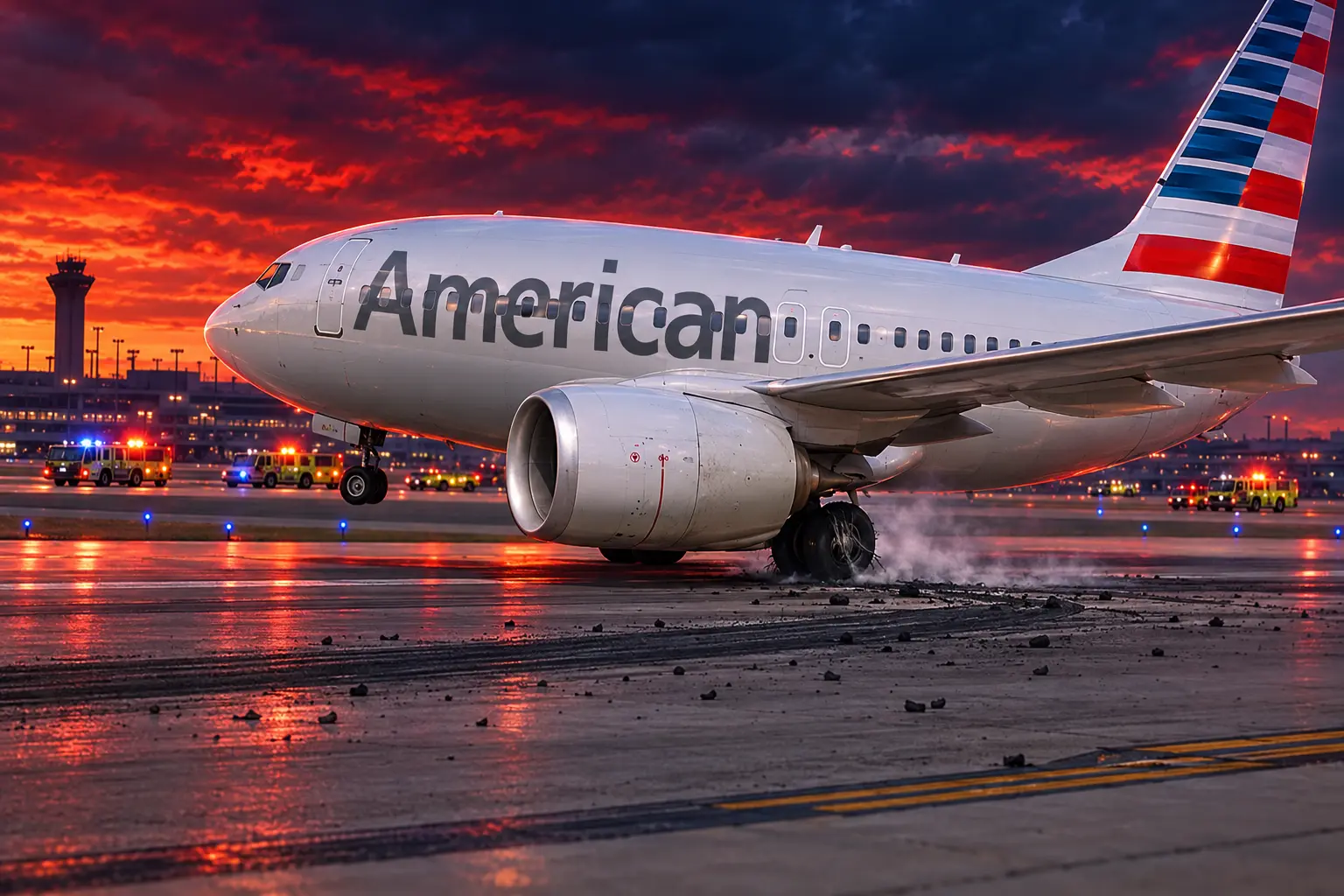
Flight 386 Blew Two Tires After the LaGuardia Hop
American Airlines flight 386 left New York-LaGuardia and landed at O’Hare at about 2 p.m. on Monday, August 17. The Boeing 737-800 came to a stop with two burst tires. First responders met the jet as a precaution, and passengers left by stairs, then buses, instead of walking on a jet bridge.
An American spokesperson said the airline followed procedure, took the aircraft out of service for a maintenance inspection, and apologized to customers for the experience. The carrier thanked its team for handling the landing. The FAA said the crew reported the blown tires after a safe landing, and that its information was preliminary.
Some people on board described a routine touchdown until heavy braking and a hard vibration started. The runway was closed long enough for crews to clear debris, and a few arrivals had to go around. Fire trucks ringed the 737 while that work finished. The airplane did not use slides.
United 739 Lost a Tire Leaving the Runway
Just over three hours later, United flight 739 arrived from Omaha. The Airbus A320 landed safely around 5:15 p.m., then suffered tire damage as it left the runway and sat still while stairs were rolled up. A United spokesperson said customers deplaned via airstairs and buses took them back to the terminal, and that no injuries were reported.
The two jets came from different airlines and two manufacturers, which is why a shared mechanical fault is a hard sell on its face. One was a Boeing on a LaGuardia hop. The other was an Airbus off a short Omaha run. Investigators still have to ask whether the pavement, the debris, the heat in the brakes, or the way the tires were inflated lined up anyway.
Four days before that pair, United 455, a 737-900 bound for Phoenix, blew tires on the takeoff roll and rejected the takeoff. Nearby crews told air traffic control they saw chunks of tire going down the runway. 167 people were put onto the pavement. Emergency crews said two tires on the right main gear had blown, and everyone on board was unhurt.
Why the FAA Widened a Runway Debris Probe
After the fifth O’Hare case, the FAA said it would look at whether the events share a cause. The working list is the one hubs use when tires fail in a bunch: surface condition, foreign-object debris, inflation and maintenance records, and hot-brake stress from short turns in summer traffic. O’Hare lays down rubber faster than most fields, and rubber shed by one jet can sit in the path of the next.
The FAA’s own debris program calls FOD objects that can damage aircraft, living or not, sitting where they do not belong. Airport operators already have guidance for airport debris programs that covers prevention, detection, removal and review. That circular is how a Part 139 field is supposed to keep junk off the movement area. Empty sweeps after August 17 do not close the file. They only say crews did not find the piece that day.
WHAT INVESTIGATORS ARE CHECKING
- Pavement: Runway and taxiway surface condition on each piece of the field where a tire failed.
- Debris: Foreign objects, including rubber from earlier landings, that can cut or overload a carcass.
- The tires: Inflation records, wear, retreads and the last time each unit was inspected.
- The brakes: Heat built up through repeated taxi, rejected-takeoff and landing cycles in August traffic.
Jamie L. Rhee, commissioner of the Chicago Department of Aviation, called the failures unusual and said the city was working with federal investigators and the airlines.
It’s rare, but what we’re doing right now is we’re working with the FAA and also our airline partners to really investigate why this is happening.
Jamie L. Rhee, commissioner, Chicago Department of Aviation
Rhee added that safety is the priority at both O’Hare and Midway, and the department said the events did not hit airport operations in a major way. Tony Molinaro, an FAA spokesperson, said the agency would investigate. Travel expert Peter Greenberg put the mix as airport temperature, wear on the tire, and the weight of a full summer airplane, and said records on rotation and retreads would be the first stop.
A dual blowout is also more than a tire change. The landing gear, wheels, brakes, antiskid units and nearby structure have to be opened up, because fragments and overload travel. That is why each of these jets went out of service instead of rolling to a gate on a spare and pushing again.
Construction Already Caps the Field at 2,708 Flights
The cluster landed inside a construction season that had already cut the airport’s planned flow. An FAA summer cap, in place from May 17 to October 24, limits O’Hare to 2,708 daily operations, below the planned 3,080, because of construction and airfield constraints. Officials say that cap is not the tire investigation. It still means more eyes on any irregularity while taxiways shift and rubber builds on the strips that remain open.
THE SUMMER OPERATING BOX
- Daily cap: 2,708 operations, down from a planned 3,080.
- Window: May 17 through October 24.
- Stated reason: Construction and airfield constraints, not the tire failures.
- City line: Each blowout was on a different part of the field, with no confirmed link.
Long taxi routes in heat are a known way to cook a tire before it ever sees a takeoff or a landing. Underinflation on one wheel of an axle dumps extra load on its pair. Once the first carcass goes, the second can follow because it is suddenly carrying a load it was not sized to hold alone. That sequence is old. It is also why a hub under a construction cap, with airplanes sitting longer on hot pavement, sits in the suspect chair even when every runway is different.
Passengers Heard a Pop and Waited for Buses
The later American case, flight 3280 to Charlotte on August 26, is the one that turned a local coincidence into a two-week count. Shortly after pushing back from the gate, the 737-800 had a tire problem on the taxiway. Both right main tires blew. A following crew saw the debris first. A controller asked if the jet was going to deplane there after two blown right mains, and the pilot said yes.
Passenger Lataisa Williams said the airplane was gaining speed when she heard a loud pop.
It was extremely loud. Everybody heard the tires pop … it all happened so quick.
Lataisa Williams, passenger, American flight 3280
Minutes later the pilot said two tires had blown and were shredded, and that people would leave in groups of 40. Williams said the wait for buses ran about an hour, then another hour for a new airplane. American said customers returned to the terminal safely and would re-depart on a replacement. The flight reached Charlotte about four hours late. No injuries were reported.
That is the passenger version of a “safe” tire failure: stairs on the taxiway, a bus, a hole in the bank of connections, and a hull that cannot fly until gear and brakes are cleared. Airline statements called it a tire issue. People on the airplane heard a pop and saw shredded rubber. A following crew, not a cockpit light, is what flagged the Charlotte jet before it took a runway.
Bill Marcus, a traveler stuck on a separate delayed United flight after the August 17 pair, said some people waited on the airfield more than an hour for buses. Reported airborne delays around those two landings stayed mostly under 15 minutes. The cost sat on the disabled jets, the people on them, and the spare airplanes pulled to cover Charlotte, Phoenix and the rest of the bank.
Tires Have Long Caused More Aborted Takeoffs Than Engines
None of the August files has a public cause. Until one does, the honest frame is the one the FAA already uses for rejected takeoffs. In a 1977 study cited in the agency’s review of a Continental DC-10 overrun at Los Angeles, tires, wheels, or brakes caused most rejected takeoffs, 87 percent of them, and engine failures were not the main driver. The FAA later said that share had fallen to about 23 percent after training and procedures changed. The physics did not.
When two tires share an axle and one fails, the survivor can be asked to carry nearly double its rated load. Heat climbs in the sidewall. Tread can throw. A third tire can go if rim pieces fly. Wet pavement then steals the stopping distance the charts assumed on a dry, intact set of wheels. That 1978 accident killed two people. The O’Hare jets in August stopped on the field, and everyone walked.
As of early September the FAA had not tied the five O’Hare failures together, and the city still points to separate pavement. Extra gear inspections remain in place on the two big carriers’ Chicago fleets. The construction cap runs through October 24. No new blowout had been posted after August 26.

Ibiza Airport Flooded as Storm Adam Broke a 2005 Record

The Louvre Is Closed as France Runs Neighbourhood Curfews

UK Tells Travellers to Leave Saudi Arabia by Land

Southwest’s Record Fares Lose Ground to $4.55 Fuel

Leeds Bradford Airport Pauses Half-Term Strikes After Rejections

Flight Cancellations Rise While the FAA Shrinks Staffing Targets

United Folds Newark’s Lima Nonstop Into Its Houston Hub

Airbnb’s 6% Direct Links Undercut the Host Website Pitch

Hitachi’s Aurora Faults Drove the EMR Bank Holiday Strike

United Bets the A321XLR on 10 New International Cities
-
 AIRLINES2 months ago
Flight Cancellations Rise While the FAA Shrinks Staffing Targets
-
 AIRLINES2 months ago
United Folds Newark’s Lima Nonstop Into Its Houston Hub
-
 HOTELS2 months ago
Airbnb’s 6% Direct Links Undercut the Host Website Pitch
-
 NEWS2 months ago
Hitachi’s Aurora Faults Drove the EMR Bank Holiday Strike
-
 AIRLINES2 months ago
United Bets the A321XLR on 10 New International Cities
-

 NEWS2 months ago
The EU Pulled the 2026 ETIAS Date After Border Chaos
-

 HOTELS2 months ago
Grand Canyon Hotels Close After a Repeat Pipe Flood
-
 NEWS2 months ago
ATSB Opens Six Sydney Airport Ground Conflict Files