
AIRLINES
American Airlines Starlux Codeshare Leaves Phoenix Off the Ticket
American Airlines will codeshare Starlux from Sept. 30 on four Taipei routes, but Phoenix metal and AAdvantage miles stay out of the deal.

American Airlines will put its code on Starlux flights from Taipei on Sept. 30, covering Los Angeles, San Francisco, Ontario and Seattle. Starlux will add its code to 26 American routes into Los Angeles and Phoenix, the hub the Taiwanese airline opened in January for those connections.
Taipei to Phoenix is not on American’s transpacific list, and AAdvantage members still will not earn miles on Starlux. The new ticket is real. The alliance benefits are not.
American Puts Its Code on Four Starlux Gateways
American filed the codeshare schedules over the weekend of Sept. 19, and route databases posted the city list on Sept. 20. From Sept. 30, an American flight number can appear on Starlux-operated trips between Taiwan Taoyuan International Airport and four U.S. airports. Phoenix Sky Harbor, Starlux’s fifth U.S. city, is not in that first Pacific group.
A codeshare is a marketing overlay, not a new airplane. American can sell a Starlux Taipei flight as if it were its own, and Starlux can sell selected American domestic trips the same way. Bags already moved through under the interline deal from last year. What changes now is whose flight number prints on the ticket and whose website can shelf the seat.
THE FOUR TAIPEI ROUTES ON AMERICAN’S CODE
- Los Angeles: Starlux’s main Southern California gate, now sellable with an American number in both directions.
- San Francisco: Daily A350 service that already sits in a oneworld West Coast city, without AAdvantage credit.
- Ontario: The Inland Empire airport Starlux added for the local Taiwanese community, still without American domestic feed on this list.
- Seattle: Alaska’s home market, where Starlux already had a deeper loyalty hook than it has with American.
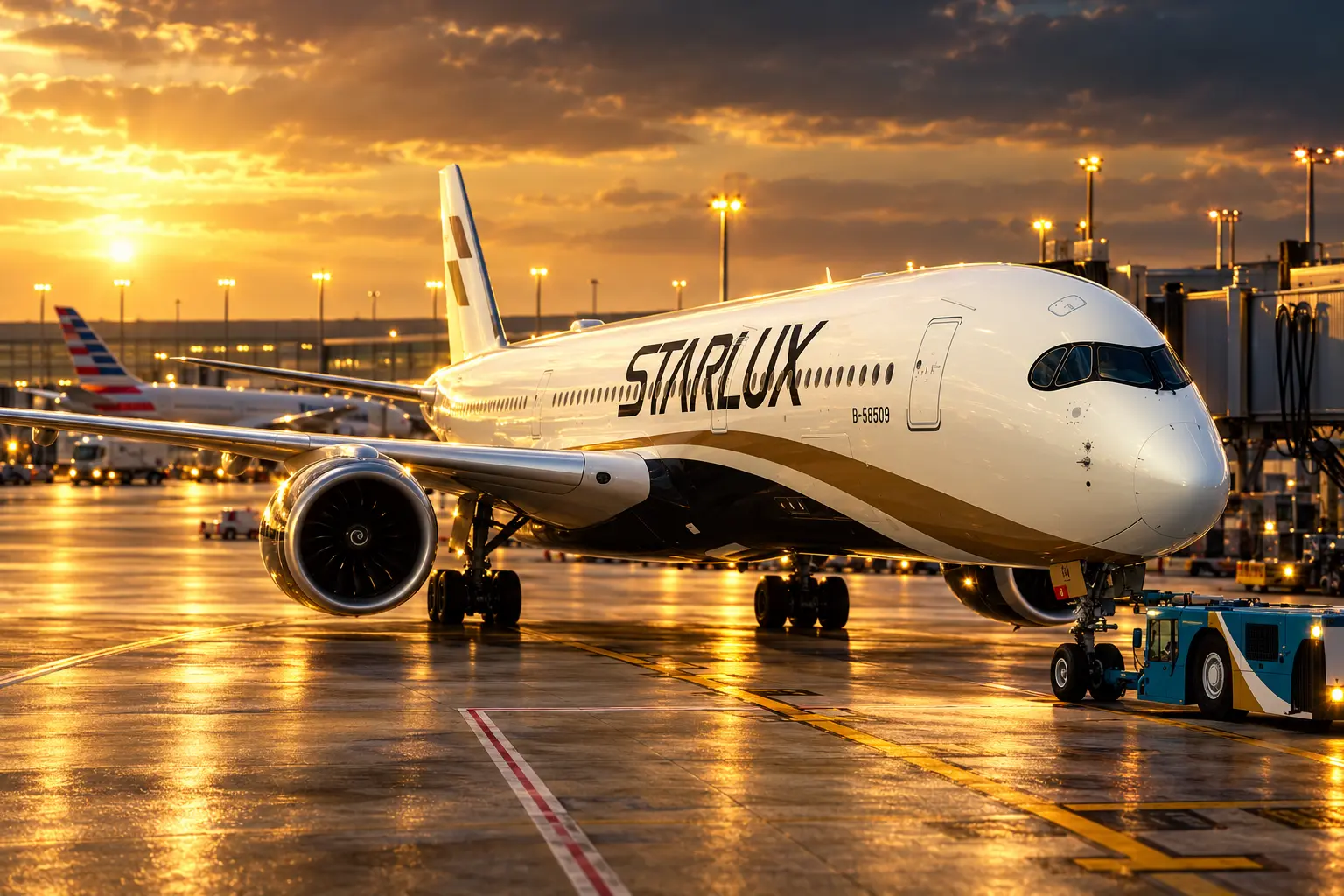
Starlux flies those trips on Airbus A350 jets with first class and business class, a cabin mix China Airlines and EVA Air do not match on the same U.S. routes. American still does not fly Taipei on its own metal. This filing lets it offer the city from its shop without adding a long-haul crew.
Phoenix Carries Most of the Domestic Codes
The 26 American routes that will carry Starlux’s code are not spread evenly. Sixteen of them start or end in Phoenix. Ten run through Los Angeles. That split is the product, not a rounding error.
WHERE STARLUX PUTS ITS CODE ON AMERICAN
| Gateway | American routes carrying a Starlux number | Count |
|---|---|---|
| Los Angeles (LAX) | Atlanta, Charlotte, Chicago O’Hare, Dallas/Fort Worth, Denver, Las Vegas, Miami, New York JFK, Orlando, Philadelphia | 10 |
| Phoenix (PHX) | Albuquerque, Atlanta, Austin, Boston, Charlotte, Chicago O’Hare, Dallas/Fort Worth, Denver, El Paso, Kansas City, Las Vegas, Orlando, St. Louis, San Diego, Tucson, Washington Reagan | 16 |
Ontario and Seattle get American’s code on the Pacific crossing, but they get none of those 26 domestic Starlux numbers. The connecting machine American is handing Starlux is Phoenix first, Los Angeles second. East Coast cities such as Boston, New York, Miami and Washington reach Taipei on this map by changing in those two hubs, not by a Starlux nonstop.
Taipei-Phoenix Still Has No American Flight Number
Starlux timed its Phoenix flights around American’s bank. The Taipei arrival was built to hit afternoon connections across American’s domestic map, and the night departure back to Taiwan was built to collect those same cities. Phoenix Mayor Kate Gallego said Starlux was the first carrier to commit to ending Phoenix’s run as a major U.S. city with no nonstop to Asia. China Airlines later added the city as well.
American will still let Starlux sell the domestic spokes at Sky Harbor. It will not, in this first filing, put an American number on the Starlux A350 that actually flies Taipei to Phoenix. That is the odd line in the list, and it is the first gap anyone reading the city pairs notices.
One reading is inventory caution. Codesharing the long-haul itself would put American’s brand on a flight it does not operate, in a market it might one day want as its own. Another is simpler: Los Angeles, San Francisco, Ontario and Seattle already had the traffic, so those four were easier to load into American’s shop. Either way, the hub Starlux opened for American is the hub American is not putting on the transpacific code.
Cathay Pacific Still Holds the Alliance Door
Starlux has said for years that oneworld is the alliance it wants. China Airlines already sits in SkyTeam. EVA Air already sits in Star Alliance. That leaves oneworld as the only global grouping still open for Taiwan’s third full-service airline. Membership is not a paperwork drill. Four surviving founders, including Cathay Pacific, are widely described in the industry as holding veto power over new members, and oneworld does not publish a public voting rulebook.
At a May shareholders meeting, Starlux Chairman Chang Kuo-wei said Cathay Pacific opposes the application. He also said the views of all members would decide the outcome and that the airline would “one day” join. Taiwan is Cathay’s third-largest traffic market after mainland China and Japan, which is the commercial reason a Hong Kong founder would rather keep Taipei traffic inside its own connecting web.
Philippine Airlines is still expected to join oneworld in 2027 as the group’s 16th member, after years of codeshares with American and others. Starlux has not received that invitation. So American is doing the next-best commercial thing, selling the seats without bringing Starlux inside the alliance that would unlock lounges, elite recognition and mileage reciprocity as a block.
Cathay Pacific remains a founding member of oneworld, and that status is the quiet party in this codeshare. Until that door moves, American can stock Starlux flights and still treat the carrier as an outsider for AAdvantage.
TAIWAN’S THREE FULL-SERVICE CARRIERS
- China Airlines: SkyTeam member, with its own U.S. long-haul map including Phoenix.
- EVA Air: Star Alliance member and United’s main Taipei partner.
- Starlux: Unaligned, with American and Alaska commercial deals and a blocked oneworld bid.
That map is why a codeshare can look large and still feel thin. Alliance membership is the product frequent flyers actually spend toward. A marketed flight number is the product airlines can ship while a founder says no.
Alaska Members Already Earn Miles on Starlux
American’s own frequent flyers are the other party this filing leaves in place. The codeshare does not add AAdvantage earning on Starlux, does not add AAdvantage award space, and does not extend elite boarding, upgrades or lounge rights onto Starlux cabins. An Executive Platinum passenger on a Starlux A350 is, for now, a Starlux passenger.
Alaska Airlines is already further along. Atmos Rewards members can earn and redeem Atmos Rewards points on Starlux, a relationship that started with an October 2024 codeshare and widened on Sept. 30, 2025. Starlux said that expansion brought 20 U.S. destinations linked to Taipei through Seattle and San Francisco, on top of the original eight cities from late 2024.
Alaska and American are oneworld partners with each other. Starlux can sit in Alaska’s award chart and still sit outside AAdvantage. Anyone holding both programs already knows which balance to use on Taipei. The new American codeshare does not change that math. It changes which website can sell the seat to a cash customer connecting in Phoenix or Los Angeles.
What You Can Book From September 30
From Sept. 30, a traveler can buy a single American itinerary that includes a Starlux-operated Taipei flight to or from Los Angeles, San Francisco, Ontario or Seattle, then connect on American in the U.S. Starlux can sell the 26 listed American domestic routes under its own numbers. The older interline already allowed mixed tickets and through-checked bags. The new layer is the code in the shopping path.
THE LIMITS OF THE NEW TICKET
- Pacific metal: American’s code covers four Starlux U.S. gateways, not Phoenix.
- Domestic metal: Starlux’s code covers 26 American routes, 16 of them at Phoenix.
- AAdvantage: No earning, no award booking, no elite recognition on Starlux in this deal.
- Alliance: Starlux is not a oneworld member, so Sapphire and Emerald benefits do not follow the passenger onto its aircraft.
The list can grow. American’s filing was an opening set, and Starlux had not yet mirrored every code in its own schedule drop when the city pairs first appeared. Until a later filing adds Taipei-Phoenix to American’s code, or AAdvantage adds Starlux as a partner, the practical advice is simple. Book the new code if you want one reservation. Keep Alaska in the loop if you want the miles.
The Partnership Stepped Up Over a Year
Starlux and American did not jump from strangers to codeshare. They built the Phoenix bank first, then asked Washington for authority, then loaded flight numbers into the schedule.
THE PATH FROM INTERLINE TO CODESHARE
- August 15, 2025: Starlux and American announce an interline deal, with single-ticket booking and through-checked bags aimed at the coming Phoenix route.
- January 15, 2026: Starlux opens Taipei-Phoenix, its fifth U.S. gateway, timed for American connections at Sky Harbor.
- July 2026: The carriers seek U.S. Transportation Department authority for a codeshare.
- September 19, 2026: American files the first codeshare schedules, posted the next day with a Sept. 30 start.
- September 30, 2026: Reciprocal codeshare service is due to begin on the listed routes.
When the interline landed, Starlux CEO Glenn Chai and American alliances chief Anmol Bhargava talked about reach, not miles. Starlux’s August 2025 partnership notice is still the last full on-the-record exchange from both airlines on the tie-up.
American is delighted to offer more travel options for customers with STARLUX. Through this interline partnership, customers can enjoy convenient connections from Taipei to more than 250 destinations in North America. We look forward to working with STARLUX to enhance opportunities for American’s customers to travel from North America to Taipei.
Anmol Bhargava, Senior Vice President of Alliances, American Airlines, Starlux partnership announcement
Chai said the same deal would expand Starlux’s reach into the United States through American’s network and add Taipei choices for American’s customers. Neither man promised AAdvantage credit. Neither promised oneworld. Thirteen months later, the flight numbers are the piece that moved.
On Sept. 30, American will sell Starlux to Taipei from four U.S. cities, and Starlux will sell American’s Phoenix and Los Angeles spokes as its own. Cathay Pacific still sits on the alliance door. AAdvantage still sits on the old side of it. The extra inventory is in the shop. The miles are not.

Ibiza Airport Flooded as Storm Adam Broke a 2005 Record

The Louvre Is Closed as France Runs Neighbourhood Curfews

UK Tells Travellers to Leave Saudi Arabia by Land

Southwest’s Record Fares Lose Ground to $4.55 Fuel

Leeds Bradford Airport Pauses Half-Term Strikes After Rejections

Flight Cancellations Rise While the FAA Shrinks Staffing Targets

United Folds Newark’s Lima Nonstop Into Its Houston Hub

Airbnb’s 6% Direct Links Undercut the Host Website Pitch

Hitachi’s Aurora Faults Drove the EMR Bank Holiday Strike

United Bets the A321XLR on 10 New International Cities
-
 AIRLINES2 months ago
Flight Cancellations Rise While the FAA Shrinks Staffing Targets
-
 AIRLINES2 months ago
United Folds Newark’s Lima Nonstop Into Its Houston Hub
-
 HOTELS2 months ago
Airbnb’s 6% Direct Links Undercut the Host Website Pitch
-
 NEWS2 months ago
Hitachi’s Aurora Faults Drove the EMR Bank Holiday Strike
-
 AIRLINES2 months ago
United Bets the A321XLR on 10 New International Cities
-

 HOTELS2 months ago
Grand Canyon Hotels Close After a Repeat Pipe Flood
-

 NEWS2 months ago
The EU Pulled the 2026 ETIAS Date After Border Chaos
-
 NEWS2 months ago
ATSB Opens Six Sydney Airport Ground Conflict Files