
NEWS
Dujuan Shuts Tokyo’s Travel Spine in Silver Week
Typhoon Dujuan stayed offshore but still halted Haneda, Narita and Tokaido trains during Silver Week, after Chiba’s August floods.

Typhoon Dujuan killed two people in eastern Japan on Monday and put 1,674,084 residents under evacuation orders. The center stayed offshore. Haneda, Narita and the Tokaido bullet trains still stopped anyway.
By Tuesday noon the weather agency had the storm well east of Honshu, a strong typhoon racing toward the open Pacific and due to weaken overnight. The holiday travel jam, and the wet hillsides around Tokyo, did not leave with it.
The Eye Stayed at Sea off Chiba
Japan’s internal affairs ministry listed those orders across Ibaraki, Chiba, Tokyo, Kanagawa and Shizuoka. They were advisories, not a legal command to move, and they still covered the capital’s eastern approaches on a national holiday.
At 4 p.m. Monday the Japan Meteorological Agency placed the year’s 25th named storm about 130 kilometers southeast of Katsuura, on Chiba’s Boso Peninsula, with a central pressure of 960 hectopascals. Maximum sustained winds were 40 meters per second (144 km/h), with gusts to 55 meters per second (198 km/h). The track was northeast, and the eye was not forecast to come ashore on the mainland.
Takuya Hosomi, director of the agency’s forecasting division, had already told reporters a major disaster could occur at any time in Level 4 zones. He said the storm had strengthened more than expected after slowing over unusually warm water near the Izu Islands. Linear rain bands were the inland threat, because they can park over one corridor and fill rivers that look ordinary on a map.
TUESDAY NOON JMA FIX
- Position: 38.7 north, 148.9 east, a strong typhoon moving east-northeast at 50 kilometers per hour.
- Core: 970 hectopascals, 35 meters per second (126 km/h) near the center, gusts to 50 meters per second (180 km/h).
- Next step: The Tuesday noon typhoon bulletin turns it into an extratropical low by 12:00 a.m. Wednesday, still heading east-northeast.
- On land: Kanto-Koshin still needed a watch for landslides, low-ground flooding and rising rivers after a record wet Monday.
Izu Oshima, about 100 kilometers from Tokyo, took the worst of the rain as the storm passed the island chain. The agency logged 832 mm there in 48 hours, an all-time high for the station, and issued a Level 5 landslide warning, the top of the five-step scale. Oshima town extended that emergency notice to 3,020 residents. In Sodegaura, east of Tokyo, a separate Level 5 notice covered 40,000 people and told them to move above the second floor and stay off slopes.

Two Dead, Four Missing on Soaked Slopes
Local governments confirmed two deaths once Monday’s slides were searched. In Yokosuka, Kanagawa, mud punched into a house and killed a woman in her 60s. Yasuhiro Kaneko of the Yokosuka city fire department said she was believed to have been buried alive while crews worked in heavy rain; she was later found inside the house.
In Sodegaura, a 51-year-old man died after a slide engulfed the excavator he was using to clear a damaged road. A woman in her 40s in the same city suffered minor injuries after driving into slide debris. Police and firefighters were still digging on Tuesday on the Miura Peninsula, including at a house in Miura hit by mud, with four people missing in Kanagawa.
WHAT WE KNOW
- Confirmed deaths: Two people, the Yokosuka woman in her 60s and the 51-year-old road worker in Sodegaura.
- Missing: Four people in Kanagawa, with searches continuing Tuesday around Miura and Yokosuka.
- Highest alerts: Level 5 for 40,000 residents in Sodegaura and 3,020 on Oshima.
- Power: TEPCO Power Grid said 50,890 homes lost electricity, 41,130 of them in Chiba.
WHAT IS UNCONFIRMED
- The missing: No public identification or a finding had been issued for the four by Tuesday morning.
- The athlete ship: Organizers had a plan to send the Costa Serena off Nagoya if the port was hit; it was not confirmed that the ship actually sailed.
- The damage book: House counts moved during the day, and a full tally was still being compiled.
The weather agency had forecast up to 250 mm of rain in the Kanto and Tokai regions and the Izu chain in the 24 hours through noon Tuesday, enough in places to pass a normal September total. Hosomi said it was extremely likely some form of disaster had already begun in landslide country, and he warned of an imminent threat to life. Several warnings were later stepped down as the core pulled away, which did not make the soaked slopes safe.
What Travelers Hit at Haneda and Narita
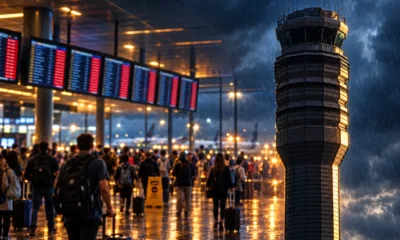
Japan Airlines cancelled 135 flights on Monday and All Nippon Airways cancelled 140, most of them domestic rotations through Haneda, for a two-carrier total of 275. Aviation tracker Flightradar24 counted nearly 500 cancellations once every airline at Haneda and Narita was included. Passengers slept in terminals while boards flipped from delay to cancel on the first full day of the five-day Silver Week holiday.
MONDAY FLIGHT CUTS
| Operator | Monday cancellations | Where it landed |
|---|---|---|
| Japan Airlines | 135 | Domestic plus a smaller international set |
| All Nippon Airways | 140 | Mostly Haneda domestic |
| JAL and ANA together | 275 | The two largest Japanese carriers |
| Haneda and Narita, all airlines | nearly 500 | Flightradar24 count at the two Tokyo airports |
ANA told customers holding tickets through Narita, Haneda, Hachijojima, Shizuoka and Nagoya Chubu that they could change or refund without fees for the listed windows on September 20 and 21, even if their own flight still operated. EVA Air posted the same kind of flexibility for eligible Haneda trips on September 21. Jetstar published a route-by-route scrap list that killed Narita flights to Taipei and Hong Kong, plus Shanghai, Kaohsiung and a string of domestic links, with a few Tuesday inbounds already gone as well.
Forty-eight-hour rain records around Chiba, Yokohama and Narita made the airport problem easy to read. Narita sits in the prefecture that took the long rain, so crews, buses and connecting trains failed together. Foreign missions told their nationals to stop unnecessary trips. The Philippine Embassy in Japan put that in writing for Filipinos in Tokyo and Kanto, with the police and fire numbers and its own assistance line.
📢 ADVISORY
TYPHOON NO. 25 (DUJUAN)
21 September 2026The Philippine Embassy in Japan advises Filipinos in Tokyo and the Kanto region to exercise caution as Typhoon No. 25 (Dujuan) brings heavy rain and strong winds to eastern Japan.
Please avoid unnecessary travel, stay away… pic.twitter.com/hig8F4jyhY
— 駐日フィリピン大使館 (@PHLinJapan) September 21, 2026
Airport limousines vanished with the flights. Airport Transport Service cancelled every Narita-bound coach after 2:45 p.m. Monday after a closure on the Higashi-Kanto Expressway, and it cut Haneda runs from Tokyo Disney Resort, Chiba and Makuhari as roads flooded. A cancelled return flight left at least one traveler on a Hikari that crawled like a local. That is the hidden cost of a capital that runs on tight domestic banks: when Haneda stops, the backup is a packed train with no empty seats for luggage.
A Five-Day Holiday on Flooded Roads
JR Central said Tokaido Shinkansen services between Tokyo and Osaka had no rain delays as of Monday afternoon. Later the same day, Japan Railways suspended some of those Tokyo-Osaka bullet trains. East Japan Railway halted lines in Chiba, Ibaraki and western Tokyo. The capital’s holiday map was a set of dead ends.
WHAT CLOSED WITH THE RAIN
- Tokaido spine: Some Tokyo-Osaka bullet trains were suspended after a wet afternoon.
- Airport coaches: Narita limousines stopped after 2:45 p.m.; Haneda buses from Disney and Chiba followed.
- City sights: Tokyo closed Ueno Zoo and Hama-rikyu Garden; Kamogawa Sea World in Chiba shut for the day.
- Shows and sport: Tokyo Game Show ended early on its last day; a Chiba outdoor festival and a baseball game were called off.
- Roads and water: Parts of the Tomei Expressway closed in high waves, Tokyo Bay ferries cancelled, and a Chiba city underpass was barred because an August flood had already killed someone there.
Kamakura, a standard day trip from Tokyo, filled with brown water. Mayor Takashi Matsuo posted a half-sunk car and wrote, “Various locations in the city are flooded, so traveling by car is dangerous.” Ichikawa and Funabashi streets turned into channels. On Chiba Prefectural Route 77 in Yachimata, cars nosed into floodwater, stalled, and blocked the lane behind them, the same pattern that killed people in this prefecture in August.
That is the second-order failure. The eye missed the mainland, so a driver could tell himself the storm was “only rain.” The rain was falling on a holiday, on soil that could not take more water, onto roads that still looked passable until the engine ingested it.
Chiba’s Ground Was Already Full of Water
Mid-August is why Monday’s slides should have surprised no one in Chiba. On August 13 and 14 the same prefecture took a named downpour, the August 2026 Chiba Heavy Rain, after the weather agency issued a Level 5 heavy-rain warning for 22 municipalities, the first of that rank in the country.
THE WET WEEKS BEFORE DUJUAN
- August 13-14, 2026: Chiba City records 367 mm in 24 hours and 115 mm in one hour. Eight people die. Thousands are stranded at Narita after rails, buses and highways fail.
- September 15, 2026: Heavy rain hits the Asian Games rowing course in Aichi. Crews need days to clear debris and repair gear.
- September 19, 2026: The Aichi-Nagoya Games open. Organizers already shift rowing heats and flag a typhoon risk for equestrian.
- September 21, 2026: Dujuan brushes the Boso Peninsula. Level 5 alerts go out on Oshima and in Sodegaura. Two people die in slides. Tokyo’s airports and some Tokaido trains stop.
- September 22, 2026: The center is east of Japan. Searches continue on the Miura Peninsula. Kanto hillsides stay on landslide watch.
Chiba station’s 367 mm in a day smashed its own record and ran at about three times a normal August total. Much of the August death toll involved cars and roads, not collapsed apartment towers. The transport ministry’s Monday underpass closure in Chiba city was a direct memory of that: one person had died in that low spot during the August flood, so the gate went down before Dujuan could refill it.
Sodegaura, Kimitsu, Ichihara, Otaki and Sanmu later joined the Level 5 list as rivers rose. The Koito River flooded in Kimitsu. A road collapsed in Chiba City’s Midori Ward. Flooded roads, overflowing manholes or inundation showed up in at least 28 Chiba municipalities. The prefecture that feeds Narita, the Disney resorts and a lot of Tokyo’s eastern housing stock was still wringing out August when the 25th typhoon of the year arrived.
Games Organizers Shift Equestrian to Tuesday
The 20th Asian Games, staged from September 19 to October 4 around Nagoya and Aichi, with aquatics and equestrian in Tokyo, had been bargaining with rain before Dujuan had a name on Japanese charts. Organizers said September 15 storms left the rowing basin dirty and broken. Heats that had already slipped to September 21 and 22 moved again, to September 23, with the following day’s program pushed to September 24.
Equestrian was the Dujuan line item. The organizing committee said expected heavy rain would delay work on the arena, so the Monday dressage moved to Tuesday morning and cross-country slid from Tuesday morning to Tuesday afternoon. Tickets for the cancelled Monday sessions were void and due for refunds after the Games; they could not be reused on the new timetable. Aichi itself was still relatively dry on Monday morning. The postponement was a precaution, which is how you run horses on turf that turns to soup.
About 4,000 competitors were berthed on the cruise ship Costa Serena in Nagoya. The organizing committee and the Nagoya Coast Guard had an advance order ready: if the port was badly hit, the ship would sail with whoever was aboard and wait the storm out. Two Singapore athletes trying to reach Nagoya from a pre-Games meet in Tokyo had their connecting flight cancelled and had to reroute. Indoor swimming was left on the original grid. Outdoor dirt was not.
Prime Minister Sanae Takaichi was supposed to leave Haneda at 7 p.m. Monday for New York, a United Nations speech on Tuesday, and a meeting with U.S. President Donald Trump. The government pushed the government aircraft to 11 p.m., a four-hour delay, and she did leave that night. Her U.S. appointments were kept. The people in the Haneda halls did not have a state backup plane.
Landslide Alerts Hold After the Storm Bends Out
Tokyo’s own Tuesday forecast had already flipped toward partly cloudy, with little rain in the afternoon numbers. That forecast is for the sky, not the hillside. Hosomi said rain could still fall as the typhoon moved north, and the agency’s short-range discussion kept a hard watch on Kanto-Koshin for slides, inundation and rising rivers on Tuesday because Monday’s totals were still in the ground.
It is extremely likely that some form of disaster has already occurred in landslide-prone areas and similar zones.
Takuya Hosomi, director of the forecasting division, Japan Meteorological Agency
Japan Airlines was still posting Typhoon Dujuan notices on Tuesday morning, warning that some international flights still affected the network and telling passengers to search their own trips before heading to the airport. Crews and aircraft that spent Monday on the ground do not snap back on the first blue hour. Silver Week traffic will try to move anyway, because the holiday calendar does not get rewritten for a near miss.
Dujuan is gone from the Izu sea as a typhoon and is forecast to be an ordinary low by Wednesday. The two dead and four missing are the human account of a storm that never needed landfall. The 275 airline cuts, the Tokaido gaps and the cars on Route 77 are the travel account, written on Chiba soil that had not dried since August.

Ibiza Airport Flooded as Storm Adam Broke a 2005 Record

The Louvre Is Closed as France Runs Neighbourhood Curfews

UK Tells Travellers to Leave Saudi Arabia by Land

Southwest’s Record Fares Lose Ground to $4.55 Fuel

Leeds Bradford Airport Pauses Half-Term Strikes After Rejections

Flight Cancellations Rise While the FAA Shrinks Staffing Targets

United Folds Newark’s Lima Nonstop Into Its Houston Hub

Airbnb’s 6% Direct Links Undercut the Host Website Pitch

Hitachi’s Aurora Faults Drove the EMR Bank Holiday Strike

United Bets the A321XLR on 10 New International Cities
-
 AIRLINES2 months ago
Flight Cancellations Rise While the FAA Shrinks Staffing Targets
-
 AIRLINES2 months ago
United Folds Newark’s Lima Nonstop Into Its Houston Hub
-
 HOTELS2 months ago
Airbnb’s 6% Direct Links Undercut the Host Website Pitch
-
 NEWS2 months ago
Hitachi’s Aurora Faults Drove the EMR Bank Holiday Strike
-
 AIRLINES2 months ago
United Bets the A321XLR on 10 New International Cities
-

 HOTELS2 months ago
Grand Canyon Hotels Close After a Repeat Pipe Flood
-

 NEWS2 months ago
The EU Pulled the 2026 ETIAS Date After Border Chaos
-
 NEWS2 months ago
ATSB Opens Six Sydney Airport Ground Conflict Files