
AIRLINES
Alaska Grows Paine Field as Sea-Tac Runs Out of Room
Alaska will add 50 percent more seats at Everett’s Paine Field, including twice-daily San Jose flights, while Sea-Tac waits on gates into the 2030s.

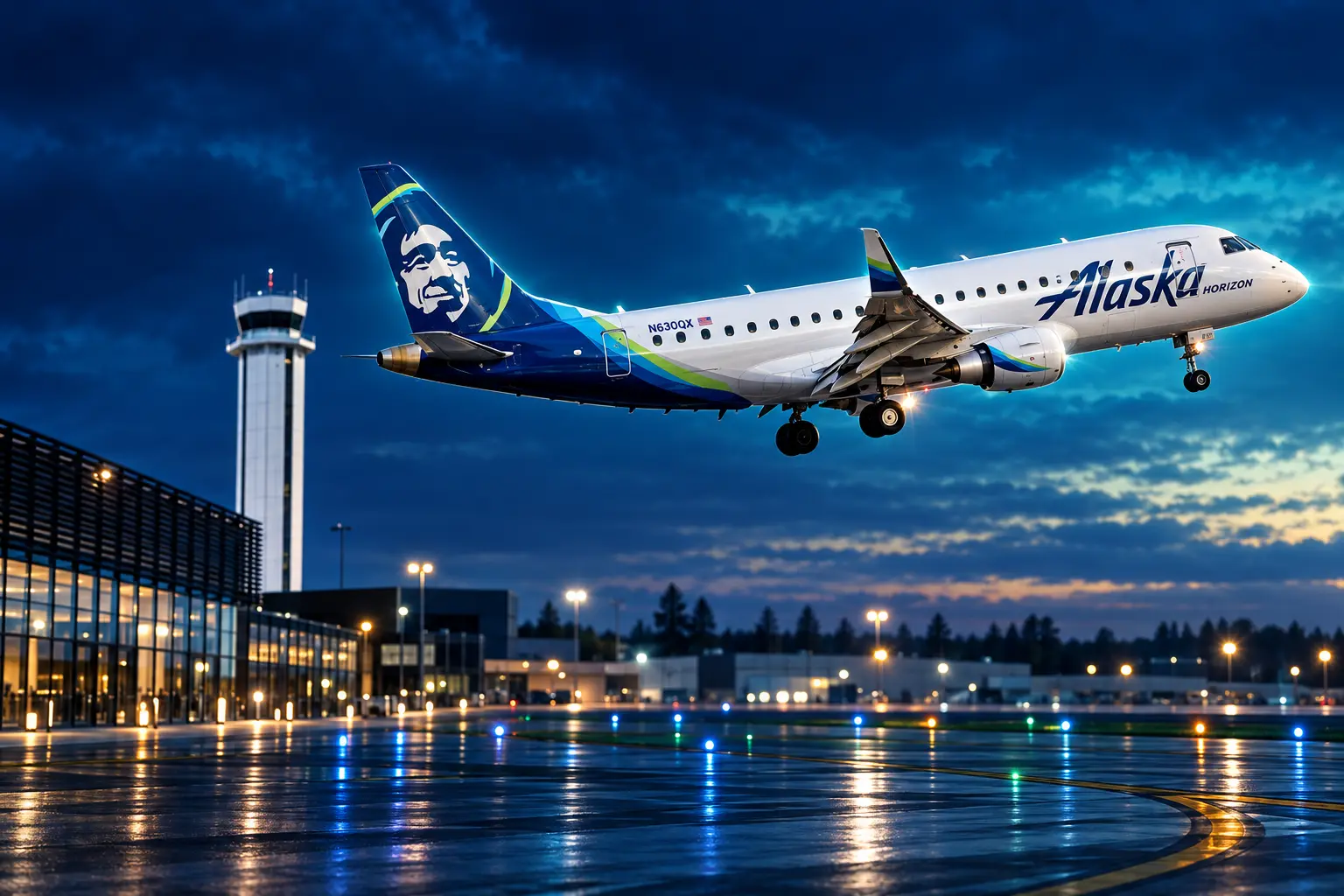
Alaska Airlines will add 50 percent more seats at Paine Field from fall 2026 through summer 2027, including twice-daily San Jose flights from April 14, 2027. The hometown carrier is the only airline at the three-gate Everett terminal, 25 to 31 miles north of downtown Seattle.
Delta Air Lines does not serve Paine Field. Every extra Everett departure is a seat Alaska can sell that its Seattle rival cannot match from that airport, while Seattle-Tacoma International Airport (SEA) is still years from a new concourse of gates.
What Changes on Each Paine Field Route by 2027
Alaska’s plan, released on September 24, 2026, is growing seats by 50 percent at Seattle/Everett through a mix of a new city, extra frequencies, and larger jets. Horizon Air, the group’s regional subsidiary, will fly the San Jose (SJC) route year-round, twice a day, on 76-seat Embraer 175s. Tickets are already on sale.
Los Angeles will rise to two daily flights, both on mainline Boeing 737s rather than the smaller E175s now used on the route. Portland will also move to two daily flights. Alaska said it will add seats to San Diego and San Francisco as well. Cirium schedules show the daily San Diego flight switching to a 737 on November 1, 2026. The airline has not said when San Francisco flights will move to a larger jet.
PAINE FIELD ROUTE CHANGES
| Route | When | How often | Aircraft |
|---|---|---|---|
| San Jose (SJC) | April 14, 2027 | Twice daily | Embraer 175, 76 seats |
| Los Angeles (LAX) | By summer 2027 | Twice daily | Boeing 737 on both flights |
| Portland (PDX) | By summer 2027 | Twice daily | Second daily added |
| San Diego (SAN) | November 1, 2026 | Daily | Switches to a 737 |
| San Francisco (SFO) | Not announced | More seats | Larger jet, date unsaid |
On paper the San Jose cabin looks small next to a 737. Alaska lists its 737-9 MAX at 178 seats, which is more than twice the 76 seats on an E175, a gain of 102 seats each time a departure moves up. That is how a 50 percent seat increase can land without restoring the 18 daily departures Alaska ran when the terminal opened.
San Jose is a return, not a debut. Alaska last flew PAE-SJC in 2019 and 2020, when the passenger terminal was new. Cirium schedule data put Alaska as the second-largest carrier at SJC after Southwest, which is why the South Bay airport is a useful spare door into the Bay Area when San Francisco is packed or delayed.
Sea-Tac’s Next Gates Are Still Years Away
Paine Field is the release valve because the main Seattle airport is short on ground. SEA handled 52.7 million passengers in 2025, a record, across 37 airlines and 96 domestic plus 36 international destinations. The Port of Seattle has been adding space by going up, not out.
The C Concourse Expansion opened in June 2026 after crews stacked four additional floors on the existing building. That project bought dining, seating, and a larger Alaska lounge. It did not buy a new row of gates.
The next big job is a rebuild of the international S Concourse, formerly the South Satellite, a 1970s building that has had little work since the 1980s. The Port’s S Concourse Evolution through 2034 is listed at about $2.5 billion. Early work is due in the fourth quarter of 2026, with major construction in 2027, and the concourse is supposed to stay open the whole time.
HOW SEA IS ADDING SPACE
- June 2026: C Concourse Expansion opens after adding four floors on the existing footprint.
- Fourth quarter 2026: Early work starts on the S Concourse Evolution rebuild.
- 2027: Major S Concourse construction begins, with a temporary annex for ground boarding while gates cycle offline.
- 2032: Planning documents set the opening year for near-term projects that include a second terminal and up to 19 new north-side gates, sized for about 56 million passengers.
- 2034: Substantial completion of the S Concourse Evolution, dates subject to change as design continues.
Those 19 north-side gates are the first real answer to SEA’s crowded ramp, and they are still six years out on the Port’s own clock. Until they open, Alaska can put more California seats into Everett without waiting on a new Sea-Tac concourse.
Delta Has No Second Airport North of Seattle
The Port’s public snapshot of SEA traffic gives Alaska Air Group 50.7 percent of passengers and Delta 24.1 percent. That is the hometown carrier at roughly two-to-one over the Atlanta airline that built a competing hub there after the two carriers ended their partnership in the mid-2010s.
SEA CARRIER SHARES
- Alaska Air Group: 50.7 percent of passengers, including Alaska, Horizon, and Hawaiian.
- Delta Air Lines: 24.1 percent, and no flights at Paine Field.
- 2025 volume: 52.7 million passengers, a slight rise from 2024.
- Field: 37 airlines, 96 domestic destinations, 36 international.
Delta’s Seattle flying is heavy on long-haul and on the main hub. It has no station at PAE, and it did not pick up the gates United left in 2021 or the ones Frontier left in January 2026. Alaska is the only airline on the three-gate concourse. Adding San Jose and a second Los Angeles departure does not steal a Delta bank at Everett, because there is no Delta bank to steal. It thickens Alaska’s hold on Snohomish County and North Seattle, where the drive to Sea-Tac runs the other way on I-5.
Andrew Harrison, Alaska’s executive vice president and chief commercial officer, framed the flying as a Puget Sound convenience play, not a shot at Delta.
Paine Field is an important part of our Puget Sound network, giving guests a simpler, more convenient way to access Alaska’s West Coast flying. As we grow, we’re strengthening our presence across the region with more seats, more frequency and more convenient travel options for guests in Snohomish County, North Seattle and beyond.
Andrew Harrison, executive vice president and chief commercial officer, Alaska Airlines
Convenience is the public line. The structural fact sits next to it: Sea-Tac cannot grow sideways, and the only other commercial terminal in the metro is one Alaska already occupies alone.
The 2019 Terminal Lost United and Frontier
Commercial passenger service returned to Paine Field in March 2019 in a privately financed terminal that Propeller Airports still operates on Snohomish County land. Alaska launched with 18 daily departures. United followed later that month with Denver and San Francisco. The building handled more than 1 million passengers in that first year.
Then the schedule shrank. United ended San Francisco in 2020 and Denver in October 2021. Alaska cut inland cities after the pandemic and dropped Portland in May 2022 before bringing it back. Frontier arrived in June 2025 with Denver, Las Vegas, and Phoenix, then left in January 2026 after saying demand was not enough to keep the flying. Propeller counted 580,000 passengers in 2024, well under the opening-year total.
By the time Frontier’s last departure went out, Alaska was down to 10 to 11 flights a day. Even with two new San Jose round-trips and extra Los Angeles and Portland frequencies, daily departures stay short of the 2019 peak. The 50 percent seat claim depends on the 737s, not on a return to 18 banks a day.
As recently as May 2025, Brett Smith, Propeller’s chief executive, described Alaska as concentrating its resources at Sea-Tac. The September 2026 plan is a turn back toward Everett, and Smith now calls it a response to demand for a closer airport.
Snohomish County Gets California, Not Spokane
After San Jose starts, Paine Field will list 10 cities, all on the West Coast or in Hawaii. The inland routes people still ask for are not in the package. Spokane and Salt Lake City came off the board when Alaska tilted the station toward leisure flying in California, Phoenix, Las Vegas, and Hawaii. Portland is the exception, and it is going to two daily flights rather than remaining a ghost.
PAINE FIELD CITIES AFTER SAN JOSE
- Year-round: Las Vegas, Los Angeles, Orange County, Phoenix, Portland, San Diego, San Francisco, and San Jose.
- Seasonal: Honolulu and Palm Springs.
- Still missing: Spokane, Pullman, Salt Lake City, and the Denver flying United and Frontier both tried and dropped.
North-end regulars already treat the terminal as a quieter club, with valet parking, short security lines, and lounge-style seating in 44,000 square feet. The joke on local threads after the announcement was not to advertise the place. The serious complaint was simpler: if Alaska has spare airplanes for Everett, send one across the state. The extra metal is going to Silicon Valley and a second Los Angeles departure instead.
That split matches how the station has been used since the recovery. The 76-seat San Jose flights will help South Bay meetings and visits without a transfer at SFO. They will not rebuild the original 2019 idea of Paine Field as a small business shuttle to Portland, Spokane, and Salt Lake. Smith still sells the building as the opposite of Sea-Tac’s crush.
Alaska’s expanded service reflects what we continue to hear from travelers: there is strong demand for more convenient air service from Paine Field. These added flights give travelers more nonstop options close to home and further strengthen Paine Field’s role in serving the region.
Brett Smith, chief executive officer, Propeller Airports
A Three-Gate Building Still Sets the Limit
The ceiling is physical. Paine Field’s passenger terminal has three gates. Boeing’s Everett factory sits on the same airport, and the passenger side was never meant to absorb Sea-Tac’s overflow at hub scale. A 50 percent seat increase on 737s and a pair of San Jose E175s will load those gates harder. It will not turn Everett into a second hub with banks of connecting flights.
Sea-Tac, for its part, will spend the next several years under construction. The S Concourse will be in pieces from 2027. The north terminal’s 19 gates are penciled for 2032. In that window, Alaska can keep feeding California from a station Delta does not use, and north King and Snohomish County passengers can skip a southbound drive for a growing list of West Coast nonstops.
San Jose goes on sale first. The twice-daily E175s are dated to April 14, 2027. The 737s to Los Angeles and San Diego start filling in from this fall through next summer, which is as far as the three jet bridges can be pushed until someone builds a fourth.

Ibiza Airport Flooded as Storm Adam Broke a 2005 Record

The Louvre Is Closed as France Runs Neighbourhood Curfews

UK Tells Travellers to Leave Saudi Arabia by Land

Southwest’s Record Fares Lose Ground to $4.55 Fuel

Leeds Bradford Airport Pauses Half-Term Strikes After Rejections

Flight Cancellations Rise While the FAA Shrinks Staffing Targets

United Folds Newark’s Lima Nonstop Into Its Houston Hub

Airbnb’s 6% Direct Links Undercut the Host Website Pitch

Hitachi’s Aurora Faults Drove the EMR Bank Holiday Strike

United Bets the A321XLR on 10 New International Cities
-
 AIRLINES2 months ago
Flight Cancellations Rise While the FAA Shrinks Staffing Targets
-
 AIRLINES2 months ago
United Folds Newark’s Lima Nonstop Into Its Houston Hub
-
 HOTELS2 months ago
Airbnb’s 6% Direct Links Undercut the Host Website Pitch
-
 NEWS2 months ago
Hitachi’s Aurora Faults Drove the EMR Bank Holiday Strike
-
 AIRLINES2 months ago
United Bets the A321XLR on 10 New International Cities
-

 HOTELS2 months ago
Grand Canyon Hotels Close After a Repeat Pipe Flood
-
 NEWS2 months ago
The EU Pulled the 2026 ETIAS Date After Border Chaos
-
 NEWS2 months ago
ATSB Opens Six Sydney Airport Ground Conflict Files