
AIRLINES
The FAA’s Two-Path Fiber Fix Failed in One Corridor
An aging FAA circuit and its backup fiber in one New Jersey rail corridor both failed, triggering Northeast ground stops after a two-path upgrade.

An aging primary circuit at Philadelphia TRACON failed on Monday, September 21, 2026, and the backup Verizon fiber was already cut. FAA ground stops then spread from Newark, Philadelphia, and Teterboro to Kennedy, LaGuardia, and Boston, and FlightAware logged about 7,000 delayed or canceled flights.
The lines were repaired by about 6 p.m. ET. The morning still showed what last year’s two-path fiber upgrade did not cover: a primary circuit due for replacement, and a backup that ran beside an active New Jersey rail job.
Both Lines Failed Before Lunch
Controllers at the Philadelphia terminal radar approach control lost the facility’s main communications circuit Monday morning. The center sequences arrivals and departures for Newark Liberty, Philadelphia International, and Teterboro, and it feeds the wider New York arrival stream. When the primary died, the system switched to backup. That line was already dead.
FAA Administrator Bryan Bedford told reporters the circuit that failed was old and slated to come out. Crews later tried to seat a replacement on the primary side, and that fix did not take, so the hole lasted into the evening. He put the fiber repair on a 13-hour clock and said a new circuit was ready to go in while that work ran.
When it went to flip into the backup, we discovered that the backup fiber had a break, and that fiber break is probably 13 hours to repair. It’s massive, I’m told. Meanwhile, we’ve got the new circuit ready to install now.
Bryan Bedford, FAA Administrator, to reporters
Bedford also said the timing was “absolutely horrible” and that safety would set the pace for reopening. “We’re going to do what is necessary to make sure the airspace is safe.” Philadelphia International later took a second ground stop before arrivals came back late in the afternoon.
Ten Feet From the Utility Marks
New Jersey Transit said that at about 9:45 a.m., a crew on the Delco Lead project between New Brunswick and North Brunswick severed a fiber-optic cable. The agency said it had been told the cable was the backup to the failed primary. The crew, NJ Transit said, was working about 10 feet from the painted utility marks, and staff were trying to learn whether Verizon or the contractor had painted them.
Transportation Secretary Sean Duffy named Amtrak first. Amtrak, Verizon, and NJ Transit then described three different versions of the same hole in the ground.
WHO SAID WHAT ABOUT THE CUT
- Duffy: An Amtrak construction crew accidentally cut a fiber line in New Jersey and forced the FAA to pause Northeast flights.
- Amtrak: The incident occurred on New Jersey Transit property and involved a New Jersey Transit contractor.
- NJ Transit: A Delco Lead crew cut the cable about 10 feet from utility marks, and the agency is checking who made those marks.
- Verizon: Construction contractors dug up and cut a Verizon fiber cable running adjacent to an Amtrak rail line; Verizon said its facilities had been working until then and that it “bears no responsibility for this incident.”
Around 5:30 p.m., NJ Transit said 36 of the 56 fiber cables were done and should come back online shortly, with the rest to be tested. A spokesman said Tuesday morning that the repairs were complete. The remaining question is narrower than who funds air traffic control. It is who painted a safe zone 10 feet from a line the FAA needed that morning.
Newark’s Morning Without Landings
The FAA paused Philadelphia, Teterboro, and Newark around 10 a.m., then added Kennedy and LaGuardia around 1 p.m. Boston Logan stopped taking arrivals because diverted traffic filled the field. Reagan Washington National halted flights for more than an hour on volume. Westchester County Airport was pulled into the inbound hold as the New York programs widened.
FlightAware counted about 7,000 delayed or canceled flights nationwide, including 1,400 at the three major New York airports, and more than 100 diversions. Flightradar24 logged no commercial landings at Newark from about 9:40 a.m. until just after 5:20 p.m. Duffy said about 6 p.m. that the telecom lines were repaired and that operations were resuming, with a backlog still to clear.
THE NORTHEAST GROUND STOPS
| Airport | Restriction | FlightAware about 9 p.m. |
|---|---|---|
| Newark Liberty | Ground stop about 10 a.m.; landings gap 9:40 a.m. to after 5:20 p.m. | 55% of scheduled flights canceled, 11% delayed |
| Philadelphia | First-wave stop, then a second stop | 22% canceled, 41% delayed |
| Kennedy | Ground stop about 1 p.m. | Part of 1,400 delayed or canceled at the three major New York airports |
| LaGuardia | Ground stop about 1 p.m. | Part of the same 1,400 New York-area total |
| Teterboro | First-wave stop with Newark and Philadelphia | Business aviation; no FlightAware share published |
| Boston Logan | Volume stop, then a delay program | Spillover from diversions, not a local gear failure |
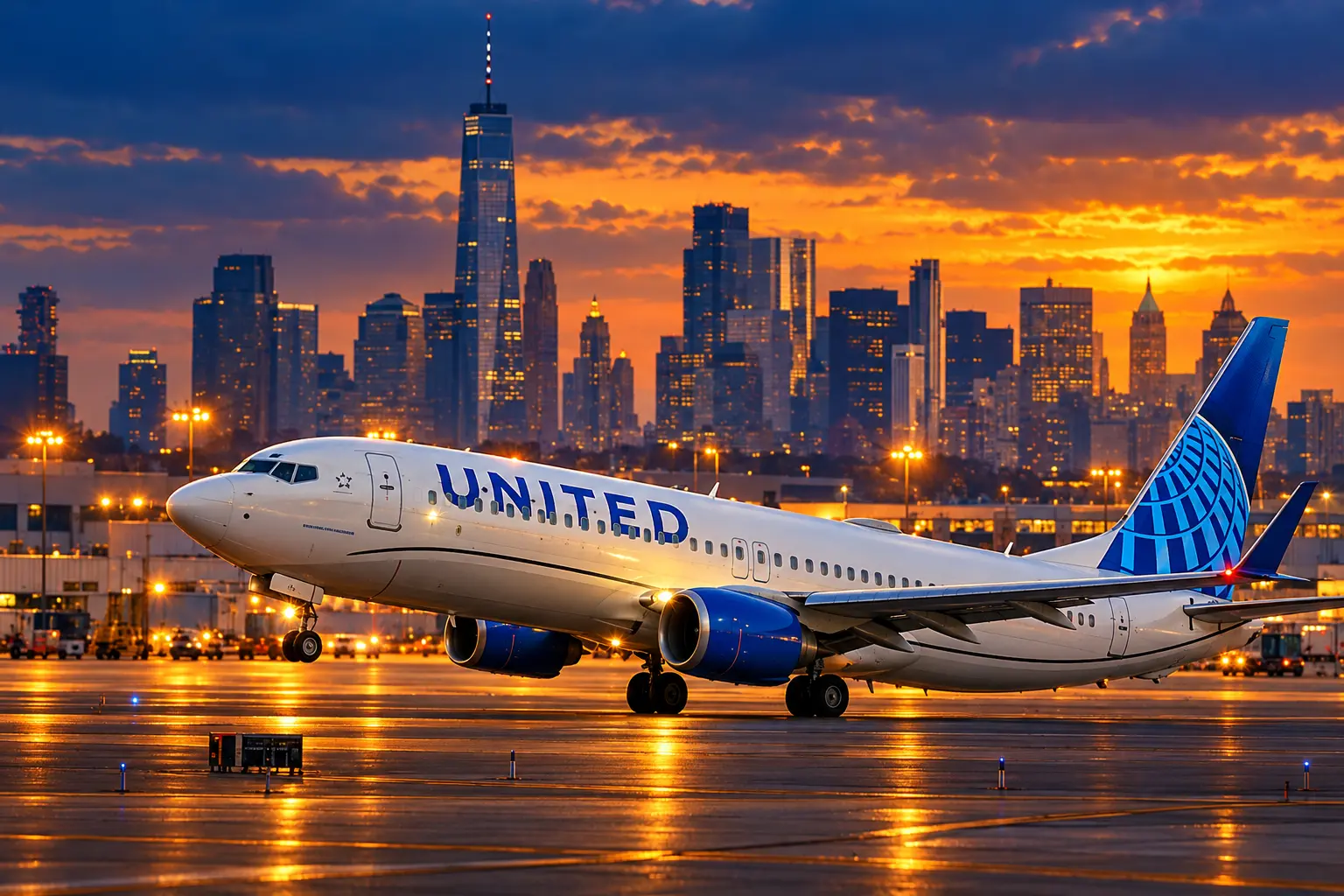
United, which uses Newark as a hub, canceled 356 flights, 11% of its schedule, and delayed 690, about 21%. “An FAA technology outage is affecting all airlines in the Northeast, including United’s operation at Newark Liberty,” the airline said, adding that it had issued a travel waiver. Philadelphia is an American Airlines hub. Jets that had been sitting on a Newark runway were sent back to the gates before the field took traffic again.
Why Newark Traffic Is Run From Philadelphia
Newark’s approach control does not sit in New Jersey. The FAA moved that airspace from New York TRACON, known as N90, to Philadelphia in 2024, after years of thin staffing and a weak training completion rate at the New York site. Philadelphia TRACON Area C now talks to the jets inbound to Newark. When its radios and data links fail, Newark fails with it, and so do the neighboring fields that share the corridor.
That is the design the agency has been defending since the 2025 blackouts. It is also why a shovel in North Brunswick can empty a Kennedy arrival bank. The radios and radar pictures controllers need are not local to the tower cab. They ride commercial fiber and aging circuits across the same right of way as passenger trains.
On Thursday, July 3, 2025, the FAA said it had switched Newark’s feed onto a new fiber network with two separate communications paths, “ensuring equipment will continue to operate if one path is disrupted.” The cable had been laid in June and tested for a month. A temporary satellite backup stayed in place. A local STARS radar hub was supposed to wean the Philadelphia room off a New York data feed.
World Leaders Hit a Closed Arrival Stream
Monday was the day 130 world leaders and dozens of ministers were due into New York for the United Nations General Assembly’s high-level week. Teterboro, which handles a large share of business and official jets, was in the first wave of stops. Bedford’s “horrible” timing line was about that calendar as much as the evening banks at Newark.
Matthew Boyle, trying to board a Washington-to-New York flight, wrote that it was the “worst possible day for all New York City airports” to go down at the start of UN week. Some travelers also described extra TSA checks at the gate on flights into the city. Those checks were presented as random. They still fed a rumor that the stops were a security event. Officials never described a threat. They described a cut cable and a dead primary circuit.
Duffy’s first written update still named Amtrak, listed which fields were moving, and turned the morning into a budget argument before the markings had been sorted out.
UPDATE: An Amtrak construction crew accidentally cut into a fiber line in New Jersey which caused a telecom outage and forced FAA to pause flights in the Northeast.
Right now:
– Flights are resuming at LGA and PHL
– Flights into EWR, JFK, and Teterboro Airport are pausedThis… https://t.co/3CDnTioMv0
— Secretary Sean Duffy (@SecDuffy) September 21, 2026
President Donald Trump’s Washington-to-New York flight left on time, even as commercial arrivals into Newark stayed closed. Across the Atlantic the same Monday, a connectivity problem at the NATS Prestwick center disrupted flights in Scotland and northern England, a separate failure that made the day look wider than one New Jersey work site.
The July Fiber Switch Did Not Hold
Philadelphia TRACON was already a known weak point. In spring 2025, after the Newark move, the same room lost radar and radio more than once. Controllers told pilots they could not see them. The agency answered with extra telecom links, a temporary backup, staffing, and then the July fiber cutover.
PHILADELPHIA TRACON SINCE THE 2025 BLACKOUTS
- April 28, 2025: Controllers lose radar and radio on Newark traffic. A controller tells a small aircraft, “You’ll have to do that on your own navigation. Our radar and radios are unreliable at the moment.”
- May 9, 2025: About 90 seconds of radar and radio are lost around 3:55 a.m. A controller tells FedEx 1989, “Our scopes just went black again,” and asks the crew to lean on the airline to get the gear fixed.
- May 11, 2025: Another telecom problem produces a Newark ground stop of about 45 minutes.
- July 3, 2025: The FAA turns on the two-path fiber network between New York and Philadelphia TRACON.
- September 21, 2026: The primary circuit fails, the Verizon backup is already cut on the Delco Lead job, and the Northeast arrival stream stops.
The July 3 notice is the document that makes Monday a reckoning rather than a freak accident. Two paths were the whole point. One of them was an aging circuit already queued for replacement. The other was Verizon fiber in a rail corridor with an active construction job and marks that, if NJ Transit is right, sat 10 feet off the line that mattered.
This upgrade significantly enhances resiliency with new fiber optic connections on two separate communications paths, ensuring equipment will continue to operate if one path is disrupted.
Federal Aviation Administration, July 3, 2025
Duffy Asked for Another $17.5 Billion
Congress in 2025 put $12.5 billion into the first slice of a national air traffic rebuild, the same pot Duffy pointed to while the stops were still on. The Department of Transportation describes that $12.5 billion air traffic rebuild as covering radar, radios, software, and telecom at more than 4,600 sites. On September 15, six days before the cut, Bedford told a House panel the agency had, as of September 1, replaced over 64 percent of copper in its old time-division multiplexing network.
THE MONEY ALREADY VOTED
- $12.5 billion: Appropriated in 2025 for the first phase of the air traffic rebuild, including telecom.
- 64 percent: Share of copper TDM telecom Bedford said had been replaced as of September 1, 2026.
- $17.5 billion: Additional sum Duffy said Monday that Congress still needed to approve to finish the job.
- 4,600-plus sites: Facilities in the rebuild the Transportation Department is tracking on its public dashboard.
Duffy said Monday the outage was “unacceptable in America.” On Tuesday he told a morning show he does not have the money to do everything needed “to make sure this crap never happens again,” and that “this will not be the last time.” The national copper score and the 12.5 billion already on the books did not keep this primary alive, and they did not move the backup off a rail job in North Brunswick.
Newark is still under an FAA operations cap that runs through October 24, 2026, now set at 72 operations an hour. Travelers who were rebooked Tuesday were moving through that cap, not through a restored 2024 schedule. NJ Transit is still the agency that has to say who painted the marks. Until that answer is public, the official story of Monday is a shovel, a dead primary, and a backup that was not a backup when the switch flipped.
Frequently Asked Questions
What Is Philadelphia TRACON?
It is the FAA room at Philadelphia International Airport that sequences arrivals and departures for the metro area, including Newark Liberty, Teterboro, and Philadelphia. The Newark slice is called Area C. Controllers there talk to aircraft on radio and see them on radar pictures that ride telecom lines, which is why a fiber cut in New Jersey can halt landings in New York.
Why Does Philadelphia Control Newark Arrivals?
The FAA moved Newark airspace off New York TRACON in 2024 because N90 had stayed short of staff and had a low training success rate. As of May 2025, Philadelphia TRACON Area C had 22 fully certified controllers and five fully certified supervisors, with more people in the training pipeline. The move fixed a staffing math problem. It also put Newark’s radios on Philadelphia’s wires.
What Is an FAA Ground Stop?
A ground stop bars departures toward a named airport until the agency lifts it, so extra aircraft do not enter airspace controllers cannot fully see or talk to. A ground delay program is different: it still lets flights leave, but assigns later departure times. After Monday’s stops, the command center’s plan listed ground delay programs at Philadelphia and Boston to meter the backlog once the radios were back.
When Did the FAA Switch Newark to Two Fiber Paths?
On July 3, 2025, after the fiber was laid in June and tested for about a month. The agency left a temporary satellite backup in place at Philadelphia TRACON and said it would add a local STARS radar hub so the room would not depend on a New York data feed. That two-path network was the answer to the spring 2025 blackouts. It was also the system that went dark on September 21, 2026.

Ibiza Airport Flooded as Storm Adam Broke a 2005 Record

The Louvre Is Closed as France Runs Neighbourhood Curfews

UK Tells Travellers to Leave Saudi Arabia by Land

Southwest’s Record Fares Lose Ground to $4.55 Fuel

Leeds Bradford Airport Pauses Half-Term Strikes After Rejections

Flight Cancellations Rise While the FAA Shrinks Staffing Targets

United Folds Newark’s Lima Nonstop Into Its Houston Hub

Airbnb’s 6% Direct Links Undercut the Host Website Pitch

Hitachi’s Aurora Faults Drove the EMR Bank Holiday Strike

United Bets the A321XLR on 10 New International Cities
-
 AIRLINES2 months ago
Flight Cancellations Rise While the FAA Shrinks Staffing Targets
-
 AIRLINES2 months ago
United Folds Newark’s Lima Nonstop Into Its Houston Hub
-
 HOTELS2 months ago
Airbnb’s 6% Direct Links Undercut the Host Website Pitch
-
 NEWS2 months ago
Hitachi’s Aurora Faults Drove the EMR Bank Holiday Strike
-
 AIRLINES2 months ago
United Bets the A321XLR on 10 New International Cities
-

 HOTELS2 months ago
Grand Canyon Hotels Close After a Repeat Pipe Flood
-

 NEWS2 months ago
The EU Pulled the 2026 ETIAS Date After Border Chaos
-
 NEWS2 months ago
ATSB Opens Six Sydney Airport Ground Conflict Files